COMSTECH, the Ministerial Standing Committee on Scientific and Technological Cooperation of the Organization of Islamic Cooperation (OIC), has launched its Research Grant Program for Young Women Researchers.
This initiative is dedicated to supporting young women scientists, engaged in indigenous S&T research within OIC member states. The program aims to promote scientific excellence, strengthen research capacity, and help curb the brain drain of talented researchers from the region. Grants may be utilized for purchasing scientific minor equipment, consumables, and specialized literature.
In response, OIC-COMSTECH received 690 applications, out of which 607 from Pakistan, and 83 from other OIC Member States.
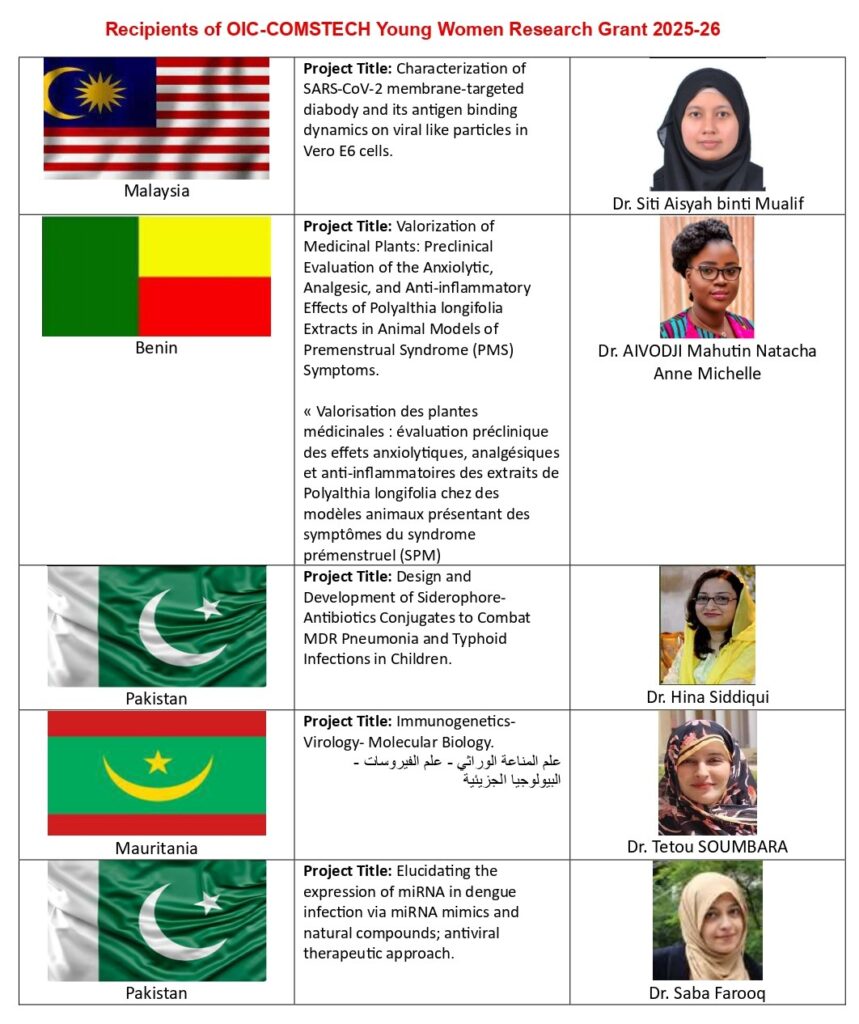
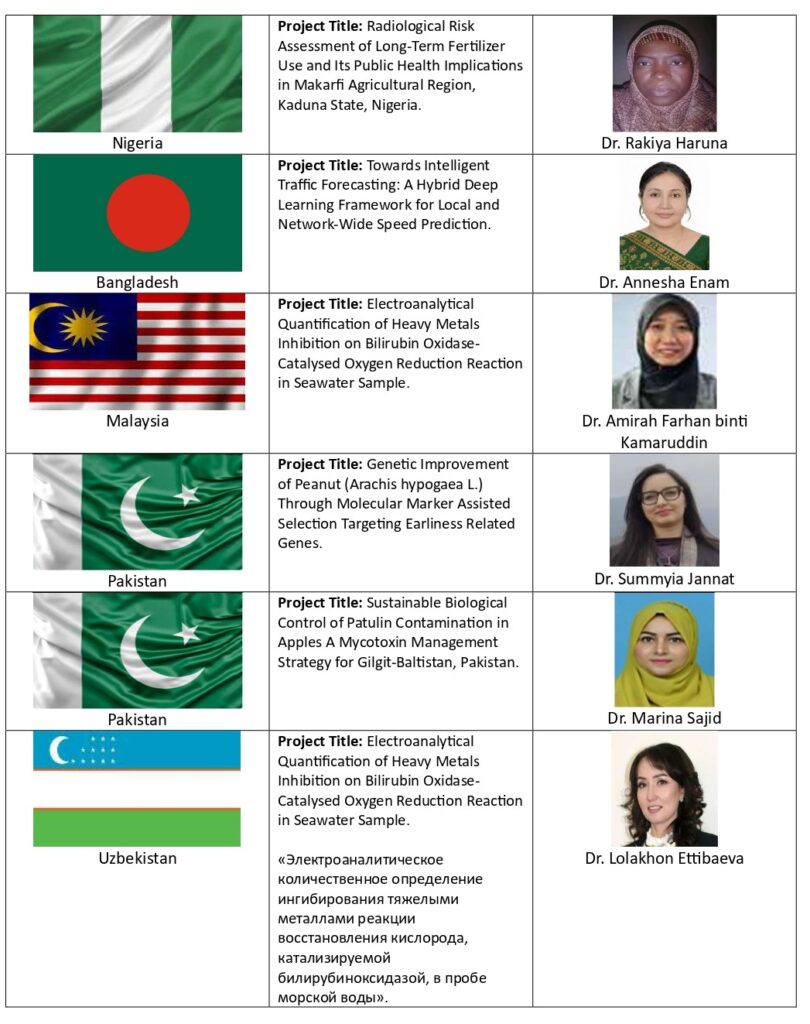
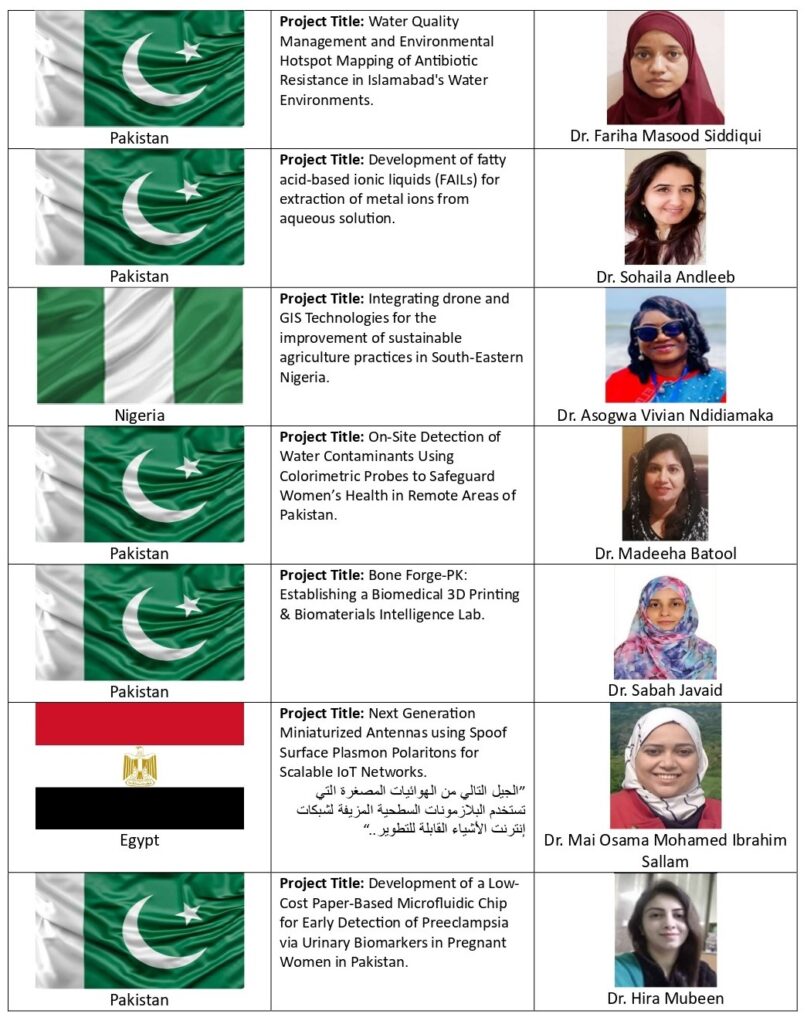
The research proposals of short-listed applicants were evaluated by external experts, and the following researchers from different OIC states were selected for the award of research grants for the Year 2025-26.
Food insecurity remains a pressing global issue, especially in many OIC countries, where challenges such as economic instability, climate change, conflicts, and disruptions like the COVID-19 pandemic and malnutrition crisis have severely affected food systems. These factors continue to impact food availability, access, and utilization, further highlighting the need for resilient and sustainable agricultural practices. Addressing these challenges requires investing in research, knowledge transfer, and capacity building to develop innovative solutions and strengthen food and nutrition security.
COMSTECH and prestigious CCoE member institutions jointly offer this research fellowship program to young researchers in OIC countries. This initiative offers opportunities for short- to medium-term research placements (3 to 6 months) in advanced institutions, aiming to build technical capacity in agriculture, food security, and related areas. The program seeks to empower early-career professionals by enhancing their research capabilities and fostering long-term collaborations across the OIC scientific community.
Fellowship Program objectives:
To contribute to the exchange of knowledge and experience among researchers, scientists and working professionals in the area of improving the food security and development of sustainable agriculture through trainings and research opportunities.
To build the capacity and increase awareness of fellows in the comprehensive domain of food security.
To strengthen the local capacity of fellows from OIC least-developed countries for the appliance of the gained knowledge and practices in their home countries.
Thematic areas
The Fellowship Program offers opportunities in areas related to the below themes. The thematic areas are subject to revision and modification as per the requests of OIC member countries.
The fellowship program is open to citizens of all OIC member states and the OIC least-developed countries: Afghanistan, Bangladesh, Benin, Burkina Faso, Chad, Comoros, Djibouti, Gambia, Guinea, Guinea-Bissau, Mali, Mauritania, Mozambique, Niger, Senegal, Sierra Leone, Somalia, Sudan, Togo, Uganda and Yemen.
Applicants must have at least a Bachelor’s degree; having Master’s or Ph.D. degrees will be an asset. The academic background in food security, agriculture, food science, food safety, or another related field.
Applicants with Bachelor’s degrees must have at least 5 years of substantive professional experience, preferably in government or national research institutions after university graduation. For applicants with a Master’s or Ph.D., at least 3 years of professional experience, preferably in a government or national research institution.
Fluent and proficient in English, with excellent written and oral communication skills.
Available full-time (40 hours per week) during the entire duration of the fellowship.
COMSTECH will accept applications on a yearly basis and select the candidates based on the pre-approved selection criteria.
Language: The fellowship will be conducted in English language.
Research fellowships are awarded by OIC-COMSTECH, as well as by the Joint Scholarship Committee of the host institutions, based on scientific merit.
Call Status
The call is currently open
Host country
Various OIC R&D and Higher Education Institutions
Eligible nationality
OIC member countries
Minimum diploma held
MS/Ph.D. or equivalent
Duration
3-6 months
Age limit
Maximum 35 years (for Master’s studies), 45 years (for doctoral studies)
Call details
Research Fellowship Offers:
Scholarships are offered for three to six months, extendable upon recommendation from the host institution.
COMSTECH will cover, low-cost international airfare and visa fees, if applicable.
Host institutions are expected to provide accommodation, subsistence supervision and mentoring of local training.
The COMSTECH Youth Leaders Program (CYLP) is a groundbreaking initiative by the Standing Committee on Scientific and Technological Cooperation of the Organization of Islamic Cooperation (COMSTECH). The program is designed to empower and equip the youth of OIC member states with the skills, knowledge, and opportunities necessary to lead advancements in science, technology, and socio-economic development.
In alignment with the global Sustainable Development Goals (SDGs) and the developmental needs of OIC member states, the CYLP provides a unique platform for young professionals to work at OIC-COMSTECH Secretariat for a period of 3-6 month. This initiative will enable them to engage with policy issues, develop innovative solutions, and foster collaborations, and propose activities which promote S&T cooperation among OIC member states that address pressing global challenges.
Focus Areas
The CYLP will concentrate on policy issues and activities related to the following priority areas:
Sustainable Agriculture and Food Security, Environment and Climate Change, Renewable Energy, Future Technologies, Manufacturing (CAD & CAM), Science Communication, S&T Policy, Water Resource Management, etc
Program Objectives
The CYLP aims to achieve the following key objectives:
Empowering Future Leaders: Equip young professionals with advanced skills and global perspectives to take on leadership roles in their fields.
Promoting Innovation: Encourage the development of creative solutions to address global challenges, including climate change, poverty, and education access.
Strengthening Collaboration: Build networks among institutions and scientists across OIC member states to facilitate the exchange of experiences, knowledge, and best practices.
Fostering Inclusivity: Ensure representation from diverse social, economic, and gender backgrounds, creating an equitable platform for sustainable growth.
Eligibility Criteria
The CYLP is open to candidates who meet the following criteria:
Age: Below 35 years.
Education: 16 years or above
Applicants must be from an OIC Member Country
Proficiency in English, Arabi or French is essential.
Commitment: Willingness to commit to a 3–6-month training program at OIC-COMSTECH Islamabad, Pakistan.
Expected Outcomes
Capacity Building: Young leaders equipped with the tools and expertise to drive change in their home countries.
Policy Advancement: Enhanced policymaking capabilities in critical areas.
Collaboration: A robust network of youth leaders committed to advancing the shared goals of OIC member states.
Innovation and Impact: Tangible solutions to pressing global challenges through youth-led initiatives and collaborations.
Certificate will be issued, confirming professional training/working at the headquarters of a multilateral organizations.
Contact Info:
For any query, Please contact on the below given Email address or Landline number.
Mr. Abdul Haleem Asghar Focal Person-Awards & Programs (Africa), COMSTECH Tel: +92-51-9220681-3 Email: abdulhaleem@comstech.org
Mr. Umer Ali Programme Officer, Phone No. : 92 51 9220681-3 COMSTECH Secretariat, 33-Constitution Avenue, G-5/2, Islamabad, Pakistan Email: umerali@comstech.org
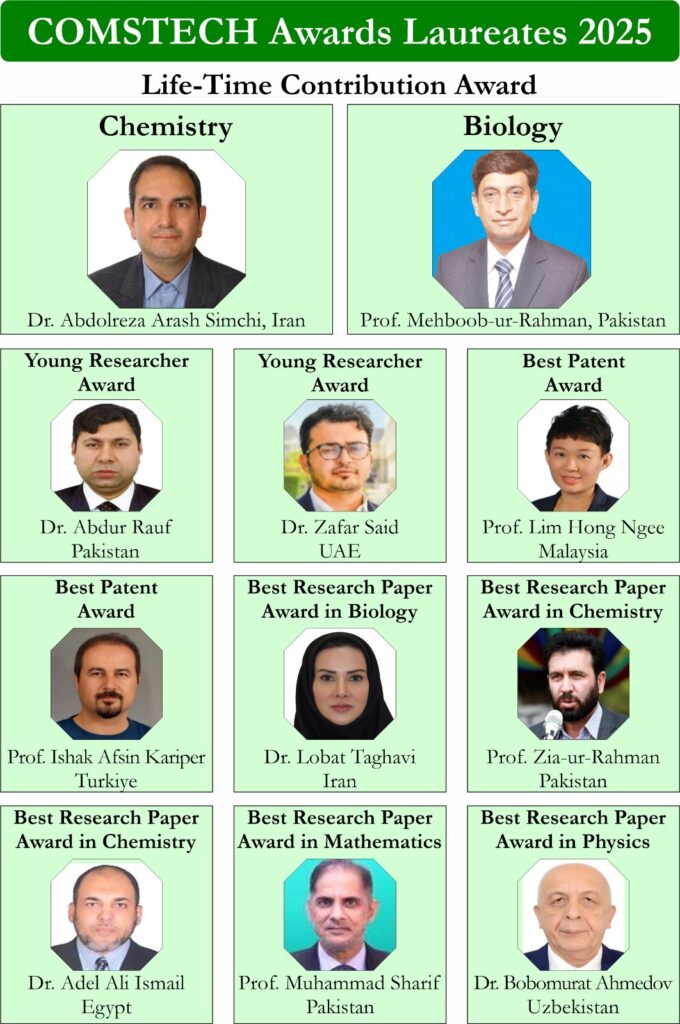
Life-Time contributions in ‘BIOLOGY’ and ‘CHEMISTRY’
The Organization of Islamic Cooperation Standing Committee on Scientific and Technological Cooperation (COMSTECH) announces awards intended to encourage and support scientific contributions in basic sciences. COMSTECH will offer awards in the fields of Biology and Chemistry during the forthcoming Session of COMSTECH General Assembly. Each award consists of a certificate, shield of honour, and cash prize of US$ 8000.
COMSTECH Awards for Excellence in Science & Technology
> The award recognizes individuals for their outstanding contributions to their respective field for discovery that has had lasting impact in furthering the theory and/or development of commercial systems
> Only those patents registered during the past five years would be considered
Each of the above three awards carries a certificate, shield of honour, and cash prize of US$ 4,000.
This award is being announced for the first time. It is awarded to individuals and institutions in OIC countries engaged in impactful science communication and outreach activities. Outstanding contributions to science communication in academia, journalism, outreach and film making will be recognized. The award carries a certificate, shield of honour, and cash prize of US$ 2,500.
IMPORTANT:
Nominations for the COMSTECH Awards 2025 are invited from science academies, national research councils, universities, research institutions, and internationally distinguished scientists who are citizens of, and working in, OIC member states. Nominations will be judged by the panels of distinguished scientists/experts in relevant field appointed by Coordinator General COMSTECH.
A signed cover letter by the nominating agency/applicant along with softcopies of the relevant nomination papers be sent to COMSTECH Secretariat (awards@comstech.org). Nominations should clearly state the contributions made in the field for which the prize would be given. The nominations must be submitted in the English language and English translation of the related documents must be accompanied along with the following documents.
Complete application form with signatures
CV (no longer than 4000 words)
List of Publications
Endorsement letter from the Head of Institution
The closing date of receipt of the applications is Monday, March 31, 2025. Applications received after the closing date shall not be entertained. For enquiries, please contactawards@comstech.org
Journal of Science Communication and Diplomacy is an open access, peer reviewed journal published biannually by COMSTECH and Ministry of Foreign Affairs, Pakistan. The journal publishes the research articles and op-eds in the areas of science communication and the diplomacy. The journal will cover all aspects of science communication and science diplomacy for the benefit of humanity.
Author’s Guideline
Researchers and scholars who wish to contribute article for publication to the JSC&D should send their original, unpublished articles in MS word file.
Author should submit her/his brief introduction along with a certificate that the research is not published elsewhere.
Structure of the Research Article
1. Title (Must be relevant to the Journal’s theme)
2. Author Name, Affiliation (if any), Email & Mobile Number
3. Keywords (5 to 7)
4. Abstract (between 200 to 250 words)
5. Introduction (Up to 250 words)
6. Literature Review
7. Main body of the Article (3000-6000 words) including references.
8. Conclusion
9. References (APA format)
The submitted article will be subjected to peer review nationally or internationally. For plagiarism the article will be strictly scrutinized. Once the article is accepted it cannot be withdrawn or neither can be published in another journal.
Conflicts around the world have led to the displacement of millions of people, resulting in a significant impact on research and higher education for those affected. Armed conflicts, civil wars, political instability, and persecution force people to flee their homes and seek refuge in other countries or within their own borders. Many refugees were involved in research or higher education in their home countries prior to displacement. The conflict disrupts their research projects, academic careers, and scientific contributions.
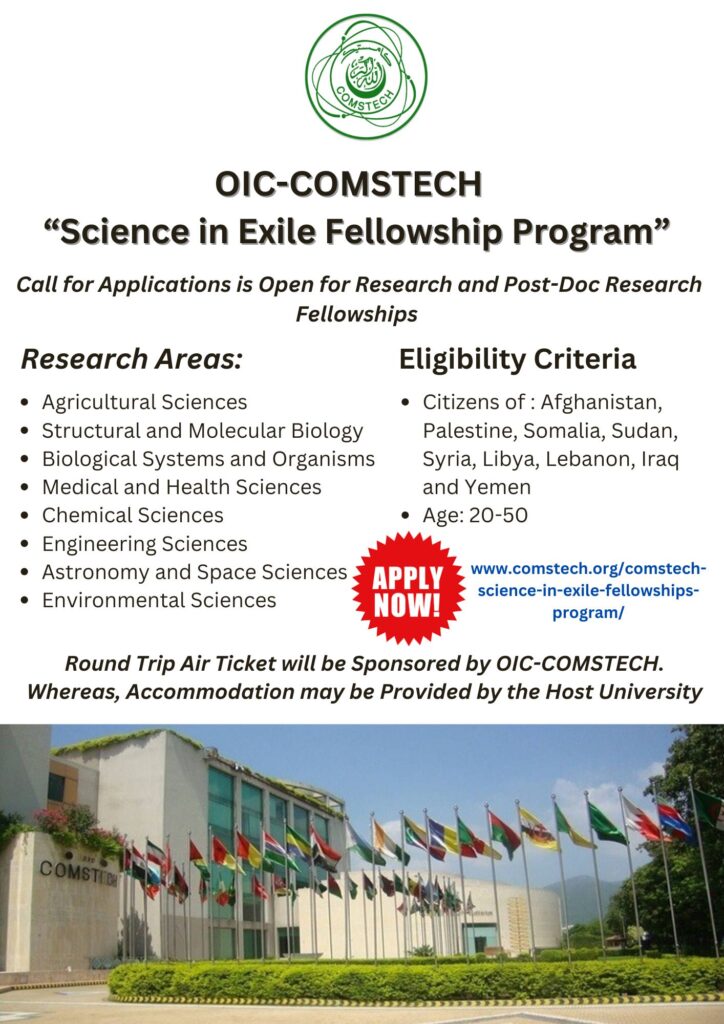
The COMSTECH Science in Exile Fellowships Program aims to support displaced and refugee scientists to stay up-to-date in their field, maintain meaningful careers, and be in a position to help rebuild their countries, once conditions allow. Until then, these professionals can be valuable assets for the countries in which they arrive.
The COMSTECH Science in Exile Fellowship Program aims to provide displaced and refugee scholars and scientists who have not yet found a safe and long-term host country an opportunity to pursue their studies/research, at institutions/universities of the COMSTECH Consortium of Excellence (CCoE).
Displaced/Refugee from Afghanistan, Palestine, Somalia, Sudan, Syria, Yemen, Iraq, Libya and Lebanon
Minimum degree held
M.S/MSc for Research Fellowship and PhD for Post-Doc Research Fellowship in relevant field of study
Duration
6 months (Full Time)
Age limit
25 – 50 years
Areas of Research
01-Agricultural Sciences 02-Structural, Cell and Molecular Biology 03-Biological Systems and Organisms 04-Medical and Health Sciences Incl. Neurosciences 05-Chemical Sciences 06-Engineering Sciences 07-Astronomy, Space and Earth Sciences 08-Mathematical Sciences 09-Physics
Language
The language of instruction is English.
Terms of the Scholarships
Applicants should be displaced or refugee scholars and scientists: i. Currently living in any OIC Member State and holding the right to live and study in the respective country. OR ii. Able to travel to Pakistan. Please note that the program is not suitable for scholars at risk who need specific assistance to leave their home country. Awardees are responsible for arranging the logistics and safety of their own relocation.
Those travelling from outside Pakistan will be eligible for one economy class return air ticket for the entire duration of the fellowship.
Applicants who hold citizenship or permanent residency in Pakistan or in safe third countries are not eligible to apply.
The fellowships are offered for a maximum duration of six months.
Upon request, the host institutions may provide free accommodation for Research Fellows and Post-Doc Research Fellows.
Applicants may apply for only one of the two types of fellowships offered under the COMSTECH Science in Exile Fellowships Programme.
Application Submission
Applicants must complete the application form and attach the required documents.
Founded in 1981, COMSTECH is the OIC Ministerial Standing Committee on Scientific and Technological Cooperation and is based in Islamabad (Pakistan). It is the leading inter-governmental OIC organization responsible for science and technology in the OIC member countries. The General Assembly of COMSTECH meets biannually in Islamabad at the level of OIC Ministers responsible for S&T. COMSTECH works to strengthen cooperation among the OIC member states in science, technology and innovation (STI), and enhance their capacities in STI, as well as cultivate a culture of science appreciation in OIC societies. Part of COMSTECH’s role is to create an effective institutional structure for planning, research, development and monitoring of scientific and technological activities at national, regional, and international levels; principally laying the foundation for COMSTECH-SAC and its perceived function.
Need for COMSTECH- SAC
The current global COVID-19 pandemic has been described as a ‘once in a hundred years emergency;’ an emergency that has highlighted the critical value of effective and integrated science advice mechanisms at all levels of the government, and in all countries. Managing the current acute response and the recovery, nationally and globally, will continue to require a range of evidence from the natural sciences, social sciences and the humanities for the next few years at least.
Needless to say, the above narrative is equally applicable to many chronic and regularly emerging quandaries; quantitative and qualitative in nature, that afflict the efficacy of the science, technology and innovation (STI) ecosystems in OIC countries, and indeed their capacity to harness the power of STI for socioeconomic progress and economic well-being. Such obstacles include, inter alia, lack of comprehensive Science, Technology and Innovation (STI) policies, and strategies emanating therefrom, the dearth or inadequacy of resources, infrastructure and institutions, gender imbalance in Science and Technology, shortage of trained personnel, prohibitive costs of acquiring knowledge and technology, and barriers to the transfer of knowledge, personnel and technologies from developed countries.
Executive Summary
COMSTECH aims to strengthen cooperation among the OIC Member States in science, technology and innovation (STI), and enhance their individual and collective capacities in STI, as well as cultivate a culture of science appreciation in all echelons of the OIC societies. In short, COMSTECH essentially works to harness the power of STI for socioeconomic progress, and economic well-being.
The COMSTECH Scientific Advisory Council (COMSTECH-SAC) 2020, is launched along the following guidelines
Vision
COMSTECH-SAC’s aims to become a forum for STI policy advisors and STI practitioners to share experience, build capacities, and primarily develop approaches to the use of scientific evidence in informing policy at all levels of government, primarily in OIC countries.
Mission
The COMSTECH-SAC shall be an advisory group of leading experts, nominated and invited by the Coordinator General COMSTECH to:
Upon the request of OIC member states, and the directive of the Coordinator General COMSTECH, assist OIC member countries to build up their science advisory capacity and develop appropriate science advisory mechanisms to complement their own national needs.
Propose a model STI advisory mechanism that COMSTECH can develop and promote and can be adapted by the OIC member countries.
Upon the request of OIC member countries, and the directive of the Coordinator General COMSTECH, offer advice and evidence-based counsel to member states of the OIC and OIC organizations on STI policies and activities.
Undertake reviews and consultations on national STI policies and strategies in OIC member countries.
Organize outreach meetings to share experiences and best practices in the domain of science advice to governments, policy-makers and other stakeholders, in cooperation with similar networks from around the world.