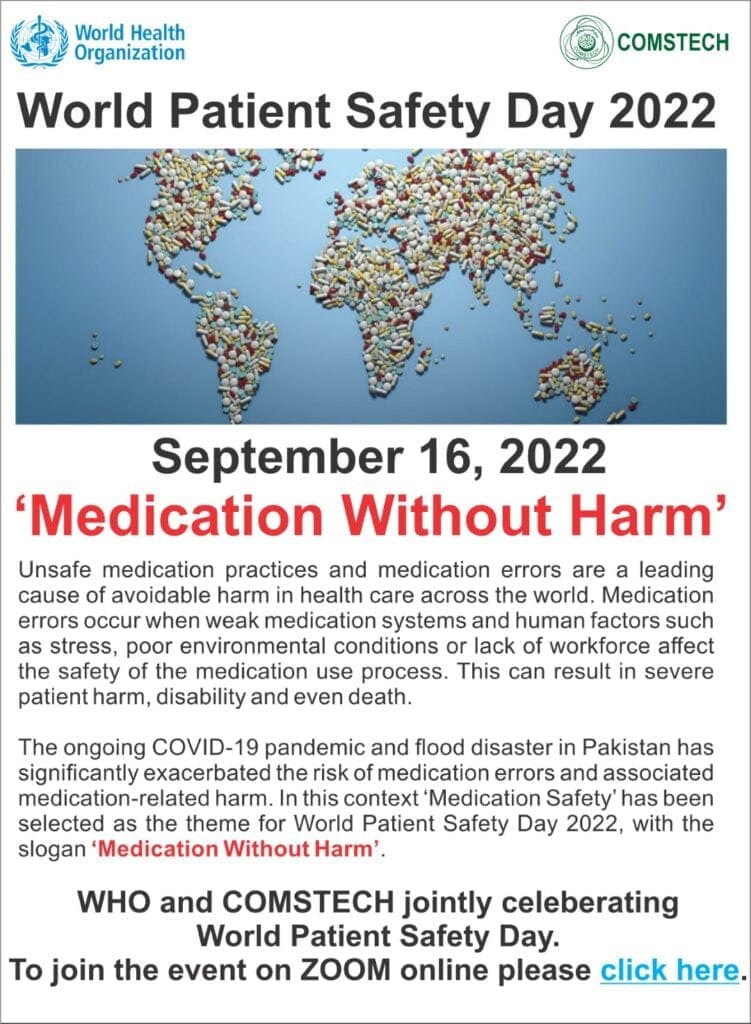
Time: Sep 16, 2022 10:20 AM Islamabad, Pakistan
Click here to join via ZOOM
OR
Use the following ID and Password to Join Online Event via ZOOM
Meeting ID: 848 7939 5257
Passcode: 048550
Time: Sep 16, 2022 10:20 AM Islamabad, Pakistan
Click here to join via ZOOM
OR
Use the following ID and Password to Join Online Event via ZOOM
Meeting ID: 848 7939 5257
Passcode: 048550
Jointly organized by
Standing Committee on Scientific and Technological Cooperation (COMSTECH)
and
Sindh Innovation, Research, and Education Network (SIREN)
PROGRAM SCHEDULE: 13th September 2022
DAY AND TIME: Tuesday (10:00 – 12:00 Hrs.)
REGISTRATION DEADLINE: 11th September 2022 (Free)
FOR REGISTRATION USE THE GIVEN LINK: bit.ly/PS-SIREN

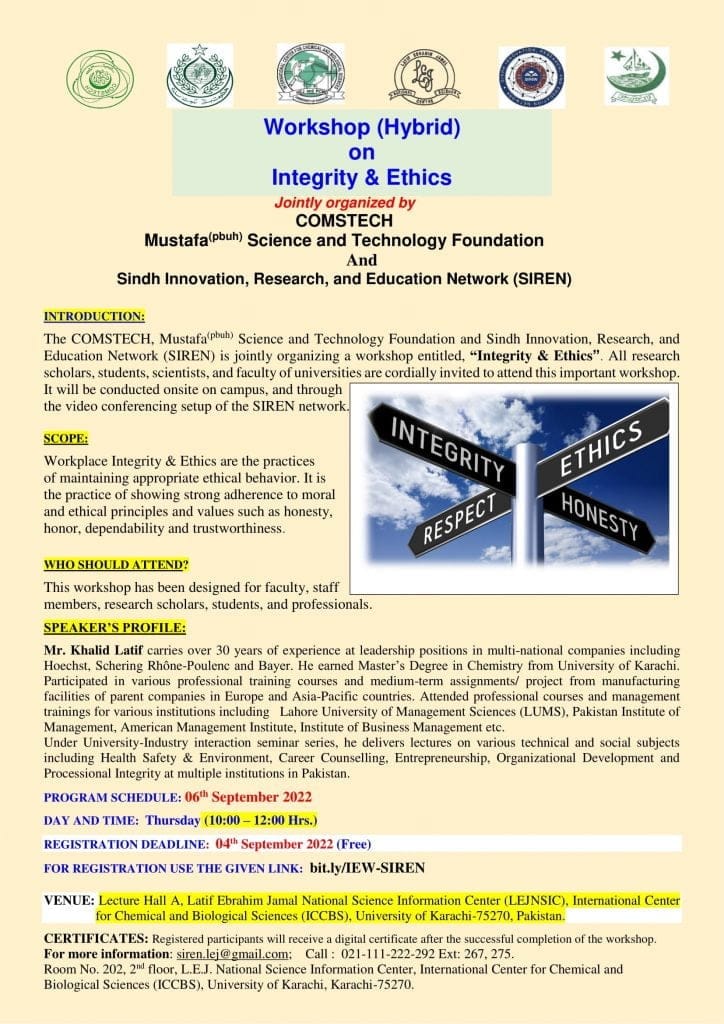
Jointly organized by
COMSTECH
Mustafa(pbuh) Science and Technology Foundation
And
Sindh Innovation, Research, and Education Network (SIREN)
PROGRAM SCHEDULE: 06th September 2022
DAY AND TIME: Tuesday (10:00 – 12:00 Hrs.)
REGISTRATION DEADLINE: 04th September 2022 (Free)
FOR REGISTRATION USE THE GIVEN LINK: bit.ly/IEW-SIREN
Date: 3rd October – 14th October 2022.
Registration Deadline: 5th September 2022
Venue: Institute for Medical Research, National Institute of Health, Setia Alam City, 40170 Shah Alam, Selangor, Malaysia.
Flyer: Click here
About the Course:
The course will focus on basic to advanced epidemiological subjects and the design of this study is divided into correct methodology, source of error, method of analysis and interpretation of complete results, other related topics and advanced analysis methods.
Target Audience:
The Course is open to students, researchers, young scientists, and academicians from the OIC member states and other countries.
Register at: https://forms.gle/SrZ4D4AAEbxxTC369
Registration deadline: 5th September 2022
For any queries please contact: khazima@comstech.org ; maham.yamin@comstech.org
*The modalities of your participation will be notified after your selection.
Prof. M. Amin Shokrollahi
2017 Mustafa (PBUH) Prize Laureate
CEO and Founder of Kandou Bus Co.
Date: September 1, 2022
Time: 06:00-8:00 GMT (11:00-13:30 Pakistan Standard Time)

Abstract:
Communication of data on electrical wires between chips is fast gaining prominence in the electronics industry. Because most of the components of the transmitter and the receiver of such links are analog, rather than digital, they don’t benefit as much from Moore’s law. On the other hand, the need to transmit data ever faster calls for higher rates of transmission over existing electrical wires. Since in this type of communication noise is highly frequency dependent, higher transmission rates lead to much higher noise, and therefore a much higher growth of power consumption than linear. The industry has long recognised this problem as the “Interconnect bottleneck”. However, fundamental solutions to this important problem have remained elusive.
A look at the capacity of these channels reveals that today we are only transmitting at anywhere between 1% to 4% of the capacity. Therefore, at least on the surface, there is a lot to be gained by applying methods from communication theory to this problem. However, unlike many other systems such as wireless, DSL, satellite, or optical communication, the constraints on the chip-to-chip communication system are very different: transmission rates are typically 1000 times those encountered in wireless communication. On the other hand, the energy consumed for the transmission and recovery of each bit is about 1000 times less than what is customary in wireless. Also, latency requirements are extremely stringent, allowing only latencies up to very few nanoseconds. Therefore, it is not possible to use fancy processing methods.
In this talk, Prof. Shokrollahi will introduce a new modulation scheme for chip-to-chip communication which is called chordal codes. These codes are somewhat reminiscent of spatial MIMO systems, and provide a first step towards a better utilisation of the available communication bandwidth between chips. Current implementations of systems based on these codes show a large reduction of total power of the communication PHY and a large increase of the communication speed compared to other classical system.
Target Audience:
The webinar is open to students, researchers, young scientists, and academicians from the OIC member states, and other countries.
For Registration please visit: https://forms.gle/wGfopgBBBfJmYNE49
Procedure to Join: Zoom link will be shared with selected participants via email.
Profile of Speaker: https://mustafaprize.org/page/?id=21
Webinar Coordinator:
Muhammad Haris Akram
Program Manager
COMSTECH, Islamabad.
Email: haris@comstech.org
Phone: +92 51 9220681
Muhammad Haseeb Ahmad
Program Officer
COMSTECH, Islamabad.
Email: Haseeb.ahmad@comstech.org
Phone: +92 51 9220681
Thursday 11th August 2022: 1.00 pm to 6 pm
Climate change is posing serious threat to Food Security of Pakistan. Punjab university together with UPSIGN, COMSTECH, SAWIE, SACAN and Dawood Agro are hosting a one day International symposium Climate Smart Sustainable Rice Wheat Production Systems at Faculty of Agriculture , Punjab University on 11th August from 1-6PM. The event is free to participate, please register online for both physical (shorturl.at/BIKL0) and Online participation (shorturl.at/ehik0).
Speakers

“Role of PCRWR in Addressing Water Security Challenges of Pakistan”
By Prof. Dr. Muhammad Ashraf
Chairman, Pakistan Council of Research in Water Resources (PCRWR)
Date: August 03rd, 2022
Time: 2:00 – 3:00 PM Pak Time
Abstract: Pakistan is home to a growing 220 million population. Land and water resources are in abundance but they are challenged by the growing food and livelihood needs of the nation. In addition to socio-economic factors, climate change has also induced stress on existing water resources. This scenario has developed a wide range of issues in the water resources sector of Pakistan. Given the geographic magnitude of Pakistan and its natural resource base, simple but game-changing approaches are required to be adopted. In this regard, Pakistan Council of Research in Water Resources (PCRWR) has made just the same difference. Although major water resources development projects are crucial for building national water security, water resources management and conservation are equally important at consumer scale interventions. In doing so, PCRWR has utilized indigenous cultural knowledge as well as advanced digital technologies for generating evidence-based actions in water resources management. These include; rainwater harvesting in deserts, dry mountainous climates, urban rainwater harvesting followed by artificial groundwater recharge, rehabilitation of Karez cultural landscape, land and water conservation in arid and irrigated agriculture, earth observation techniques for surface and groundwater monitoring, digital irrigation advisory services for 20,000 farmers in Pakistan. On the policy side, PCRWR has also added values by sharing its knowledge driven by its execution experience. PCRWR has participated in developing National Water Policy 2018 followed by Provincial Water Acts, reporting and capacity building of Sustainable Development Goal 6. This talk will briefly reflect on these activities undertaken by PCRWR.
Muhammad Ashraf is basically an Agricultural Engineer. He graduated from the University of Agriculture, Faisalabad, and earned his PhD from the University of Newcastle, UK. He has more than 30 years of research and development experience in water resources development and management in arid and semi-arid areas and has over 100 national and international research publications at his credit. He is also the editor of the journal Paddy and Water Environment published by Springer. Presently, he is working as Chairman, PCRWR. He is also the convenor of Pakistan National Committee of International Hydrological Program (IHP) of UNESCO and the Coordinator of the Upper Indus Basin Network (UIBN).
Flyer of the event: Attached
Target Audience:This webinar is open to academics, scientists, water policy experts and general public from all OIC states.
Register with us to attend this event: https://forms.gle/jrSaSCHS6PozpjvM8
Contact us for further details:
khazima@comstech.org

Hybrid Event
VENUE
NFLARC, Dr. Panjwani Center for Molecular Medicine and Drug Research (PCMD), International Center for Chemical and Biological Sciences (ICCBS), University of Karachi 75270, Pakistan. (Only for Karachi Participants).
Rest will Join Through Zoom.
Date:
Registration Deadline:
Registration Link:


“Extracellular vesicles: Different sources, Different applications”
By Prof. Dr. Faezah Shekari
Assistant Professor in the Royan Institute
Royan Extracellular Vesicle Group Tehran, Iran
Date: July 29th, 2022
Time: 2:00 – 3:00 PM Pak Time
The therapeutic potential of naturally secreted micro- and nanoscale extracellular Vesicles (EVs) as attractive candidates for regenerative medicine and pharmaceutical science applications. In this session, sources, characterization of EVs leading to their potential applications will be discussed.
Dr. Faezah Shekari: is a member of Royan Extracellular Vesicle Group. She graduated in B.Sc. and M.Sc. of Cellular and Molecular Biology from Tehran University. During her undergraduate studies, she got interested in proteomics. She joined Royan Institute in 2005 to pursue her interests on membrane proteomics. During her PhD thesis, she got interested in subcellular fractionation and organellar proteomics under supervision of Dr. Hosseini Salekdeh and Prof. Baharvand. She performed international projects including membrane proteome analysis of liver microsomal fraction from international membrane proteomics initiative (MPI) as well as prepared and characterized standard sample for Asian and Oceania human embryonic stem cell MPI under supervision of Prof. Yu-Ju Chen (from Academia Sinica, Taiwan) and Dr. Hosseini Salekdeh and Prof. Baharvand (from Royan institute) in Academia Sinica. Currently, she works as an Assistant Professor in Royan Extracellular Vesicle Group. She is also chair of ISEV Rigor and standardization task force: https://www.isev.org/page/conditionedmedium
Flyer of the event: Attached
Target Audience:This webinar is open to academics, scientists and general public from all OIC states.
Register with us to attend this event: https://forms.gle/L9FBB7Lyr4zMocJc9
Contact us for further details:
khazima@comstech.org;
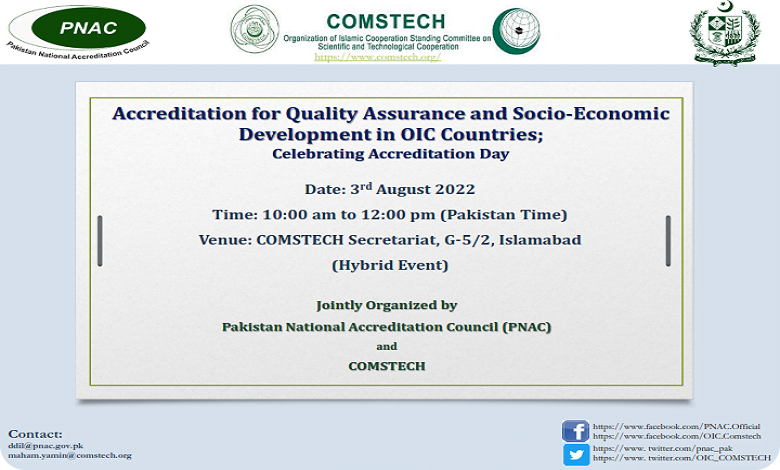
Date: 3rd August 2022
Time: 10:00 am to 01:00 pm (Pakistan Time)