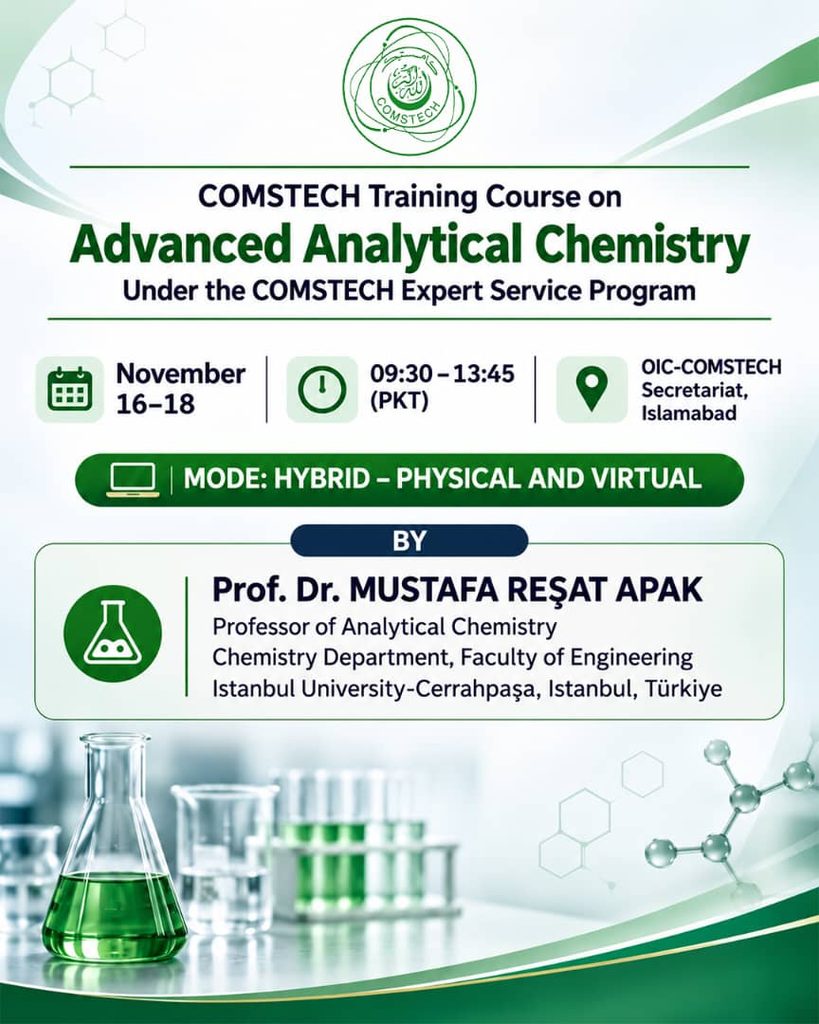
COMSTECH Training Course on “Advanced Analytical Chemistry”
Under the COMSTECH Expert Service Program
Date: November 16–18, 2026
Time: 09:30 – 13:45 (PKT)
Venue: OIC-COMSTECH Secretariat, Islamabad
Mode: Hybrid – Physical and Virtual
Introduction:
Chemical equilibria sit at the heart of analytical chemistry. Almost every classical and modern analytical method – from titrations and gravimetric analysis to separations, sensors and environmental speciation – depends on how acid-base, solubility, redox and complexation equilibria behave on their own and how they influence one another in real samples. The OIC-COMSTECH is organizing a three-day training course on “Advanced Analytical Chemistry” to give researchers, faculty members and postgraduate students from OIC Member and Observer States a rigorous, calculation-oriented command of these equilibria and of the coupled systems they form. Through worked calculations, species distribution (log C/pH and log C/pM) diagrams and Eh/pH diagrams, the course builds the reasoning skills that underpin method development and quality control, and contributes to strengthening analytical chemistry capacity.
Course Content:
- Introduction: The Philosophy of Analytical Chemistry, Introduction to Chemical Equilibria, Equilibrium Constant, Relationship with Thermodynamic Parameters (Free Energy) and Le Chatelier’s Principle
- Acid-Base (Neutralization) Equilibria
- Basic definitions and historical background; approximate pH calculation of various acid-base systems
- Calculations involving mono- and poly-basic acids and bases
- Calculations involving acid-base titrations of single species and their mixtures
- Indicator selection and indicator errors
- Strengthening of acidity/basicity to titratable level through thermodynamic coupling
- Detailed pH calculation of complex systems incorporating dissociation constants, material balances, proton condition and electro neutrality principle
- Buffer index and end-point sharpness index
- Acid-base species distribution diagrams of Log C (species concentration) versus pH, and solution of complex analytical problems with the aid of Log C/pH diagrams
- Solubility and Precipitation of Sparingly Soluble Salts
- Analysis of factors affecting solubility of sparingly soluble salts
- Coupling of solubility with acid-base equilibria
- Coupling of solubility with complexation equilibria
- Inert electrolyte effect (activity versus concentration) and common ion effect
- Redox Equilibria and Redox Titrations
- Relationship with thermodynamic parameters, half-cell reactions, standard and actual redox potentials, and the Nernst Equation
- Calculations in redox titrations
- Indicator selection, indicator error and its compensation
- Redox equilibria coupled to pH changes and complexation
- Eh/pH diagrams: construction, evaluation, and geophysical/environmental reflections
- Complexometric Equilibria and EDTA Titrations
- Lewis acid-base concept, introduction to coordination chemistry and origin of metal-ligand complex stability
- The conditional stability constant; calculation of free metal concentration at various stages of the metal ion-EDTA titration curve
- Metallochromic indicators and titration errors
- EDTA titration of single metal ions and their mixtures; pH and masking agent control
- Free metal and metal-complex distribution diagrams of Log C (species concentration) versus negative logarithm of free metal concentration (pM)
- Precipitation Titrations (exemplified with argentometric titration) and Indicator Error
- Introduction to Basic Equilibria Involving Solvent Extraction
- Introduction to Basic Equilibria Involving Adsorption/Solid-Phase Extraction
Course Schedule:
| Day | Time (PST) | Session |
| Monday, 16 November | 10:00 – 11:45 | Course 1: Introduction; Acid-Base Equilibria |
| 12:00 – 13:45 | Course 2: Acid-Base (Neutralization) Equilibria | |
| Tuesday, 17 November | 09:30 – 11:15 | Course 3: Acid-Base Equilibria (cont.); Solubility and Precipitation of Sparingly Soluble Salts |
| 11:30 – 13:15 | Course 4: Redox Equilibria and Redox Titrations | |
| Wednesday, 18 November | 09:30 – 11:15 | Course 5: Complexometric Equilibria and EDTA Titrations; Precipitation Titrations |
| 11:30 – 13:00 | Course 6: Basic Equilibria in Solvent Extraction and Adsorption / Solid-Phase Extraction | |
| 13:00 – 13:30 | Closing of the Training | |
| Course 1 covers Subject 1 and partly Subject 2 Course 2 covers Subject 2 Course 3 covers Subjects 2 & 3 Course 4 covers Subject 4 Course 5 covers Subjects 5 & 6 Course 6 covers Subjects 7 & 8 | ||
Pre-requisites:
Applicants should hold a minimum of Bachelor’s degree in Chemistry, Applied/Industrial Chemistry, Chemical Engineering, Pharmacy, Environmental Sciences, Food Science, or a closely related discipline, with a working knowledge of general and analytical chemistry.
Who Can Apply:
Researchers, faculty members and postgraduate (MS/MPhil/PhD) students from universities and research institutions across OIC Member and Observer States are encouraged to apply.
Registration:
| Physical Registration | (For participants based in Rawalpindi/Islamabad) https://forms.gle/F8QrkCyXomRCURWD6 |
| Virtual Participation | https://forms.gle/kDhy1aGFXdbQJeUr9 |
Speaker Profile:
This training course will be delivered by Prof. Dr. Mustafa Reşat Apak, Professor of Analytical Chemistry at the Department of Chemistry, Faculty of Engineering, Istanbul University-Cerrahpaşa, Türkiye. His research spans analytical and environmental chemistry, spectroscopy, electrochemistry, separation techniques, and colorimetric sensors and Nano sensors. He has more than 400 Web of Science-indexed publications, over 26,000 Google Scholar citations and an h-index of 73.
Detailed profile of Prof. Dr. Mustafa Reşat Apak can be accessed at: https://avesis.iuc.edu.tr/rapak
Workshop Coordinator:
Muhammad Haseeb Ahmad
Program Officer
OIC-COMSTECH
Haseeb.ahmad@comstech.org