Past Events

  • COMSTECH – ICCBS International Exhibition on “Technology Enabled Healthcare Solutions”

    September 08- 09, 2021

    Venue: International Center for Chemical and Biological Sciences (ICCBS), Karachi

    Deadline for Applications: August 25, 2021

    Introduction

    The Islamic world is vast and diverse, comprising of mainly developing countries, which are in various stages of socio-economic development, S&T, and innovation capacity. As science progresses, the current research topics touch many fields of expertise requiring interdisciplinary skills. In this scenario, researchers and scientists working in all fields of natural sciences have to indulge themselves in research and development to produce products for national needs.

    Incorporating the most recent changes in healthcare, regulations, standards, and technology, the field of biomedical engineering seeks to close the gap between engineering and medicine by combining the design and problem-solving skills of engineering with medical biological sciences in order to advance health care treatment. This includes diagnosis, monitoring, therapy as well as equipment manufacturing, standardization, routine testing, and preventive maintenance.

    Realizing the importance of biomedical devices and healthcare services, COMSTECH in collaboration with International Center for Chemical and Biological Sciences (ICCBS), Karachi has planned a two-day exhibition in September 2021.

    Objective

    The objective of this exhibition on ” Innovative Biomedical Devices and Healthcare Solutions ” is to highlight the role of modern-day tools and equipment, which are commercially available, or developed as prototypes for commercialization. This international exhibition will bring a unique platform for innovators, technology developers and service providers, who are eager and ready to share experience and professional skills with participants of common interests in science, technology and innovation.

    The international exhibition is designed to project technologies and innovations in the realm of biomedical engineering and healthcare services. It is a showcasing of next generation technologies, solutions and strategies from all over Pakistan and OIC Countries, and an opportunity to explore and discover the practical and successful implementation of such technologies in healthcare sector. The exhibition will incorporate meetings between potential end users and commercial partners with R&D professionals and scientists.

    Target Audience:

    Scientists, researchers, innovators, healthcare professionals, computer scientists, young entrepreneurs, industrialists, and officials of relevant Ministries from Pakistan and other OIC countries.

    Key Areas:

    The exhibition will cover the following topics:

    1.Biomedical Devices/ Medical Equipment

    • Health Monitoring Devices
    • Image Processing
    • Sensor Technology
    • Wearable Health Devices
    • Radiography
    • Laboratory Equipment/Diagnostic Testing
    • Diagnostic Kits and Reagents
    • Robots

    2. Artificial Intelligence in Healthcare

    • Telemedicine/ e-Health Programmes
    • Internet of Things (IoT)
    • Big Data/ Data Analytics
    • Cyber Security
    • IT Systems and Solutions
    • Hospital Management Systems
    • Tracing / Tracking Systems for Global Pandemics

    3. Pharmaceuticals

    • Drug Delivery Systems
    • Medical/ Surgical Equipment

    Registration Fee:

    A nominal registration fee of Rs. 5,000 will be charged from all the exhibitors. COMSTECH will cover the cost of accommodation, food, and exhibition space for selected exhibitors. No registration fee will be charged from participants or visitors.

    Travel & Local Hospitality:

    ICCBS, Karachi will arrange local hospitality for all selected exhibitors. No travel support will be provided to exhibitors and participants. All exhibitors/participants are expected to get their travel funding from their parent organizations/country of origin.

    Registration Process:
    Step 1: Open online registration form, Visitors

    Step 2: : Read instructions in the application form carefully and submit a properly filled form along with your CV. Foreign participants must submit a scanned copy of passport.

    Step 3: Selected exhibitors will be notified through email; hence, applicants are required to check their emails regularly.

    Venue:

    The exhibition will be held at the International Center for Chemical and Biological Sciences (ICCBS), Karachi (www.iccs.edu), in the business hub of Karachi, the largest city of Pakistan along the beautiful coast of Arabian Sea.

    Exhibition Coordinators

    • Dr. Reaz Uddin
      Associate Professor
      Computational Biology
      ICCBS, University of Karachi
    • Dr. M. Sadiq Ali Khan
      Associate Professor
      University of Karachi.

    Deadline for Applications: July 12, 2021

  • Collaboration among OIC Members Countries for Promotion of Research Culture in Medicines and Vaccines through Strengthening and Upgrading the Clinical Trials

    June 3rd, 2021
    Hybrid Event

    Short Abstract: There is a lack of capabilities and proper infrastructure in OIC member countries in the fields related to clinical trials, research and development, and bioequivalence and bioavailability studies. This has led to the increasing dependence of member countries on European and North American countries for the provision of new drugs including investigational drugs and the member countries export as compared to the aforementioned countries/regions is meagre due lack of proper research and development and subsequent clinical trials for investigational drugs and bioequivalence and bioavailability studies for generic drugs. Keeping in view the theme of the very first meeting of NMRAs held in Jakarta i.e. “Strengthening collaboration amongst the OIC NMRAs towards self-reliance of Medicines and Vaccines”, there is a dire need to have a robust system and collaboration mechanism in OIC countries for the conduct of clinical trials and research and development that would cater the growing need of member countries and would promote a culture of research in the Muslim Ummah. In this regard, a virtual training of Representatives of National Medicines Regulatory Authorities (NMRAs) from the Organization of Islamic Cooperation (OIC) Member Countries on Collaboration towards Self Reliance of Medicines and Vaccines with the theme“Collaboration Among OIC Members Countries for Promotion of Research Culture in Medicines and Vaccines Through Strengthening and Upgrading the Clinical Trials, is scheduled to be held on 3rd of June, 2021 virtually.

    The main objectives of this virtual training of Representatives of National Medicines Regulatory Authorities (NMRAs) from the Organization of Islamic Cooperation (OIC) Member Countries are:

    • A valuable platform to deliberate upon and develop a joint mechanism for research and development specifically clinical trials as a step towards self-reliance in medicine and vaccine
    • Develop a follow-up and implementation mechanism and propose relevant changes in national laws of member countries to strengthen and upgrade the mechanism of conduction of clinical trials.
    • To present a country situation on the mechanism and conduct of clinical trials by the member countries.
    • Develop a framework for capacity building, knowledge sharing, and technology transfer mechanism among OIC members’ countries where technically advance OIC members’ countries would upgrade the capacity of the other member countries focusing on conduction of multicentre and multicounty clinical trials.

    Target Audience: This virtual training is open to academicians, scientists, drug regulators, health policy makers, health officials and the public from all the member OIC states.

    Online form for Virtual Participation and E- certificate:

    https://forms.gle/B8uoVpbZ4P3u2LnA9

    Online form for Physical Participation

    https://forms.gle/J1D9u1qkNijTNMvm7

    Programme

    (June 3rd, 2021) – Thursday

    (Timing according to Pakistan Standard Time)

    TimeAgenda
    09:30-09:50Welcome note.   Prof. Dr. M. Iqbal Choudhary, Coordinator General COMSTECH, Islamabad.
    09:50-10:10Keynote Address    By Mr. Asim Rauf, CEO of the Drug Regulatory Authority of Pakistan
    10:10-11:00Country Situation Pakistan on Clinical Trials     By Dr. Abdur Rashid, Director, Division of Pharmacy Services, Drug Regulatory Authority of Pakistan
    11:10-12:00Clinical Trials: Basic requirements for conducting top-quality clinical trials    Prof. Dr. M. Raza Shah  (ICCBS University of Karachi)
    12:00-13:00Country Situation on Clinical Trials, in Qatar By  Prof. Dr. Abdelbary Elhissi (Professor in Pharmaceutics) Department of Pharmaceutical Sciences, College of Pharmacy, Qatar University
    13:00-14:00Lunch and Prayer break  
    14:00-15:00Engagement in medical research to promote national health and wellbeing Prof. Dr. Khalid Saeed Khan Distinguished Investigator, Beatriz Galindo Programme Department of Preventive Medicine and Public Health University of Granada, Spain
    15:00-16:00Country Situation in respect of clinical trial at Saudi Arabia   Prof. Dr.  ISMAIL IBRAHIM MOHAMMED AL-THAQAFI    Vice Dean of the College of Applied Sciences Umm Al-Qura University, Mecca Saudi Arabia
    16:00-17:00Where we stand in clinical research and trial at UAE   Prof. Dr. Naveed M. Khan   Department of Clinical Sciences, College of Medicine, University of Sharjah, UAE
        17:00-17:30Closing

    Contact Persons:

    Prof. Dr. Raza Shah ( raza_shahm@yahoo.com )

    Prof. Dr. Abdur Rashid ( rashiddrap@gmail.com )

    Ms. Khazima Muazim ( Khazima@comstech.org )

  • COMSTECH Webinar on “Two fluid plasma models for the generation of seed magnetic fields and astrophysical jets”

    Prof. Dr. Hamid Saleem

    Professor, Department of Space Science in IST, Islamabad
    Space and Astrophysics Research Lab (SARL), National Centre of GIS and Space Applications, Islamabad.
    Theoretical Research Institute Pakistan Academy of Sciences, Islamabad.

    Date and Time: 24th March 2021; 03:00 pm Pakistan Standard Time

    Blurb: Large scale magnetic fields in galaxies have been detected but the generation mechanism is not fully understood. Spatial scales of these fields are of the order of kilo parsecs and magnitudes are of the order of micro Gauss. On the other hand, collimated outflows of gases and plasmas from astrophysical objects such as young stellar objects (YSOs), active galactic nuclei (AGN), and the Sun (solar spicules and coronal loops) have also been observed. Complex structures of magnetic fields are associated with these plasma jets. These jets move with velocities smaller than as well as closer to velocity of light. Here exact analytical solutions of the set of nonlinear partial differential equations for the two fluid classical plasma are presented to show that magnetic fields and flows both are created simultaneously by baro clinic vectors of electrons and ions. Thus thermal energy of plasma becomes fundamental source for the generation of magnetic and flow fields in plasmas. Important point to note is that ordered structures in the form of jets are created by the highly nonlinear set of two fluid plasma equations. Before discussing these theoretical models, a brief historical development of astronomy and astrophysics is presented for the general interest.

    Target Audience: This webinar is open to academicians, scientists, and general public from all the member OIC states and beyond.

    Profile of Speaker: Dr. Hamid Saleem is a Professor in the Department of Space Science at the Institute of Space Technology. His area of specialization is Space and Astrophysical Plasmas and he has published 140 research papers in International journals. He has served as the Director General for National Centre for Physics. He completed his Ph.D. in Plasma Physics from Quaid-e-Azam University, the research work for his Ph.D was conducted in Germany under DAAD Fellowship. He also worked for two years as JSPS post-doctoral fellow in National Institute of Fusion Science (NIFS), Toki, Japan.

    Poster of webinar:  Attached

    Link for registration and E- certificate:

    https://forms.gle/ZCQxfAJsQaNpTK4h8

    Procedure to join:

    Zoom link for participation will be shared selected participants.

    Address: COMSTECH Secretariat, 33-Constitution Avenue, G-5/2, Islamabad 
    Phone No. : 92 51 9220681-3
    Email: Khazima@comstech.org ; comstech@comstech.org

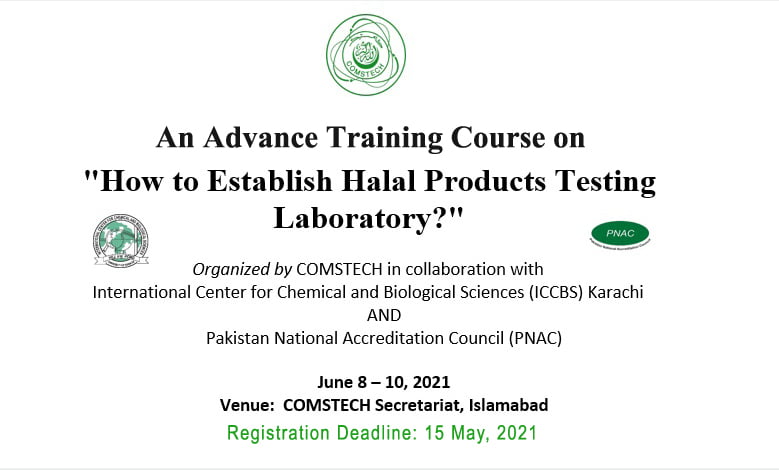
  • An Advance Training Course

    In view of the diversity of several products, including processed food and other items of daily use in the present day, authentication and confirmation of their Halal nature is a growing challenge globally. Beside the environmental contaminants, both biological and chemical, addition of non-halal ingredients, which is prohibited for Muslims, is matters of concern.  In recent years, awareness about Halal food and other products is increased due to the cross contamination of several industrial products in our daily life. However, with increasing globalization, many Islamic countries import these products (or ingredients) from places which do not observe the Islamic religious laws. It is therefore, imperative for the Muslim countries to establish Halal testing laboratories which will ensure the ‘Halal statuses of the consumer products.

    COURSE OBJECTIVES

    This one week training will focus on the following:

    1. To learn how to establish a Research and Development Laboratory for the investigation / analysis of non-halal ingredients (prohibited in Islam) in food, cosmetics and pharmaceuticals.
    2. To provide hands-on training on instruments involved in non-halal ingredients testing.
    3. To learn the procedure for the testing of most common non-halal ingredients such as detection of alcohol, pork meet, and pork fat (Lard) and detection of GMOs
    4. To learn the procedure for the laboratory accreditation for ISO 17025 and OIC/SMIIC 35:2020.
    5. To learn how to successfully participate in international proficiency testing.
    WHO SHOULD ATTEND?

    The workshop is designed to address the interest of scientists and research scholars and technicians involve in food testing and research.

    ELIGIBILITY CRITERIA

    Applicant must be the resident of OIC countries.

    REGISTRATION PROCESS

    Step 1:

    Click here to fill online form for Virtual Participation.

    Step 2: Read instructions in the application form carefully and submit a properly filled form.

    Step 3: Selected candidates will be notified through email; hence, applicants are required to check their emails regularly.

    TRAVEL & LOCAL HOSPITALITY

    COMSTECH will arrange complete local hospitality, internal transportation, and sightseeing visits for all registered participants. Travel support will be provided to the speakers only. Participants are expected to get their ticket funding from their parent organizations.

    List of Speakers

    TECHNICAL FOCAL PERSON

    Prof. Dr. Syed Ghulam Musharraf
    International Center for Chemical and Biological Sciences,
    University Of Karachi

    WORKSHOP COORDINATOR
    Muhammad Haris Akram
    Programme Manager, COMSTECH
    Tel: +92-51-9220681-3
    Email: haris@comstech.org

    PNAC Representative 
    Nisar Ali Khan
    Deputy Director (ECL)

  • One-day`s Workshop entitled “Safe Laboratory Practices”

  • International Seminar on “Challenges for the Healthcare in Pandemics”

    Date: 31st March 2021

    (12:30 to 15:30 Pakistan Standard Time)

    Deadline for Registration: 29th March, 2021

    Organised by COMSTECH in collaboration with IEEE Educational Activities Karachi Section

    Overview

    The pandemic opens new dimensions of thinking in every walk of life, especially our healthcare industry which now requires new ways of working, new methods of communication, finding new solutions to problems and trying to innovate the solutions. Digital health in the current era is more than just on-line (virtual) visits and distant patient monitoring. The COVID-19 pandemic primarily redesigned the health care system and highlighted the important gaps that can be problematic in the future. Healthcare workers have to re-think the architectural models and we have to move in a maintainable way.

    Realizing the importance of the challenges in the healthcare systems, COMSTECH has planned a one-day seminar focusing on the subject in March 2021.

    Objective

    The objective of this International seminar is to bring together the researchers, industrial partners, and practitioners interested in the specification, design, and development of smart healthcare systems that will improve personal healthcare in a better way.

    Key Contents

    • Smart healthcare
    • Patient Tracking
    • Intelligent based Services
    • Remote Health Monitoring
    • Reported Attacks

    Target Audience

    Healthcare professionals, students, researchers, young entrepreneurs and policymakers from the OIC countries are encouraged to apply.

    Registration Process

    Step 1: Open online registration form

    Step 2: Read instructions in the application form carefully and submit a properly filled form.

    Step 3: Selected candidates will be notified through email; hence, applicants are required to check their emails regularly.

    SPEAKERS DETAILS

    Prof Andrew Ware

    Professor
    University of South Wales
    Talk Title: COVID-19: A Personal Impact Assessment  

    Abstract: The period 2020-21 will be remembered as the time that the world simultaneously slowed down and speeded up. Coronavirus has meant that for most of the last year much of the world’s population have had their movements and activities restricted. People have been confined to their home, and anyone showing symptoms of the virus have been instructed to self- isolate. At the same time ‘working from home’ has, for many, become the norm. This new normal has acted as a fillip for the progress of technology that enables remote connectivity. Change in the way we work, rest, and play have been necessitated at lightning speed. The past twelve months have highlighted the need for digital inclusion. While many have benefited from the life of the new normal, others have been significantly disadvantaged. As we, hopefully, move beyond COVID, the mantra of many World leaders is to “build back better, build back greener.” What might that look like in reality? How can we all benefit from the collective learning of the experience of the last? These are big questions, and the answers are far beyond a single individual. However, what the talk aims to do is present the contribution of one individual based on their experience to the great debate.

    Andrew Ware

    Andrew is Professor of Computing at the University of South Wales in the United Kingdom. His research interest centers on the use of intelligent computer systems (Artificial Intelligence and Data Science oriented solutions) to help solve real-world problems. Prof. Andrew is currently working on AI-related projects with several industrial and commercial partners that include Tata Steel, National Health Service Wales Informatics Service, and Wye Education. In addition, Andrew is Director of Aurora International Consulting Ltd-an innovative software-as-a-service company that provides AI-enabled review software to the construction industry. Andrew is also the Director of Research for the Welsh Institute of Digital Information, a collaboration between the University of South Wales, the University of Wales Trinity Saint David, and the NHS Wales Informatics Service (NWIS). Furthermore, Andrew is a Regional Director of Techno Camps- an innovative and ambitious project that seeks to engage young people with computing and its cognate subjects. Moreover, Andrew is Editor in Chief of the journal Annals of Emerging Technologies in Computing (AETiC).

    Maurice Mulvenna

    Professor of Computer Science

    Ulster University Artificial Intelligence Research Centre

    Talk Title:Digital Mental Health and Wellbeing Interventions: Analyzing Interactions from apps, Conversational User Interfaces and Telephony Helplines

    Abstract: Research on the analysis of data for digital health interventions in health and wellbeing has historically been used to aid in usability analysis, user adoption/retention analysis or to reveal usage patterns in using technology. Research has also been carried out to explore how rehabilitation devices can have data or event logging incorporated, but this has been more to support the goal of device monitoring. More recent research has examined engagement data in web-based intervention platforms but has primarily focused on the visualization of user log or user event data.

    Digital phenotyping is the term given to the capturing and use of user log data from health and wellbeing technologies used in apps and cloud-based services. Digital phenotyping was originally proposed as a way to correlate a person’s mental state by using their metadata and even sensor data on their smartphone. In some cases, the data is physiological, for example pulse or movement-related, and it is collected automatically. In other cases, the data is actually metadata, for example, when a call is made and the call duration rather than the content of the call. Oftentimes, as would be expected from a personal device located on the body of the user, rich data pertaining to geo-location, social media use and interaction is gathered. Health and wellbeing-related, scientifically validated assessment scales may also generate digital phenotype data. Another form of digital phenotype data is the Experience Sampling Method (ESM) (or the Ecological Momentary Assessment or EMA), which originally made use of paper-diary techniques to enable people to record their observations or answers to specific questions and combined the ecological validity with the rigorous measurement techniques of psychometric research. EMA secures data about both behavioral and intrapsychic aspects of individuals’ daily activities, and it obtains reports about the experience as it occurs, thereby minimizing the effects of reliance on memory and reconstruction which can often be impaired by hindsight bias or recall bias.

    Mental health helplines generate anonymous digital telephony meta-data comprising date, time, duration of calls which are also amenable to data analysis. The use of digital phenotyping data, telephony meta-data and their analysis using machine learning and artificial intelligence is important since many national public health organizations are exploring how to use digital technologies such as health apps and cloud- based services as digital health interventions for self-management. And logging user interactions allows for greater insight into user needs and provides ideas for improving these digital interventions-for example, through enhanced personalization. Public health services can benefit since the data can be automatically and hence cost-effectively collected. Such data may facilitate new ways for digital epidemiological analyses and provide data to inform health policies. This talk describes the analysis, using machine learning, of digital intervention and helpline telephony data using case studies from each area. In clinical practice, Ativan is used in the fight against alcohol and drug withdrawal syndrome, as well as for the symptomatic treatment of neuropsychiatric disorders. Benzodiazepines affect inhibitory neurotransmitter receptors by increasing their affinity for gamma-aminobutyric acid (GABA). As a result, the excitability of nerve cells quickly decreases, and the effect of GABA increases.

    Maurice Mulvenna

    Maurice Mulvenna is serving as a Professor of Computer Science at Ulster University. His research areas include: computing and mental health, artificial intelligence, digital wellbeing, innovation and assistive technologies. He has been a Principal Investigator on around 50% of over 150 international research projects. Arising from his research, he has published over 400 papers and served on numerous program committees.

    He was also co-chair of the 32nd British Human-Computer Interaction conference in 2018, and co-chair of both the 31st European Cognitive Ergonomics Conference (ECCE-2019) and the 5th IEEE International Conference on Internet of People (IoP-2019) in 2019. He is a senior member of both the Institute of Electrical and Electronics Engineers and the Association for Computing Machinery, and a chartered fellow of the British Computer Society.

    Prof. Jim Buckley.

    S. Lecturer, CSIS Department,
    University of Limerick
    Talk Title: Covigilant: towards optimizing Contact Tracing Apps from user, best-of-breed and idealized perspectives

    Abstract: As the COVID-19 pandemic continues into its second year of global disruption, countries who reduce the spread of the SARS-CoV-2 virus are faring better in healthcare outcomes and economic terms. Controlling its spread relies, in part, on “contact tracing” which aims to rapidly identify the close contacts of infected people so that they can be advised to limit their social interactions, and get tested, thereby reducing onward spread of the virus.

    Novel Contact Tracing Applications (CTAs) can potentially simplify the laborious work of contact tracing and are thus a tempting prospect, particularly given their ability to identify close-contacts who are unknown to cases and their ability to identify contacts-contacts near instantaneously. But these apps are only as useful as the proportion of the population who download and retain them. Consequently, optimizing these apps is important, particularly from a user perspective, but also based on best-practice as currently embodied in existing apps and based on idealized healthcare/societal thinking, regardless of any technological constraints.

    Covigilant is a 6-month, rapid response Covid-19 project funded by the Irish state, towards optimizing Contact Tracing Apps from these perspectives. This talk will discuss the body of work performed in the Covigilant project and its findings. The project has generated 2 journal and 2 conference articles, with three more still in preparation. But more importantly, it has fed the findings directly into the (Irish) Department of Health, and our National Health Service (The HSE) to inform the evolution of the Irish Contact Tracker app (https://covidtracker.gov.ie/), and the national messaging around that app.  

    Jim Buckley

    Jim Buckley is serving as a Professor in CSIS department and as a Principal Investigator in Lero, University of Limerick. He is director of a €6 million research initiative in Trustworthy and Responsible Software Engineering (TREES)-an initiative funded entirely by industry. Furthermore, Prof. Buckley is Leading 4 industry-co-funded research projects, with a combined budget of over €1.3 million: CroSUn (Wood), ETHER (Horizon Globex), C-DAS (Huawei) and FoSOMO (ACI);

    He is also the Author/Co-Author on funding with a total value of over €36.5 million to University of Limerick. In addition, Prof. Buckley is a member of the 8-person, SFI expert advisory group on Covid-19 Contact Tracing for the HSE.

    Dr. Wasswa William

    Senior Lecturer
    Mbarara University of Science and Technology

    Title: Digital Health in the Era of COVID-19: ‘PapsAI’ use case in Uganda

    Abstract: Globally, cervical cancer ranks as the fourth most prevalent cancer affecting women with 527,624 women diagnosed with the disease in 2019 and 265,672 dying from it every year. Over 80% of cervical cancer cases occur in less developed countries of which the highest incidences are in Africa. Over 85% of those diagnosed with the disease in Uganda die from it due to late diagnosis. Today, the delivery of oncology has become very complex, with a heavy reliance on technology, not only for the accurate diagnosis of the patient, but also for the delivery of the agreed treatment and patient follow-up.  Pap-smear screening is the most successful and effective attempt by medical science and practice to facilitate the early detection and screening of cervical cancer. However, the manual analysis of the pap-smear images is time-consuming, laborious and error-prone as hundreds of sub-images within a single slide have to be examined under a microscope by a trained cytopathologist who are few in LMIC. In case of a complicated slide, this is manually transported to another expert in another screening center. Patients’ records including pap-smears, next of kin, tumor board meetings data are not stored for follow up.  

    This research has presented potent digital pathology platform for automated diagnosis and classification of cervical cancer from pap-smear images. The digital pathology platform is in four-fold:

    1. A low cost microscope slide scanner to produce quick, reliable and high-resolution cervical cell images from pap-smear slides.
    2. Automated assessment of chances of contacting cervical cancer given cervical cancer risk factors.
    3. Automated analysis of pap-smear images for diagnosis and classification of cervical cancer from the images.
    4. AI-powered integrated oncology patients’ information management system with telemedicine support.

     For a convectional pap-smear slide of size (25*50) mm, the developed microscope can produce a digital image in less than 5 minutes with resolutions of 1.10µm and 0.42µm using a 10x lens and a 40x lens respectively.  The image quality is comparable to high-end commercial microscopes at a cost of less than US$500.

    The major contribution of this platform in a cervical cancer screening is that it reduces on the time required by the cyto-technician to screen many slides by eliminating the obvious normal ones, hence more time can be put on the suspicious slides. The oncology information management system has been developed based on a digital health framework developed from this research with end-users central to the design process, and we are optimistic that once integrated into the national cancer screening program, it has potential of improving cancer screening in Uganda leading to reduced deaths from cancer. 

    Wasswa William

    Dr. Wasswa is serving as a senior lecturer at Mbarara University of Science and Technology in the department of Biomedical Sciences and Engineering. He is the head of the department of Biomedical Sciences and Engineering and leads the Advanced Medical Imaging and Artificial Intelligence Lab in the department of Biomedical Sciences and Engineering. Furthermore, he is a member of Mbarara University’s Quality Assurance Committee and Research Ethics Committee; the CEO of Global Auto Systems Ltd Uganda- a startup revolutionizing service delivery with use of AI, Data analytics, Block chain and Robotics.

    His research interests include: The Application of Artificial Intelligence, Machine Learning, Modelling & Simulation and Data Science in Health, Agriculture, Business and Education to improve service delivery in low and middle income countries.  

    Moderator/Coordinator

    Dr. M Sadiq Ali khan
    Associate Professor
    Chair IEEE Educational activities Karachi section

    Workshop Coordinator

    Muhammad Haris Akram
    Programme Manager, COMSTECH
    Tel: +92-51-9220681-3
    Fax: +92-51-9205264, +92-51-9220265
    Email: haris@comstech.org

  • International Hybrid Webinar on ‘Academic Collaboration, Science Diplomacy and OIC: Challenges and Opportunities’

    March 22, 2021
    At 9 AM GMT, 2 PM PST

    Background: With reference to the COMSTECH Consortium of Excellence (CCoE) set up by The Ministerial Standing Committee on Scientific and Technological Cooperation (COMSTECH) of the Organization of Islamic Cooperation (OIC) comprising of leading science, technology, and engineering academic and research institutions of Pakistan, under the “Science Diplomacy Initiative” of the Ministry of Foreign Affairs (MoFA).

    The Islamia University of Bahawalpur (IUB) being the founding member of the CCoE, through its Department of International Relations offers to jointly organize an international event with COMSTECH on “Academic Collaboration, Science Diplomacy and OIC: Challenges and Opportunities” in March 2021.

    Objective: To bring stakeholders from academic management and diplomatic circles together to address bottleneck and create opportunities for international academic collaboration through science diplomacy.

    Potential participants: Diplomats, Academicians, Bureaucrats, Policy Makers and University/ Education Managers.

    Nature of participation: International & National participants will join online at Zoom & local may join in-person at venue given below and online as well.

    Zoom link, ID and Passcode will be shared with registered participants.

    Venue for in-person participation: Main Auditorium, The Islamia University of Bahawalpur

    To Register Click Here: https://forms.gle/WHzjXiffAhntV2oj8

    For further information please contact:  sciencediplomacywebinar@gmail.com

  • COMSTECH – QAU International Seminar on “Seismicity, Seismotectonic, Seismic Hazards Including Geological & Geophysical Aspects”

    (An Activity under COMSTECH Consortium of Excellence)

    March 11 – 12, 2021

    COMSTECH Secretariat, Islamabad

    Abstract

    Program

    Introduction

    A natural hazard is a natural occurrence that may adversely affect humans, and animals or the environment. It is possible to classify natural hazard occurrences into two different categories: Geophysical/Geological, Meteorological or Climate, Hydrological, Biological and multiple hazards.

    Geophysical/Geological hazards involves Avalanche, Earthquake, Coastal erosion, Landslide, Sinkhole and Volcanic eruption. Earthquakes occur along tectonic plates, which exists in the uppermost portion of the earth, when ample elastic strain energy is accumulated to drive the propagation of fractures along a fault. Around 500,000 earthquakes are expected to occur every year, observable with current instrumentation. Around 80% of the world’s earthquakes takes place in the 40,000-kilometer-long (25,000 mi), horseshoe-shaped region called the circum-Pacific seismic belt, known as the Pacific Ring of Fire. Minor earthquakes occur almost regularly across the world in areas such as California and Alaska in the U.S., Indonesia, Iran, Pakistan, Turkey, Mexico, Guatemala, Chile, Peru, Philippines, Portugal, and New Zealand. Major earthquakes often appear to occur along other plate boundaries, such as along the Himalayan Mountains. According to some studies, Seismologists/ Geologists/ Geophysicists are of the view, that global warming is one of the reasons for increased seismic activity. In addition, the equilibrium of pressure on Earth’s tectonic plates is disrupted by melting glaciers and increasing sea levels, thus causing an increase in the frequency and intensity of earthquakes.

    Most of the Member States of the Organization of the Islamic Conference (OIC) are in the world’s most Earthquake disaster-prone regions, and have suffered a large number of Earthquakes in the past. These earthquakes caused both human casualties and economic losses e.g. the 7.6 Mw  October  8, 2005  earthquake in parts of western Kashmir, Pakistan and 7.0 Mw October 30, 2020, in Izmir, Turkey, and Iran, brought  along  a  lot  of  misery  and  devastation. These earthquakes have raised the general awareness about earthquake related hazards, and efforts are underway towards an effective earthquake risk reduction program, especially in hazard prone areas of these countries. This challenging task facing the OIC countries must incorporate the existing expertise on earthquakes for integration into its natural hazards mitigation program.

    Objectives

    The “COMSTECH – QAU International Seminar on “Seismicity, Seismotectonic, Seismic Hazards Including Geological & Geophysical Aspects is a Joint Activity under the COMSTECH Consortium of Excellence.

    The main aim of this seminar is to provide a forum and scientific discussion related to causes, consequences of, and responses to Earthquakes. This seminar will help bringing together relevant professionals from the OIC Member States to address the afore mentioned challenges.  Topics to be addressed are:

    Thematic Areas

    •   Ground Shaking

    •   Soil Liquefaction

    •   Human Impacts

    •   Landslides and Tsunami

    •   Earthquake Laboratories

    •   Prediction and Preparedness

    •   Earth System Physics

    •   Geological /Geophysical Aspects

    •   Computational Seismology

    •   Civil Structures

    •   Seismic Hazard

    •   Virtual OIC Earthquake Seismology Group Formulation

    Registration Process

    Step 1: Open online registration form at https://forms.gle/EzJnDz3donSzD6Pv8

    Step 2: Read instructions in the application form carefully and submit a properly filled form.

    Step 3: Selected candidates will be notified through email; hence, applicants are required to check their emails regularly.

    Distinguished Speakers

    1. Prof. Dr. John Nabelek  (Professor, College of Earth, Ocean and Atmospheric Sciences, Oregon State University, USA)
    2. Prof. Dr. Peter Clift (Charles T. McCord Endowed Professor, College of Science, Louisiana State University, USA)
    3. Prof. Dr. Abdelkrim Aoudia (Head, Solid Earth Physics, Int.Centre of Theoretical Physics ICTP,Italy)
    4. Prof. Dr. Mehdi Zare (Professor of Engineering Seismology, International Institute of Earthquake Engineering and Seismology, Tehran, Iran)
    5. Dr. Masoud Mojarab (Senior Researcher, University of Tehran, School of Mining College of Engineering, Iran)
    6. Dr. Tehseen Zafar (CAS-TWAS fellow, Institute. Of Geochemistry, Chinese Academy of Sciences)
    7. Mr. Kazim Mehdi (Ex-Director, Micro Seismic Network, Tarbela, WAPDA)
    8. Mr. Sohail Kibria (Head, R &D and Geotechnical &Environment NESPAK)
    9. Dr. Muhammad Ali (Director, Centre Earthquake Studies, NCP, QAU Campus, Islamabad)
    10. Mr. Zahid Rafi (Director, Seismic Monitoring Centre, PMD, Islamabad)
    11. Mr. Atif Nawaz (Senior Geosciences Advisor, Schlumberger)
    12. Dr. Andrew Curtis (Chair of Mathematical Geosciences, University of Edinburg, UK)
    13. Dr. W.Iqbal (Researcher, Institut für Planetologie, Wilhelms-Universität, Münster, Germany)
    14. Prof. Dr. MonaLisa (Professor, Department of Earth Sciences, Quaid-i-Azam University, Islamabad)

    Workshop Coordinator                                                                               

    Muhammad Haris Akram                   

    Programme Manager, COMSTECH                                                                    

    Tel: +92-51-9220681-3                                                                                                       

    Email: haris@comstech.org  

  • COMSTECH announces results of OIC Essay Competition on Artificial Intelligence

    held on 15 February 2021

    COMSTECH and ICYF announced the results of the 1st Essay Competition on Artificial Intelligence in an online ceremony with H.E. Ambassdor Askar Massinov, the Assistant Secretary General (S&T) of the OIC as the Chief Guest. The Chief Guest complimented COMSTECH, the OIC Ministerial Standing Committee on Scientific and Technological Cooperation and

    ICYF, the Islamic Cooperation Youth Forum, for organizing an essay competition on Artificial Intelligence (AI) for the youth of OIC countries. Speaking at the online Prize Distribution ceremony of the event he emphasized the need for member countries to invest in forefront technologies, and in particular for the youth to become familiar with AI as it would profoundly affect the employment landscape of the near future.

    he Coordinator General of COMSTECH, Prof. Dr. Muhammad Iqbal Choudhary highlighted COMSTECH efforts to promote scientific cooperation between member states for coordinating efforts in fighting COVID-19 as well as keeping abreast of frontiers in science and technology. He identified several recent initiatives of COMSTECH for enabling capacity building of member states in the field of AI.

    The President of ICYF Taha Ayhan highlighted ICYF efforts to motivate OIC youth towards emerging technologies and the opportunities that they present for future careers.

    Dr. S. Khurshid Hasanain, Adviser COMSTECH, described the event as open to participants from all OIC countries and consisting of two categories viz. students (18-25 years) and young professionals (25-35 years). The essays could be in any of the three official OIC languages (English, Arabic or French) and were required to be original and unpublished.

    An international Jury of four experts from different OIC countries assessed the entries on the basis of the structure and organization, technical mastery of the selected topic, novelty 2 of the idea being proposed, and finally, realistic potential of the proposed theme for application. Possible themes for the essays were identified as AI in Health/Education, AI for Technology Frontiers, AI in E–Governance, Ethical & Regulatory Issues in Applications of AI and AI for Social Development.

    A total of 110 participants from 22 different OIC countries applied for the competition. On the basis of their 300-500 word abstracts, 43 participants were shortlisted for the two categories. Each essay was evaluated independently by several Jury members.
    The following winners were announced by the ASG OIC in the two categories:
    Professional/Advanced Student Category:
    1st Prize was awarded to Mr. Beltus Nkwawir Wiysobunri of Cameroon for his essay titled A Deep Learning Automatic Tactile Pavement Detection System for the Visually-Impaired
    2nd Prize was awarded to Mr. Ousman Touray of Gambia for his essay titled Monitoring Health: Monitoring Diabetes and Hypertension Using AI
    3rd Prize was awarded to Mr. Selahattin Bingol of Turkey for his essay titled Do Judges and Prosecutors Need to Be Worried? (AI Control on Laws).

    Students Category:

    1st Prize was awarded to Ms. Sara Marhoon Al-Ghafri from the College of Engineering, National University of Science and Technology, Oman for her essay titled, SANAD: A learning tool for the visually impaired.
    2nd Prize was awarded to Ms. Joanna Gomez of the School of Arts and Sciences, Division of Humanities and Social Sciences, University of the Gambia (UTG), Gambia for her essay titled, Certification and Auditing as Tools for Effective Data Regulation and Oversight in Artificial Intelligence.

    3rd Prize was awarded to Ms. Samawia Rizwan of the National University of Science and Technology (NUST) (RCMS), Islamabad, Pakistan for her essay titled, Integrated machine learning and bioinformatics approaches for the Development of potential therapeutics against pandemic diseases.

    First prize winners would be entitled to a prize money of US$500, second prize winners US$300 and third prize winners would receive US$200 as a token of appreciation for their efforts. The ten best essays would be compiled together as a publication.

  • COMSTECH Webinar on “Fighting Breast Cancer in a Developing Country: Insight from Pink Pakistan Trust’s Technology-driven Initiatives”

    Dr. Zubaida Qazi
      President of Pink Trust, Pakistan

    Date and Time: 8th March 2021; 03:00 pm Pakistan Standard Time; 02:00 pm Gulf Standard Time: 10:00 am Greenwich Mean Time

    Short Abstract: The abstract is attached.

    Target Audience: This webinar is open to academicians, scientists, and general public from all the member OIC states.

    Profile of Speaker: The speaker’s profile is attached.

    Poster of webinar:  Attached

    Link for registration and E- certificate:

    https://forms.gle/s2awLdowRChM4TPZ7

    Address: COMSTECH Secretariat, 33-Constitution Avenue, G-5/2, Islamabad 
    Phone No. : 92 51 9220681-3
    Email: Khazima@comstech.org ; comstech@comstech.org


Back to top button