Past Events

  • COMSTECH Distinguished Scholar Webinar on “Regulatory Innovation in Clinical Trials: Bridging Gaps in Pakistan’s Regulatory Ecosystem”  

    Date: Monday, August 4, 2025. 3:30 PM (Pakistan Standard Time)
    By:
    Dr. Shamsher Ali
    Clinical/Regulatory Affairs Specialist at the University of Massachusetts Chan Medical School, USA.

    Flyer: Click Here

    Introduction:

    In recent years, the importance of robust clinical trial frameworks has grown significantly, particularly as global health crises and rapid advancements in medicine demand faster yet safer drug development. Pakistan, with its large and diverse patient population, holds untapped potential for clinical research. However, the regulatory environment governing clinical trials in the country remains a significant bottleneck. The approval processes managed by the Drug Regulatory Authority of Pakistan (DRAP) are often slow, which discourages both local and international research sponsors.

    Despite attempts to align with international standards, Pakistan’s clinical trial regulations remain loosely harmonized with global benchmarks such as those set by the FDA, EMA, and ICH. Ethical oversight mechanisms, particularly Institutional Review Boards (IRBs), are inconsistently developed across institutions, often lacking the training and resources required to conduct timely and rigorous reviews. This adds further delays and raises concerns about compliance with Good Clinical Practice (GCP).

    In addition, regulatory bodies face challenges in terms of staffing, expertise, and technological infrastructure. The absence of digital submission systems, real-time monitoring tools, and centralized databases hinders the efficiency and transparency of trial management. Legal ambiguities around participant rights, data protection, and injury compensation further complicate the regulatory landscape, contributing to an environment of uncertainty for sponsors and investigators alike.

    This talk will examine the primary regulatory challenges confronting clinical trials in Pakistan today, evaluates their impact on research and innovation, and outlines actionable steps to align the country’s clinical trial framework with global best practices.

    Speaker Profile:

    Dr. Shamsher Ali is a highly experienced clinical and regulatory affairs professional with more than 15 years of multidisciplinary expertise spanning clinical research, regulatory strategy, scientific innovation, and trial operations. With a robust academic foundation and advanced training in biomedical research, Dr. Ali has successfully transitioned into leading global Phase I–III clinical trials in diverse therapeutic areas, including oncology (CAR-T, plasma-derived therapies), cardiology, dermatology, diabetes, autoimmune, and rare diseases.

    Currently serving as a Clinical/Regulatory Affairs Specialist at the University of Massachusetts Chan Medical School, Dr. Ali oversees end-to-end regulatory operations for over 100 active clinical studies. He is responsible for regulatory submissions (INDs, CTAs, ICFs, CSRs), AE/SAE reporting, TMF and CTMS oversight, vendor management, and regulatory correspondence with the FDA, EMA, and major IRBs (WCG, Advarra, NCI CIRB). His expertise in tools such as OnCore, Advarra eReg, REDCap, Medidata, and Shared Investigator Platform (SIP) enhances trial efficiency, documentation integrity, and inspection readiness.

    Dr. Ali’s industry and academic career includes leadership roles at Alliance Foundation Trials, Beth Israel Deaconess Medical Center, Dräger Medical Systems, and American International Chemical. Across these positions, he led regulatory and quality operations, vendor compliance programs, global clinical submissions, and cross-functional collaboration to meet both scientific and regulatory milestones.

    Prior to transitioning into regulatory leadership, Dr. Ali conducted extensive postdoctoral research in biomedical sciences. At Harvard T.H. Chan School of Public Health, he led projects on airway remodeling and stem cell behavior using advanced biophysical and imaging techniques. At MIT/Harvard (Brigham and Women’s Hospital), he co-developed microgel-based bioengineered tissue platforms and pioneered cell-patterning technologies for regenerative medicine. At Northeastern University, he specialized in the chemical modification and structural characterization of bioactive oligosaccharides, contributing to drug development for inflammatory diseases.

    Dr. Ali holds a PhD in Chemistry and a Master of Science in Regulatory Affairs from Northeastern University. His unique blend of translational science, clinical operations, and regulatory strategy positions him as a leader at the intersection of innovation, compliance, and patient-focused research. Dr. Ali has published his research in peer-reviewed journals like PNAS and Lab on a Chip

    Who can attend?

    Potential participants for the webinar include clinical researchers, regulatory professionals, pharmaceutical companies, healthcare policymakers, academic researchers and educators, and international research sponsors.

    How to register

    For registration, please fill the following form: Click Here

    Zoom Link will be shared with the participants 1-2 days before the webinar.

    Webinar Coordinator:

    Muhammad Haseeb Ahmad
    Program Officer
    Haseeb.ahmad@comstech.org

  • COMSTECH Distinguished Scholar Webinar on Public Health Career: Scope and Opportunities

    Date: August 28, 2025, Time: 14:00-15:30 PKT
    By:
    Prof. Dr. Muhammad Aziz Rahman
    Professor of Public Health,
    Research Adviser,
    Institute of Health and Wellbeing, Federation University Australia

    Flyer: Click Here

    Introduction:

    The webinar will showcase public health career pathway of the speaker along with scope and opportunities to contribute globally in this domain, including research, teaching, programs, collaboration, policies and advocacies.

    Speaker Profile:

    Professor Rahman is an experienced academic, a medical doctor, and a public health professional. He has worked in public health research and teaching for over 20 years in Australian and international settings. He has an excellent track record of providing leadership in completing different research and community projects successfully focusing on various aspects of public health, securing funding, producing high-quality research publications, supervising higher degree research students, assisting in capacity building, and providing supportive supervision to the early/mid-career researchers and collaborating successfully with experienced researchers. He has published more than 200 research papers in multidisciplinary journals with more than 125,000 citations. Due to his extraordinary track record of research citations, he has been ranked amongst the world’s top 2% scientists for the last five years (2020-24), ranking done by Elsevier BV and Stanford University, USA. He has contributed to generating over $13 million in funding in his professional career. He has extensive international research collaborations with over 25 countries and has successfully led several multi-country research projects with significant outputs.

    Professor Rahman is currently working as the Professor of Public Health and Research Adviser at the Institute of Health and Wellbeing at Federation University Australia. He is also the Vice President of the Public Health Association of Australia (PHAA).

    Who can attend?

    Potential participants for the webinar include public health students and graduates, public health professionals, medical and healthcare practitioners, academic researchers and educators, policy makers and advocates, NGOs and community leaders, and early/mid-career researchers.

    How to register

    For registration, please fill the following form: Click Here

    Zoom Link will be shared with the participants 1-2 days before the webinar.

    Webinar Coordinator:
    Muhammad Haseeb Ahmad
    Program Officer
    Haseeb.ahmad@comstech.org

  • Hybrid Symposium Preventing Inherited Disorders in Consanguineous Populations: A framework for Action

    Registration link: Click Here

  • OIC-COMSTECH In a Fragmented World, Science Remains Our Common Language.

    Registration link: Click Here

  • COMSTECH-UPM EAGLE PhD Finishing Program

    A Collaboration between OIC Standing Committee on Scientific and Technological Cooperation (OIC-COMSTECH) and Universiti Putra Malaysia, under the COMSTECH Distinguished Scholars Program

    Date: 13-17 July, 2026
    Venue: Faculty of Design and Architecture, Universiti Putra Malaysia, Malaysia

    Instructor:
    Professor Ts. Dr. Rahinah Ibrahim, FTWAS, FASc, FIVMM
    COMSTECH Distinguished Scholar
    Faculty of Design and Architecture, Universiti Putra Malaysia,
    43400 UPM Serdang, Selangor, MALAYSIA
    Email: rahinah@upm.edu.my

    About the EAGLE Program:
    EAGLE stands for Excellence Accelerator for Grounded Learning Environment. It is a structured academic support framework designed to help postgraduate students complete their research. By understanding their cultural and language behaviors, PhD students can be more efficient and independent to manage their PhD journey.
    The EAGLE techniques and tools were developed from the founder’s first-hand experience overcoming significant challenges during her PhD at Stanford University, combined with over two decades of supervising as well as teaching research methodology at Universiti Putra Malaysia (UPM). These techniques have been successfully applied to numerous postgraduate students, including supervised graduates and external postgraduate researchers.
    Unlike conventional approaches that are method-centric or language-focused, EAGLE adopts a theory-centric and content-driven approach. It prioritizes strong theoretical grounding and
    logical argumentation before technical writing or methodological detail.

    Through EAGLE, participants learn to:

    • Identify missing or weak components in their thesis;
    • How to relate theory to develop research methodology;
    • How to link data to theory;
    • How to align results with theory;
    • Reduce writing time through content restructuring;
    • Identify whether thesis has potential to create intellectual property (IP) asset; and
    • Develop confidence as independent scholarly researchers

    Overall, the EAGLE framework accelerates postgraduate progress by strengthening critical thinking, clarifying structural impacts, and improving academic independence—key factors for timely and high-quality research completion.

    About the Lead Trainer:
    Professor Dr. Rahinah Ibrahim is an entrepreneurial design scientist who strives working with transdisciplinary peers especially when Arts and Humanities merge with S&T to produce an invention appropriate to serve vulnerable communities. Trained by Stanford Research Institute and Oxford University Innovations in innovations and entrepreneurship and permitted to become Co-Founder of Grounded Learning (M) Sdn. Bhd. —a startup company under UPM’s Innohub—to commercialize the EAGLE Program. Prof. Rahinah
    believes that having innovation and entrepreneurship knowledge during R&D phase would improve an invention’s market acceptance later. Moreover, applying proven R&D outputs in classrooms would allow students to jump start their life-long learning before a product even hits the market. She is a strong advocate for Social Sciences and Arts & Humanities to make STEAM impacts to the world. She has graduated 33 Master/PhD students and is Principal Inventor for 23 intellectual properties (IP).

    Program Synopsis:
    The PhD Finishing Program is an intensive, structured academic workshop designed to enable PhD candidates to consolidate, rescue, and reinforce their research work from Chapter 1 through to Chapter 6 of their thesis.
    The program focuses on diagnosing weaknesses in participants’ existing research progress and systematically rebuilding a strong, defensible research foundation. Through guided lectures, applied in-class work, participants are led through a process of alignment between research questions, theoretical framing, methodology, and data.
    This program is especially designed for candidates who have already started their PhD but are experiencing difficulty in progressing, maintaining coherence, or completing their thesis within the expected timeframe.

    By the end of the program, participants will produce:

    • A working thesis draft covering Chapter 1 to Chapter 5 or 6, depending on their current research stage
    • A clear research overview of their thesis
    • An improved thesis structure ready for supervisor review
    • A revised and defensible thesis

    Objectives:

    • Diagnose and evaluate each participant’s current PhD research progress
    • Identify conceptual, theoretical, and methodological gaps in the thesis
    • Reinforce the coherence between research questions, theory, and methods
    • Guide participants in restructuring and strengthening their thesis chapters
    • Enable participants to produce a working thesis draft by the end of the program depending on their current PhD progress

    Program Format s Schedule:
    Mode: Physical, face-to-face, participants remain on-site
    Duration: 5 days (9am-5pm)
    Schedule: Click here to download

    Target Participants:

    • This program is designed for:
    • PhD candidates who have already started their PhD
    • Candidates who have begun proposal writing, data collection, or analysis
    • Candidates who are stucked, delayed, or uncertain about the quality and coherence of their thesis

      Prerequisite:
    • PhD candidates who have already started their PhD studies.
    • Have at least a draft research proposal, or draft chapters, or data collected, or ongoing thesis work.
    • From an OIC Member State currently residing in Malaysia.

    Registration:
    For registration, please fill out the following form along with required documents: https://form.jotform.com/261059258880465
    Note:
    Please note that this a physical on-site training, for limited candidates from OIC Member States currently resident in Malaysia. The selected candidates will have to cover their own travel and accommodation (if from outside the city).
    This program is especially designed for candidates who have already started their PhD but are experiencing difficulty in progressing, maintaining coherence, or completing their thesis within the expected timeframe.

    Queries
    For any queries, please contact at: haseeb.ahmad@comstech.org


  • REGULATORY STRENGTHENINGWORKSHOP

  • OIC-COMSTECH and Ningbo University Certificate Course On Applied Biomedical AI

     “Unlocking the Future of Healthcare & Life Sciences with Artificial Intelligence”

    Guest Speaker
    Prof. Dr. Yuzong Chen
    Deputy Director, State Key Lab of Chemical Oncogenomic
    Ningbo University, China

    Technical Facilitator/ Speaker
    Prof. Dr. Wang Likun
    Ningbo University, China

    Organized by:

    Science, Technology and Innovation Center (STIC), COMSTECH

    Workshop Details:

    This certified course is designed for senior researchers, clinicians, data scientists, and academic faculty from the fields of Biotechnology, Bioinformatics, Computer Science, Pharmacy, and Life Sciences who are eager to integrate AI into biomedical applications. The program aims to equip participants with practical skills and hands-on experience in applying Artificial Intelligence to solve real-world challenges in healthcare and biomedical research especially in resource-constrained settings. Attendees will also gain insights into establishing and sustaining AI-driven biomedical research initiatives within their institutions.

    Learning Objectives:

    By the end of this course, the participants will:

    • Understand the foundational principles and practical applications of AI in biomedicine and healthcare.
    • Apply AI tools and techniques in data analysis, diagnostics, and research within resource-constrained environments.
    • Identify their own training needs to enhance AI integration in biomedical and clinical research.
    • Outline key requirements for establishing AI-powered biomedical research or clinical research centers in their institutions.

    Target Audience:

    • Senior Healthcare Professionals and Researchers
    • Faculty Members and Academic Leaders in Life Sciences, Computer Science, and Biomedical Fields
    • Healthcare Administrators and Policy Makers
    • Government Officials involved in S&T, Health, and Education sectors
    • Data Scientists and AI Enthusiasts working in biomedical research

    Course Module:

    Lecture No.TitleTopics Covered
    1AI OverviewWhat is AI? How does AI work? Machine learning vs. deep learning, history of AI
    2AI and Big Data in BiomedicineAI and big data in language, image, audio, biomedicine; biomedical databases
    3Supervised Machine Learning Methods – Part 1Simple supervised ML methods, k-nearest neighbor, Bayesian classifiers
    4Supervised Machine Learning Methods – Part 2SVM, decision trees, random forest, performance measurement, training with small datasets
    5Unsupervised Machine Learning MethodsDistance/similarity measures, hierarchical clustering, K-means, fuzzy C-means
    6Machine Learning Regression MethodsLinear/polynomial regression, PCA, PLS, logistic regression, ridge, LASSO
    7Biomedical Machine LearningApplications of ML in biomedical fields
    8Data Dimensionality Reduction, Feature Selection & Biomedical ApplicationsPCA, t-SNE, UMAP, visualization, feature selection methods, biomedical applications
    9Deep Learning CNN ModelsBasics of Convolutional Neural Networks (CNNs)
    10Deep Learning Biomedical CNN ModelsCNNs applied to biomedical data and diagnostics
    11Word Embedding and Bio molecular EncodingWord embedding techniques, biomolecule encoding (DNA, RNA, protein), chemical and food encoding
    12Recurrent Neural Network (RNN) and ApplicationsRNN basics, LSTM, RNN vs. LSTM, applications in sequence data
    13TransformerAttention mechanisms, introduction to Transformer architecture
    14Pharmaceutical Deep Learning ModelsDrug discovery, deep learning in pharmaceutical applications
    15Spectroscopic Deep Learning in Biochemistry & BiomedicineSpectroscopy techniques, DL models for spectroscopic data
    16Metabolomic ML and DLMetabolomics, ML and DL applications in metabolomics
    17Microbial Genomics & Metagenomic Deep LearningMicrobial genomics, metagenomics, deep learning applications
    18Herbal AITraditional medicine, herbal databases
    19Food Machine Learning and Deep LearningFood tech, databases, ML and DL in food science
    • Date: 23rd – 31st July-2025
      Session 2: 11th August – 15th August 2025 (Excluding 14th August 2025; Public holiday in Pakistan)
      Session 3: 18th – 22nd August 2025
      Session 4: 25th – 27th August 2025
    • Timing: 1:30PM (Pakistan Standard Time)
    • Procedure to join: In-Person- Online
    • Address: COMSTECH Secretariat, 33-Constitution Avenue, G-5/2, Islamabad 
      Phone No. : 92 51 9220681-3
      Email:  comstech@comstech.org

  • OIC-COMSTECH & National Centre for Physics (NCP) Hands on Training Workshop in Advanced Analytical Instrumentation

    Registration Link: Click Here

    OIC-COMSTECH in collaboration with National Centre for Physics (NCP) is jointly organizing a 5-day “International Hands-on Training Workshop” in advanced analytical instrumentation, scheduled to take place from 29 June to 3 July, 2026, at the NCP campus in Islamabad, this workshop is designed to provide intensive practical training on cutting-edge analytical equipment. Participants will gain hands-on experience with techniques including X-Ray Photoelectron Spectroscopy (XPS), Powder XRD, Electrochemical Workstations, EDX Mapping, and FESEM with STEM mode. The workshop is open to junior faculty and researchers currently pursuing their MS or Ph.D. in the Natural and Biological Sciences. Interested candidates are encouraged to apply by the deadline of 28 June, 2026. Selected outstation participants will be provided with partial travel assistance, accommodation, and meals during the workshop. For further details regarding eligibility and application submission.

    Contact Information: 

    Tufail Dawar
    Program Officer
    Email: mtofil@comstech.org
    Phone: +923439140306

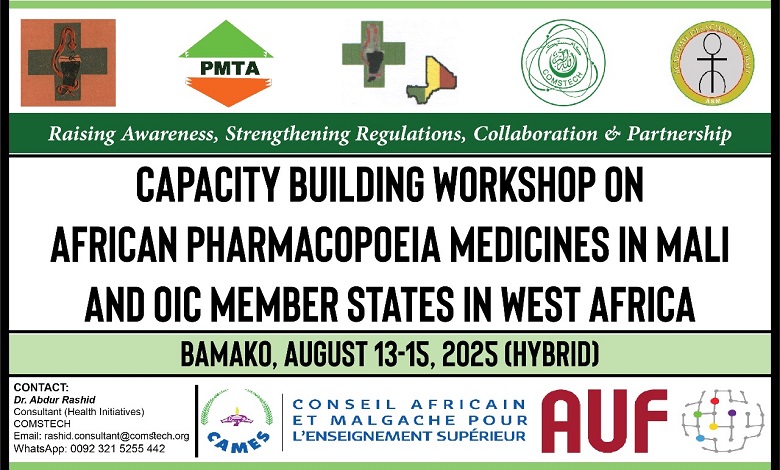
  • VISIT OF SENEGALESE PHARMACEUTICAL REGULATORY AGENCY (ARP) OF W.H.O PREQUALIFIED DRUG TESTING LABORATORIES IN PUNJAB, PAKISTAN

  • Capacity Building on Machine Learning and Genome Data Analysis for Infectious Diseases

    Background

    Advances in machine learning and genome data analysis are transforming the way infectious diseases are detected, monitored, and studied. To support researchers and young scientists in OIC Member States, OIC-COMSTECH is organizing a specialized training workshop to enhance skills in computational approaches for infectious disease research and public health applications.

    Objectives

    • Strengthen participants’ knowledge of machine learning applications in life sciences.
    • Build capacity in genome data analysis and bioinformatics tools.
    • Enhance understanding of data-driven approaches for infectious disease surveillance and research.
    • Promote scientific collaboration and knowledge exchange among researchers.

    Target Audience

    Researchers, university faculty, postgraduate students, laboratory scientists, bioinformaticians, and professionals working in genomics, computational biology, public health, and infectious disease research.

    Event Details

    Format: In-Person Training Workshop

    Guinea: 22-23 June 2026
    Department of Biochemistry and Cell Biology, Faculty of Science and Technology (FAST), University of Abomey-Calavi, Benin

    Benin: 25-26 June 2026
    IRBAG, Conakry, Guinea

    The workshop will be facilitated by leading experts from Pakistan with extensive experience in machine learning, bioinformatics, genomics, and infectious disease research.

    For more information:

    Dr. Gautier Roko (Senior Program Manager, OIC-COMSTECH),  gautier.roko@comstech.org

Back to top button