Past Events

  • OIC-COMSTECH and Ningbo University Certificate Course On Applied Biomedical AI

     “Unlocking the Future of Healthcare & Life Sciences with Artificial Intelligence”

    Guest Speaker
    Prof. Dr. Yuzong Chen
    Deputy Director, State Key Lab of Chemical Oncogenomic
    Ningbo University, China

    Technical Facilitator/ Speaker
    Prof. Dr. Wang Likun
    Ningbo University, China

    Organized by:

    Science, Technology and Innovation Center (STIC), COMSTECH

    Workshop Details:

    This certified course is designed for senior researchers, clinicians, data scientists, and academic faculty from the fields of Biotechnology, Bioinformatics, Computer Science, Pharmacy, and Life Sciences who are eager to integrate AI into biomedical applications. The program aims to equip participants with practical skills and hands-on experience in applying Artificial Intelligence to solve real-world challenges in healthcare and biomedical research especially in resource-constrained settings. Attendees will also gain insights into establishing and sustaining AI-driven biomedical research initiatives within their institutions.

    Learning Objectives:

    By the end of this course, the participants will:

    • Understand the foundational principles and practical applications of AI in biomedicine and healthcare.
    • Apply AI tools and techniques in data analysis, diagnostics, and research within resource-constrained environments.
    • Identify their own training needs to enhance AI integration in biomedical and clinical research.
    • Outline key requirements for establishing AI-powered biomedical research or clinical research centers in their institutions.

    Target Audience:

    • Senior Healthcare Professionals and Researchers
    • Faculty Members and Academic Leaders in Life Sciences, Computer Science, and Biomedical Fields
    • Healthcare Administrators and Policy Makers
    • Government Officials involved in S&T, Health, and Education sectors
    • Data Scientists and AI Enthusiasts working in biomedical research

    Course Module:

    Lecture No.TitleTopics Covered
    1AI OverviewWhat is AI? How does AI work? Machine learning vs. deep learning, history of AI
    2AI and Big Data in BiomedicineAI and big data in language, image, audio, biomedicine; biomedical databases
    3Supervised Machine Learning Methods – Part 1Simple supervised ML methods, k-nearest neighbor, Bayesian classifiers
    4Supervised Machine Learning Methods – Part 2SVM, decision trees, random forest, performance measurement, training with small datasets
    5Unsupervised Machine Learning MethodsDistance/similarity measures, hierarchical clustering, K-means, fuzzy C-means
    6Machine Learning Regression MethodsLinear/polynomial regression, PCA, PLS, logistic regression, ridge, LASSO
    7Biomedical Machine LearningApplications of ML in biomedical fields
    8Data Dimensionality Reduction, Feature Selection & Biomedical ApplicationsPCA, t-SNE, UMAP, visualization, feature selection methods, biomedical applications
    9Deep Learning CNN ModelsBasics of Convolutional Neural Networks (CNNs)
    10Deep Learning Biomedical CNN ModelsCNNs applied to biomedical data and diagnostics
    11Word Embedding and Bio molecular EncodingWord embedding techniques, biomolecule encoding (DNA, RNA, protein), chemical and food encoding
    12Recurrent Neural Network (RNN) and ApplicationsRNN basics, LSTM, RNN vs. LSTM, applications in sequence data
    13TransformerAttention mechanisms, introduction to Transformer architecture
    14Pharmaceutical Deep Learning ModelsDrug discovery, deep learning in pharmaceutical applications
    15Spectroscopic Deep Learning in Biochemistry & BiomedicineSpectroscopy techniques, DL models for spectroscopic data
    16Metabolomic ML and DLMetabolomics, ML and DL applications in metabolomics
    17Microbial Genomics & Metagenomic Deep LearningMicrobial genomics, metagenomics, deep learning applications
    18Herbal AITraditional medicine, herbal databases
    19Food Machine Learning and Deep LearningFood tech, databases, ML and DL in food science
    • Date: 23rd – 31st July-2025
      Session 2: 11th August – 15th August 2025 (Excluding 14th August 2025; Public holiday in Pakistan)
      Session 3: 18th – 22nd August 2025
      Session 4: 25th – 27th August 2025
    • Timing: 1:30PM (Pakistan Standard Time)
    • Procedure to join: In-Person- Online
    • Address: COMSTECH Secretariat, 33-Constitution Avenue, G-5/2, Islamabad 
      Phone No. : 92 51 9220681-3
      Email:  comstech@comstech.org
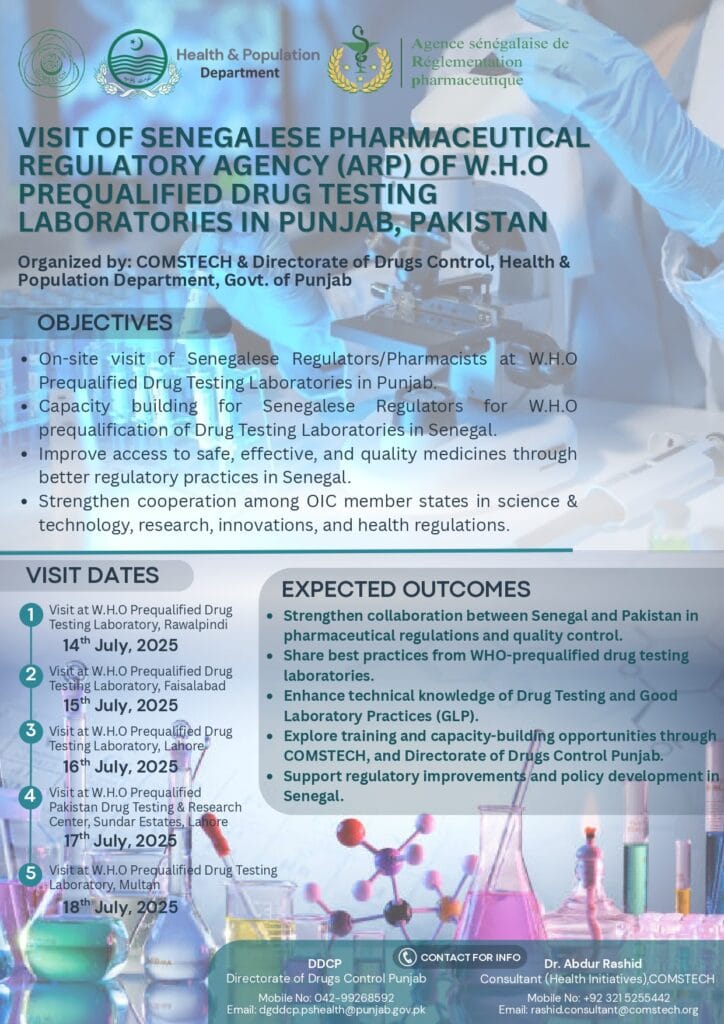
  • VISIT OF SENEGALESE PHARMACEUTICAL REGULATORY AGENCY (ARP) OF W.H.O PREQUALIFIED DRUG TESTING LABORATORIES IN PUNJAB, PAKISTAN

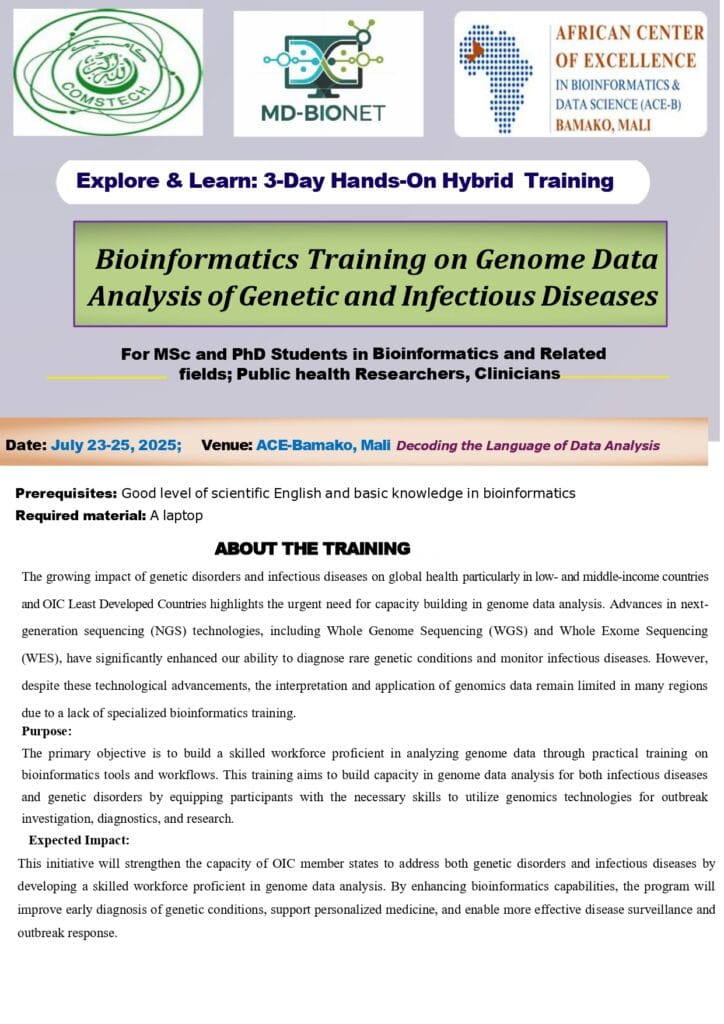
  • Bioinformatics Training on Genome Data Analysis of Genetic and Infectious Diseases

    Date: July 23-25, 2025
    Venue: ACE-Bamako, Mali

    Registration Link: Click Here

  • COMSTECH Regional Workshop: Information and Awareness on Opportunities Offered by COMSTECH and the Role of Emerging Technologies in Strengthening the Resilience of Ecosystems and Communities in Africa.

    Date : From June 16 to 18, 2025

    Venue : Institute of Food Technology (ITA), Hann Maristes – Dakar, Senegal

    Flyer: Click Here

    1. Context

    In 1981, the OIC (Organization of Islamic Cooperation) decided to establish COMSTECH (Standing Committee on Scientific and Technological Cooperation), with the primary mission of promoting scientific and technological cooperation among OIc member states. This dynamic cooperation aims to create critical masses of human resources in science and technology to better address social demands in all their diversity and complexity, thereby fostering inclusive and sustainable socio-economic and industrial development. It also involves ensuring scientific and technological vigilance to adopt global advancements while respecting ethical, bioethical, and biosecurity rules.

    To achieve its objectives, COMSTECH has implemented numerous projects and programs, including:

    • Training, particularly for youth and women, through the provision of scholarships in cutting-edge scientific research and emerging technologies,
    • Developing complementary and interdisciplinary collective skills in priority areas identified by member countries,
    • Facilitating researcher mobility to leverage the comparative advantages of host countries,
    • Enhancing the scientific research and technological innovation capacities of member countries.

    The regional center AGRHYMET, a specialized institution of CILSS (Permanent Inter-State Committee for Drought Control in the Sahel), is mandated to inform and train countries in areas such as food security, natural resource management, combating desertification and climate change, water management, and market access. AGRHYMET CCR-AOS maintains a regional database with over 50 years of climate and impact data. As part of its environmental monitoring, AGRHYMET CCR-AOS has documented, in an updated ATLAS every five years, the evolution of West African landscapes from 1975 to 2023, providing a detailed description of changes in land use classes. AGRHYMET CCR-AOS also hosts graduate programs at the Master’s, engineering, and technical levels.

    The Senegal Directorate of Environment, under the Ministry of the Environment and Ecological Transition, is responsible for implementing state policies on environmental and forest resource management; developing rules for environmental protection and pollution, natural risk, and disaster prevention; ensuring compliance with international environmental conventions and national environmental laws; and integrating environmental concerns into sectoral policies and national development strategies.

    Thus, to inform and raise awareness about the opportunities available to member countries and to facilitate expert discussions on the role of emerging technologies in strengthening ecosystem and community resilience, COMSTECH is organizing this workshop in partnership with AGRHYMET and the Senegal Directorate of Environment with the technical support of Senegal Institute for Agricultural Research and Ecological Monitoring Center.

    This workshop aligns with the “One Health” principle, an integrated and inclusive approach to improving the health of populations, animals, and ecosystems sustainably.

    Recent data estimates that over 700 million people suffer from hunger worldwide, including nearly 170 million in sub-Saharan Africa (UN, 2023). To achieve SDG 2 “Zero Hunger” by 2030, the main challenges for agriculture include: (i) producing enough to feed a growing population, (ii) ensuring food safety, and (iii) reducing the environmental impact of agriculture while remaining competitive. To address these challenges, farmers need increasingly predictive tools for monitoring, treatment, and production, such as the Internet of Things (IoT) and Artificial Intelligence (AI).

    Beyond production-boosting technologies, others like blockchain ensure traceability and transparency throughout the food supply chain by securely recording data on the origin, quality, safety, and sustainability of agricultural products. This technology can enhance consumer trust, combat food fraud, and improve food recall management in case of contamination.

    Globally, pastoralism, a traditional extensive livestock system, is practiced by over 200 million herders (FAO, 2018), playing a significant socio-economic and environmental role. To enhance pastoral system performance, digital tools are increasingly used for herd management, animal health, and marketing. Digital technologies in pastoralism can:

    • Revitalize herding professions by developing devices tailored to pastoral practices,
    • Generate new references through sensors and data collection tools,
    • Foster knowledge exchange among pastoral stakeholders via collaborative platforms.

    With the advent of Artificial Intelligence (AI), it is easier to identify animals, interpret behaviors, and monitor livestock health using remote surveillance and decision-support systems. Additionally, drones and machine learning enable precise pasture monitoring, improving productivity and sustainability.

    Human activities are responsible for the deforestation of 10 million hectares annually (FAO, 2020), with agriculture alone accounting for 73% of forest degradation. Restoring and conserving forest and agroforestry ecosystems requires advanced technologies. Combining AI and Earth observation technologies (satellite imagery, ground sensors, etc.) can enhance forest monitoring and management. AI, IoT, and drones can:

    • Rapidly and accurately analyze vast areas for diagnostics,
    • Provide cost-effective and regular monitoring,
    • Predict and reduce environmental risks,
    • Create digital twins for ecosystem restoration projects, simulating forest growth and tracking ecological indicators like canopy height, carbon storage, and biodiversity.

    The COMSTECH workshop will enable the Ministry of Environment to learn about COMSTECH’s training programs, particularly those on innovative environmental monitoring technologies. The tools shared during the workshop will serve as awareness-raising resources for field agents.

    Given COMSTECH’s ambitions to leverage science and technological innovation for inclusive and sustainable growth in the Islamic world, and the opportunities offered by emerging technologies, this workshop will serve as a platform for high-level expert exchanges.

    2. Objectives

    The workshop has two main objectives:

    • Widely disseminate the mechanisms established by COMSTECH to promote science and technological innovation in OIC member countries,
    • Review the state-of-the-art emerging technologies used or applicable in ecosystem preservation strategies in Africa, particularly West Africa.

    3. Deliverables

    • Review all training and researcher mobility opportunities, especially for youth and women,
    • Propose solutions to better address youth training needs in COMSTECH programs,
    • Share country experiences on emerging technologies for ecosystem protection,
    • List constraints related to accessing and disseminating advanced technologies,
    • Formulate concrete proposals to address challenges hindering the adoption and scaling of advanced technologies for ecosystem protection,
    • Establish an expert network to better target priority areas for COMSTECH programs.

    4. Workshop Format

    The workshop will be facilitated by an expert moderating the sessions. The first part will focus on COMSTECH’s training and scholarship programs. The second part will showcase country experiences in using emerging technologies to strengthen ecosystem resilience to climate change. The third part will discuss mechanisms to expand and amplify COMSTECH programs in West Africa.

    5. Participating Countries

    In addition to the host country,  West African countries will be represented by high-level expert.

    Contacts :

     Dr. Ismaila Diallo, Regional Advisor for OIC-Africa
    ismaila.d@comstech.org

    Ms. Tayyaba Awan, Sr. Consultant (Partnerships and Cooperation)
    tayyaba.awan@comstech.org

    Mr. Renaud Makaka, Sr. Technical Manager, COMSTECH
    renaudmakaka@comstech.org

  • Emerging Technologies and the Structural Transformation of the Economy in Africa: Contributions from Researchers and Startups.

     CONCEPT NOTE SCIENTIFIC WORKSHOP

     1ST EDITION: 30 june – 02 July 2025
    Republic of Cameroon

    Flyer: Click Here

    1. Background and justification

    Through its National Development Strategy (NDS30), Cameroon aspires to become an emerging country by 2035. The integration of emerging technologies within this vision represents a strategic lever to accelerate the country’s socio-economic development and enhance its competitiveness on the international stage. Recognizing this, and the important role that development partners can play, Intellium Global Perspective Group, a national incubator dedicated to strengthening human capital across Africa and offering strategic support to international organizations, is co-organizing a scientific workshop in partnership with OIC-COMSTECH to advance the role of emerging technologies and research  in fostering youth and women’s entrepreneurship, as well as in enhancing scientific and technological cooperation.

    COMSTECH (the OIC Ministerial Standing Committee on Scientific and Technological Cooperation), based in Islamabad, Pakistan, was established during the third Islamic Summit held in Mecca in January 1981. Its main mandate is to strengthen cooperation among OIC Member States in the fields of Science, Technology, and Innovation (STI), build capacities through training in emerging fields, implement OIC resolutions, and propose programs aimed at boosting scientific and technological competencies in member countries. The ultimate goal is to foster a scientific culture and use STI as a driver for socio-economic development and industrialization.

    Scheduled for June 30 –  July 02, 2025, this scientific workshop is part of an ambitious dynamic: to drive Cameroon’s technological transformation, implement the OIC STI Agenda 2026, and strengthen innovation and scientific research ecosystems. The choice of Cameroon as the host country is particularly relevant. As “Africa in miniature”, Cameroon has a robust academic ecosystem, including eight public universities and numerous research centers. Moreover, the NDS30 places innovation and technology at the heart of its transformational vision.

    This initiative marks a turning point in South-South scientific cooperation. On the one hand, it allows COMSTECH to strengthen its role as an innovation facilitator, demonstrating its concrete commitment to technological development in its member countries. On the other hand, it creates a replicable model for other countries while bringing STEM researchers together around shared goals. Through capacity building and synergy creation, the workshop paves the way for enhanced collaboration among research laboratories and promotes sustainable university-industry partnerships.

    The outlook is promising for both researchers and Cameroon as a whole. Researchers benefit from privileged access to international networks and funding opportunities, while the country strengthens its position as a sub-regional tech hub. Moreover, this scientific workshop aligns perfectly with the objectives of the NDS30. By accelerating digital transformation and strengthening national technological capacities, it directly contributes to the emergence of innovative industries in Cameroon.

    Therefore, to ensure the sustainability of outcomes, Intellium Global Perspective and COMSTECH plan to establish a comprehensive follow-up mechanism. This will include the creation of a continuous collaboration platform and a post-workshop mentorship program to ensure continuity of the projects initiated.

    This represents a strategic opportunity to durably transform Cameroon’s research and innovation ecosystem. By catalyzing the convergence of academic research, technological innovation, and economic development, the workshop lays the groundwork for a profound transformation of Cameroon’s scientific landscape. Through this holistic approach, Intellium Global Perspective aims to provide a unique local platform to rethink R&D through the lens of DeepTech. This innovative approach opens new avenues for scientific research valorization and propels Cameroon toward sustainable and inclusive technological development.

    2. General Objective of the Workshop

    The workshop aims to leverage the opportunities offered by OIC-COMSTECH, create a platform for dialogue and reflection on the strategic integration of emerging technologies in the implementation of Cameroon’s NDS30, while strengthening the capacity of local actors in the adoption and application of these technologies.

    3. Specific Objectives

    Specifically, the workshop seeks to:

    • Analyze Cameroon’s current technological ecosystem and identify opportunities for integrating emerging technologies into the priority sectors of NDS30.
    • Map out COMSTECH programs aligned with national priorities.
    • Deploy a mobility program for Cameroonian and sub-regional researchers and  startups for short-term training in COMSTECH Centers of Excellence (CCoE).
    • Build the capacities of stakeholders in R&D (researchers, policymakers, entrepreneurs) on emerging technologies and their transformative potential.
    • Facilitate knowledge transfer and experience sharing between international experts and local actors around DeepTech.
    • Develop concrete recommendations for a technological roadmap aligned with NDS30.

    4. Intervention Logic

    The workshop will include 2 plenary sessions, 2 panel discussions, 2 masterclasses, 2 workshops, and 1 project pitch session. Below is a proposed program structure:

    Tentative Program :

    HOURSACTIVITIES ON JUNE 30, 2025RESPONSABLEMETHODS
    08H00 – 09H00Welcome of participantsINTELLIUMRegistration on the list
    09H00 – 09H50OPENING CEREMONY   Welcome by : Minister/ President Intellium Global Perspective   Opening remarks : OIC-COMSTECH  
    09H50-10H00Group photo
    10H00 – 10H30Presentation of COMSTECH and its opportunities/programmesCOMSTECH RepresentativePowerpoint
    10H30 – 11H00COFFEE & NETWORK BREAK
    11H00 – 12H00Digital sovereignty and endogenous technological development: the role of universities and StartupsMODERATOR MINESUPPlenary session
    12H00 – 13H00Central Africa: National technological capabilities and international competitivenessMODERATOR MINRESIPANEL DISCUSSION
    13H00 – 14H00LUNCH BREAK
    14H00 – 14H30Emerging DeepTech ecosystems: African models and global perspectives.EXPERT INTELLIUMMASTER CLASS
    14H30 – 16H30Training and retaining STEM talent: how to boost South-South collaboration?COMSTECHWorkshop
    HOURSACTIVITIES ON JULY 1st , 2025RESPONSABLEMETHODS
    08H00 – 09H00Welcome of participantsINTELLIUMRegistration on the list
    09H00 – 10H00Emerging technologies as a catalyst for Cameroon’s National Development Strategy (SND30)MODERATOR COMSTECHPLENARY SESSION
    10H00 – 10H30COFFEE  BREAK
    10H30 – 11H30Intellectual property and the protection of DeepTech innovations in universities and research centersMODERATOR COMSTECHPLENARY SESSION
    11H30 – 13H00University-industry partnerships in the knowledge economy.INTELLIUMWORKSHOP
    13H00 – 14H00LUNCH BREAK
    14H00 – 14H30Venture capital and financing technological innovation in AfricaEXPERT BA / VC / PEMASTER CLASS
    14H30 – 15H30PROJECT PITCHINTELLIUMWORKSHOP
    15H30 – 16H30AWARDS AND CLOSING CEREMONY
    HOURSACTIVITIES ON JULY 2nde , 2025RESPONSABLEMETHODS
    09H00 – 13H00-Working Session/Meeting with Ministry of Scientific Research and Innovation & Officials    INTELLIUMWorking session/meeting  
    14H00-15H00-Working Session/Meeting with Ministry of Agriculture  INTELLIUMWorking Session/Meeting
    END

    5. Target audience for the scientific workshop

    In the current context, this scientific workshop will bring together:

    • Researchers from the Ministry of Higher Education (MINESUP) and the Ministry of Scientific Research and Innovation (MINRESI), with priority given to heads of laboratories, department heads, and engineers;
    • Any researcher capable of leading a technology-oriented project, regardless of academic rank;
    • Postgraduate research students;
    • Startup founders;
    • Company executives: General Managers, COOs, CTOs, CFOs, HR Directors, etc.

    6. Expected outcomes

    a. In-depth understanding

    • Enhanced understanding of the challenges and opportunities related to emerging technologies, and the opportunities offered by COMSTECH;
    • Clear identification of technological priorities for the NDS30;
    • Mapping of stakeholders and available resources.

    b. Capacity building

    • Improved skills in emerging technologies;
    • Acquisition of methodologies for transforming research into enterprises;
    • Development of professional networks.

    c. Tangible deliverables

    • A detailed report outlining the current state and key recommendations;
    • A list of specific programs for Cameroon and the sub-region that COMSTECH could support.
    • A roadmap for the integration of emerging technologies;
    • A portfolio of potential DeepTech projects;
    • A post-workshop action plan for follow-up and continuity.

    7. Institutional partners

    Depending on time and protocol, the workshop may be held under the High Patronage of the Ministry of Scientific Research and Innovation (MINRESI). Other government ministries may collaborate with MINRESI depending on their mandate—such as the Ministry of Higher Education (MINESUP), the Ministry of Posts and Telecommunications (MINPOSTEL), the Ministry of Decentralization and Local Development (MINDEVEL), the Ministry of Economy, Planning and Regional Development (MINEPAT), the Ministry of Agriculture and Rural Development (MINADER), etc.—as well as local chambers of commerce, chambers of agriculture, and active foundations.

    • LIST OF POTENTIAL SPEAKERS
    FULL NAMEPOSITIONINSTITUTION
     Pr Jean-Paul MBIA MANGAConseiller TechniqueMINESUP
     Pr Isidore BIKOKOPresidentINTELLIUM
     Pr MAMA FOUPOUAGNIGNIPresidentAIMS CAMEROUN
     Dr Patrice ELE ABIAMA Permanent secretary.National Committee for Technological Development (CNDT)
     Dr Fabrice ABUNDE Deeptech ExpertSCINO 360
     Dr Thierry MINDJOSHead Of B2B Marketing/Senior Manager MTN CAMEROON
     Dr Paulin MELATAGIA YONTAExpert IAUniversity of Yaoundé 1
     Paul MBUAInvestment & IT ExpertZixtech Hub
     Mr. Sylvevère BOUSSAMBADirectorOgooue Labs Gabon
  • Workshop on Scientific and Technological Cooperation between CENAREST and COMSTECH

    OIC-COMSTECH in Central Africa

    Date: June 23-27, 2025
    Venue: Hibiscus Hotel, Libreville, Gabon

    Flyer: Click Here

    1. Context

    OIC-COMSTECH, the Standing Ministerial Committee on Scientific and Technological Cooperation of the Organization of Islamic Cooperation (OIC), based in Islamabad, Pakistan, was created during the third Islamic Summit held in Mecca in January 1981. Its main mandate is to strengthen cooperation among OIC member states in the fields of Science, Technology, and Innovation (ST&I), to develop their capacities through training in emerging fields, to implement the resolutions of the OIC, and to propose programs aimed at increasing the scientific and technological competencies of member countries. The ultimate goal is to promote a scientific culture and to use ST&I as a driver of socio-economic development and industrialization.

    Gabon, a country rich in natural resources and biodiversity, seeks to strengthen its scientific and technological development in order to address sustainable development challenges, particularly in the sectors of forestry, biodiversity conservation, agriculture, industry, renewable energy, and health. International scientific cooperation is a strategic lever for the country, enabling it to strengthen its capacities in research, innovation, technology, and natural resource management. However, despite the progress made, several challenges remain, such as the lack of funding for research projects, the low integration of Gabonese researchers into international scientific networks, and the insufficiency of sustainable partnerships between local and international institutions.

    In this context, a workshop co-organized by CENAREST (National Center for Scientific and Technological Research of Gabon) in collaboration with COMSTECH aims to strengthen Scientific Cooperation between Gabon and others  OIC member states. This workshop will aim to raise awareness among Gabonese researchers about the opportunities offered by COMSTECH, to identify priority research areas, to promote the creation of sustainable partnerships, and to sign a collaboration agreement to launch the joint scientific project.

    2. General Objective

    The general objective of this workshop is to promote scientific cooperation between Gabon and others OIC countries by facilitating access to opportunities offered by COMSTECH and supporting sustainable partnerships in priority research areas.

    3. Specific Objectives

    1. To inform and raise awareness among Gabonese researchers about funding possibilities and opportunities for scientific collaboration offered by COMSTECH.
    2. To identify and prioritize research areas that require technical and financial support from COMSTECH, and that have significant potential for scientific and technological development in Gabon.
    3. To encourage and facilitate the creation of sustainable partnerships between Gabonese institutions and other research centers in OIC member countries, in the identified priority areas of scientific and technological research.
    4. To select and prepare a first cohort of Gabonese researchers to participate in short-term scientific mobility programs, as part of targeted research projects, within the COMSTECH network.
    5. To sign a collaboration agreement between CENAREST and COMSTECH as a basis for launching collaborative scientific projects in Gabon.

    4. Expected  Results

    1. Information and awareness of Gabonese researchers on funding, mobility, and scientific collaboration opportunities offered by COMSTECH.
    2. Identification and prioritization of research areas requiring technical and financial support and presenting strong potential for Gabon’s scientific and technological development.
    3. Establishment of sustainable partnerships between Gabonese research institutions and centers of excellence in OIC member countries, around priority scientific themes.
    4. Selection and preparation of a first cohort of Gabonese researchers to participate in short-term scientific mobility programs, as part of targeted research projects, within the COMSTECH network.
    5. Signing of a framework cooperation MoU between CENAREST and COMSTECH, formalizing the launch of collaborative projects and establishing the basis for enhanced scientific collaboration.

    5. Target Audience

    This workshop is aimed at:

    • Gabonese researchers and scientists from universities and research institutes
    • Leaders of research institutions, including CENAREST
    • Representatives from Gabonese administrations involved in scientific, technological, and development research
    • Civil society organizations and national and international NGOs engaged in development

    Technical and financial partners

    • Companies and partner organizations in the scientific and technological innovation sector

    6. Methodology, Duration and Venue of the Workshop

    The workshop will be structured into several interactive sessions and presentations, including lectures, roundtables, practical workshops, and case studies. The main methods to be used are:

    • Plenary sessions for presentations and discussions on funding and scientific collaboration opportunities
    • Practical workshops to identify priority research areas and develop collaborative project proposals
    • Roundtables for exchanging on partnerships and research project management
    • Initiating the selection of a first cohort of Gabonese researchers for short-term scientific mobility within the COMSTECH network
    • Signing of MoU between CENAREST and COMSTECH for the launch of collaborative projects

    7. Monitoring and Evaluation

    A detailed report will be drafted at the end of the workshop, with an evaluation of the discussions and decisions made. An action plan will be established to monitor the implementation of scientific partnerships and collaborative research projects initiated during the workshop.

    Contacts :

    Mr. Renaud Blanchard MAKAKA, COMSTECH
    Email : renaudmakaka@comstech.org

    Professor Christian MIKOLO YOBO , CENAREST
    Email: christian-mikolo@cenarest-gabon.org

  • Bioinformatics Training on Genome Data Analysis of Genetic and Infectious Diseases

    Date: 28th – 30th July 2025, 3 days
    Venue: University of Nouakchott, Mauritania

    Flyer: Click Here

    Introduction

    We are pleasd to announce a specialized training program on Genomics for Infectious Diseases and Genetic Disorders, designed to equip researchers, clinicians, and public health professionals with essential skills in genomic data analysis. The course will focus on practical applications of Whole Genome and Exome Sequencing (WGS/WES), offering hands-on experience with bioinformatics tools used in identifying disease-causing genetic variants and tracking infectious disease outbreaks.

    This program is designed to bridge the knowledge gap in genomic data interpretation, especially in resource-limited settings. By strengthening local capacity in genomic analysis, the training will empower participants to apply advanced genomic technologies in real-world clinical diagnostics, research, and public health strategies. This program is especially valuable for researchers, clinicians, and public health professionals in resource-limited settings seeking to harness the power of genomics in their work.

    Mode of Delivery:

    On-site hands-on workshop through lectures, tutorials, and guided exercises.

    Objectives:

    • To introduce participants to the fundamentals of NGS technologies and their application in genetic disorder diagnostics and Infectious Diseases.
    • To train participants in bioinformatics pipelines for data preprocessing, alignment, variant calling, and annotation
    • To strengthen capacity in computational tools for genomic surveillance and outbreak tracking.
    • To build expertise in filtering and prioritizing disease-causing variants
    • To enhance the use of public databases and interpretation tools specific to diseases
    • To present case studies highlighting the impact of genomics in diagnosing conditions
    • To foster collaboration and knowledge-sharing among researchers in genomics and public health.
    • To promote the integration of genomic data into national health strategies and disease control programs.

    Expected Outcomes:

    • Participants will gain hands-on skills in WES/WGS data analysis for genetic and infectious diseases.
    • Improved capacity to support clinical diagnostics and research using bioinformatics tools.
    • Enhanced understanding of variant classification and phenotype-genotype correlations.
    • Creation of a regional network of trained professionals in disease genomics.
    • Strengthened ability to conduct local genomic surveillance and respond to outbreaks.

    Eligibility Criteria:

    This TRAINING program is open to candidates who meet the following criteria:

    • Age: Below 35 years.
    • Education: 16 years or above
    • Applicants must be from an OIC Member Country
    • Proficiency in English, Arabic or French is essential.
    • Commitment: Willingness to commit to a 3days training program at Nouakchott, Mauritania
    • Field: Genomic Innovations in Virology and Infectious Disease Engineering

    Focus Areas:

    The training program will concentrate on policy issues, research, and capacity-building activities related to the following priority areas:

    • Genomics for Infectious Disease Surveillance and Control
    • Rare Genetic Disorders and Precision Diagnostics
    • Next-Generation Sequencing (NGS) and Bioinformatics Tools
    • Data Management, Sharing, and Genomic Infrastructure
    • Maternal, Neonatal, and Pediatric Genomic Health

    Registration Link: Click Here

    Biographies of the trainers:
    Dr. Waseem Haider
    Dr. Zaira Rehman

    Application Deadline: 30th– 06-2025

    Contact Info:

    For any query, please contact on the below given Email address or Landline number

    Address: COMSTECH Secretariat, 33-Constitution Avenue, G-5/2, Islamabad
    Phone No: 92 51 9220681-3
    Fax: 92 51 9211115, 9220265, 9205264
    Email: Khazima@comstech.org; comstech@comstech.org;

  • Tapping into the Full Potential of the Stratosphere

    Date: Monday, June 23, 2025
    Time: 15:00-16:00 Pakistan Standard Time (PKT)

    Flyer: Click Here

    Introduction:

    High-Altitude Platform Stations (HAPS) are emerging as a key complement to LEO satellite mega-constellations, offering a scalable solution for global connectivity and bridging digital divides where terrestrial and satellite networks fall short. Operating from the stratosphere, HAPS leverage advanced beamforming and free-space optics (FSO) to deliver high-capacity and low-latency communications across diverse geographical areas. This talk explores the technological connectivity advancements driving HAPS by highlighting how intelligent beam management and optical feeder and inter-HAPS links can democratize broadband access and provide also unique solutions for disaster recovery, paving the way for a more connected world.

    Speaker Profile:

    Mohamed-Slim Alouini, was born in Tunis, Tunisia. He earned his Ph.D. from the California Institute of Technology (Caltech) in 1998 before serving as a faculty member at the University of Minnesota and later at Texas A&M University at Qatar. In 2009, he became a founding faculty member at King Abdullah University of Science and Technology (KAUST), where he currently is the Al-Khawarizmi Distinguished Professor of Electrical and Computer Engineering and the holder of the UNESCO Chair on Education to Connect the Unconnected. Dr. Alouini is a Fellow of the IEEE, OPTICA, and SPIE, and his research interests encompass a wide array of research topics in wireless and satellite communications. He is currently particularly focusing on addressing the technical challenges associated with information and communication technologies (ICT) in underserved regions and is committed to bridging the digital divide by tackling issues related to the uneven distribution, access to, and utilization of ICT in rural, low-income, disaster-prone, and hard-to-reach areas.

    Who can attend?

    Telecommunications professionals, satellite and aerospace industry stakeholders, policy makers and regulators, academics and researchers, business leaders and entrepreneurs can attend this webinar to explore advancements in global connectivity technologies.

    How to register

    For registration, please fill the following form: Click Here

    Zoom Link will be shared with the participants 1-2 days before the webinar.

    Webinar Coordinator:

    M. Haseeb Ahmad
    Program Officer
    Workshops@comstech.org

  • Seminar: Water Crises and the Indus Waters Treaty

    Date: June 4, 2025
    Venue: COMSTECH Auditorium, Islamabad

    Organized by: OIC-COMSTECH, in collaboration with: Karachi Council on Foreign Relations, Hisaar Foundation, and Panjwani-Hisaar Water Institute

    Strategic Dialogue at a Critical Time

    Amid escalating tensions following India’s unilateral suspension of the Indus Waters Treaty (IWT), this high-level seminar will critically assess Pakistan’s strategic, legal, and diplomatic options.

    Bringing together experts in hydrology, international law, environmental science, and regional geopolitics, the seminar will explore:

    🔹 The implications of the IWT suspension on Pakistan’s water security
    🔹 Scientific realities of Indus River hydrology and regional geography
    🔹 Diplomatic and adaptive responses rooted in evidence and resilience


    Key Message

    Despite political rhetoric, the science is clear: India cannot simply “turn off” Pakistan’s water. The Indus River’s flow is sustained by a vast, complex system of tributaries and glacier melts—far beyond the reach of any single actor. Dam-building in the unstable, high-altitude upper Indus is neither feasible nor sustainable.

    Pakistan must counter fear with facts—and assert its rights as a lower riparian state through international legal mechanisms and coordinated diplomacy.


    📍 Join us for this timely and urgent conversation on securing Pakistan’s water future.

    For further information please contact mtofil@comstech.org

    Join Zoom Meeting
    https://zoom.us/j/96230276253?pwd=fK5FjzFfxbiLnPLc5a3ufOm0FHCdtl.1
    Meeting ID: 962 3027 6253
    Passcode: 891257

  • COMSTECH Webinar on Recent trends and applications of metabolomics in food analysis, authentication, process monitoring and gut interactions

    By Prof. Dr. Mohamed Farag
    Faculty of Pharmacy, Cairo University, Egypt
    Editor In Chief Journal of Advanced Research, efoods

    12th June, 2025 (12:30 PM, Pakistan Standard Time)

    Abstract: 

    Metabolic Profiling and Metabolomics are unique tools in modern system biology that have been employed for fingerprinting and studying the overall chemical makeup of food products. Different analytical approaches are followed in non-targeted metabolomics (while targeted metabolomics is similar to classical analytics). These include “metabolic profiling” with an emphasis on classes of metabolites versus “metabolic fingerprinting” that refers to analysis of the total set of metabolites without knowledge of any components, avoiding biases against certain classes of compounds. Both metabolic approaches are used in the search for new biomarkers of quality and authenticity, and, certainly, contribute to the biochemical knowledge of foods and to the molecular understanding of bioactivities or changes in food-production processes. Detecting food components on a molecular level offers valuable insights into the complex relationships between its bioactive components and its nutritive and other effects, e.g. organoleptic, toxic, or health promoting properties. Metabolomics also is an indispensable tool to assess the authenticity of food.  It helps to evaluate the molecular changes incurred as a results of food processing. In fact, metabolomics has been exploited to assess different topics involving food safety, food quality, as well as authenticity and traceability. This talk entitled “Recent trends and applications of metabolomics in food analysis, authentication,  process monitoring and gut interactions” shall present on both qualitative and quantitative analytical techniques used to analyze food metabolites at a holistic level in relation to organoleptic, medicinal and nutritive determinants which is extensively reported in literature. Examples presented from Dr. Mohamed Farag research https://www.researchgate.net/profile/Mohamed_Farag6 shall include methodology contribution to metabolomics analysis in food matrix, effects of processing on food metabolome, metabolites and metabolic pathways that affect food flavor, and detection of food adulteration and quality identification.

    Compared to extensive applications of metabolomics in food analysis, its role in assessment of  interactions between the intestinal microbiota and different dietary components and impact on food outcomes is less well reported. In addition, most foods are complex matrices made up of a wide variety of different components such as water, lipids, carbohydrates, proteins, vitamins and bioactive compounds (including flavonoids, phenolic acids, stilbenes, terpenoids, saponins, alkaloids, oligosaccharides, polysaccharides, etc.). Such large structural diversity among phytonutrients confers a myriad of biological actions including the influence of different dietary components on gut homeostasis and or functions.  The role of different dietary components on the regulation of gut microbiota or gut barrier as a mediator of human health using metabolomics shall also be presented using coffee and tea as model functional foods in food gut microbiota interactions based on his recent published work in Journal of Advanced Research and Food Chemistry.

    Target Audience:

    This webinar is open to academicians, scientists, and general public from all the member OIC states and beyond.

    Profile of the Speaker:

    Prof. Farag is a full professor at Cairo University, his home institute where he has established the first natural products metabolomics lab in Africa for applications in foods and functional foods and to publish a prolific number of papers in high quality journals with close to 10,000 citations for a total 360 publications.  Specializing in metabolomics, natural products chemistry, and plant biochemistry, Mohamed A. Farag completed his PhD at Texas Tech University, USA, in 2003. In 2005, after spending time as a postdoctoral fellow at The Samuel Noble Foundation, USA, and the James Graham Brown Cancer Center, USA, he became assistant professor in 2005 at the Faculty of Pharmacy, Cairo University, Egypt. 

    Since 2009, Dr Farag has been working as a part time visiting professor at the Technical University of Munich, Germany, to participate in teaching plant metabolomics and chemomterics modelling for master students, and in 2009–2010 he held the Alexander von Humboldt fellowship at the Leibniz Institute for Plant Biochemistry, Germany.  Dr. Farag now works full time as a professor at the Pharmacognosy Department within the Faculty of Pharmacy, Cairo University where his research work focuses primarily around applying innovative biochemical technologies (metabolomics) to help answer complex biological questions in medicine, herbal drugs analysis and agriculture.    Dr. Farag has also recently developed the first metabolomics platform for volatiles profiling in microbes along with colleagues in Louis Pasteur Institute pertaining bacterial volatiles role in plant protection, infection progression and microbial resistance.

    Dr. Farag has been recognized with several awards, including UNESCO Award in life sciences 2023, Abd el Hameed Shoman award (2016), Egypt Higher State Incentive Award (2012), Cairo University Incentive Award (2009), TWAS award in science diplomacy (2014), and the Mass Spectroscopy Performance Award, TTU, USA (2004).  For his highly cited publications with close to 20,000 citations and an H index of 64 https://scholar.google.com/citations?user=nWjY6yoAAAAJ&hl=en&oi=ao, Dr. Farag was selected as a top researcher in the field of plant biology in Africa by the American society of plant biology, USA.  Dr. Farag is a current TWAS fellow in Agriculture from Egypt.

    Poster of webinar:  Attached

    Register at: Click Here

    Procedure to join:

    Zoom link for participation will be shared selected participants.

    Address: COMSTECH Secretariat, 33-Constitution Avenue, G-5/2, Islamabad 
    Phone No. : 92 51 9220681-3
    Email: Khazima@comstech.org ; comstech@comstech.org

Back to top button