Co-sponsored by COMSTECH

  • Singularity University Islamabad Chapter Holds First Event on Technology for the Greater Good 16th Mar, 2018


    Jerome C. Glenn, a renowned futurist co-founder, CEO of the Millennium Project described how humans and technology are increasingly merging to eventually become a Conscious-Technology Civilization. The quality of the merger would be determined by how well the mystic and technocrat can synergize, in his opinion. He was speaking as the keynote speaker at the event organized by the Islamabad Chapter of the Singularity University at the COMSTECH auditorium.

    Other speakers of the event included Dr. Shaukat Hameed Khan (Coordinator General COMSTECH), Senator Musadiq Malik (Advisor to PM), Mr. Yusuf Hussain (CEO, Ignite), Ms. Puruesh Chaudhary (CEO, Agahi Foundation), Dr. Shahid Mehmud (Member, Singularity University Islamabad Chapter).

    Singularity University Islamabad Chapter organized the first of its quarterly series’ events hosted by COMSTECH Secretariat and supported by IGNITE (National Technology Fund) in Islamabad. The event brought together enthusiasts, business leaders, academicians, policymakers, media, civil society, and students. The first event broadly concentrated on Technology for the Greater Good of Society.


    “COMSTECH is attempting to embed a culture of the ‘thinking mind’ among OIC academics who will drive change and transformation in an age of prosperity for all, a congruence between technical capabilities, social capital and attitudes,” says Dr. Shaukat Hameed Khan, Coordinator General of COMSTECH, Islamabad.

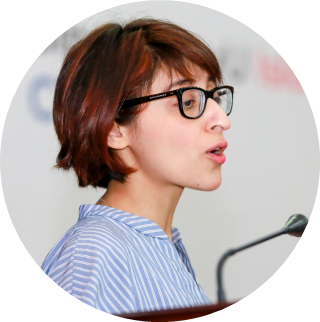
    Puruesh Chaudhary a Futurist and an SU Alumni, in her founding remarks explained the Chapter’s focus on the human purpose driving the next wave of technologies in the 4th Industrial Revolution. SU focuses on positively impacting the world’s greatest challenges through the use of exponential technologies – those which are rapidly accelerating and shaping major industries and all aspects of our lives including, artificial intelligence (AI), augmented and virtual reality (AR/VR), data science, digital biology, medicine, nanotech and digital fabrication, networks and computing systems, robotics, and fintech.
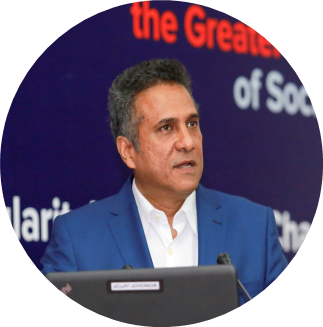
    Mr. Yusuf Hussain, CEO IGNITE emphasized on humane values, and remarked that “Humane values must be consciously and proactively built into the innovation value chain
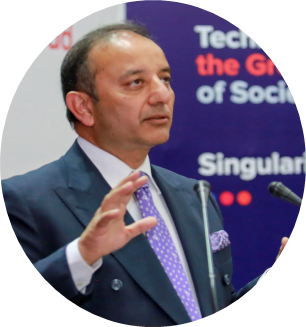
    Senator Musadiq Malik (Advisor to the Prime Minister) was of the opinion that prosperity is connected with innovation, creativity and human ingenuity. He further explained that “It appears from raw data that innovation may not be causing prosperity but certainly innovation has something to do with prosperity”. So while not claiming any causal relation he pointed out the correlation between the two.

    Dr. Shahid Mehmud (Member of SingulariyU Leadership Team) talked about the issues that humans have already started facing because of depleted resources and increasing population. In his opinion, “humanity’s new war is how do we sustain the 9 billion population in the next 24 years, and that is where Singularity University is playing its role”.

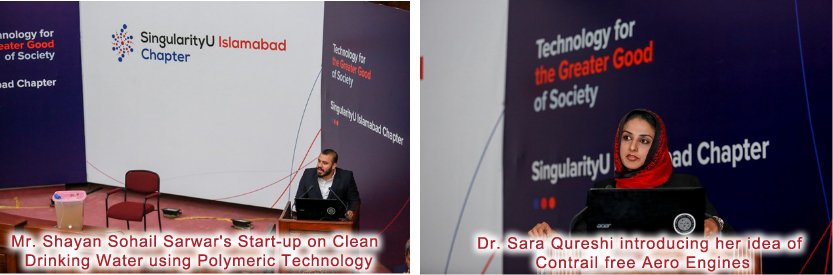
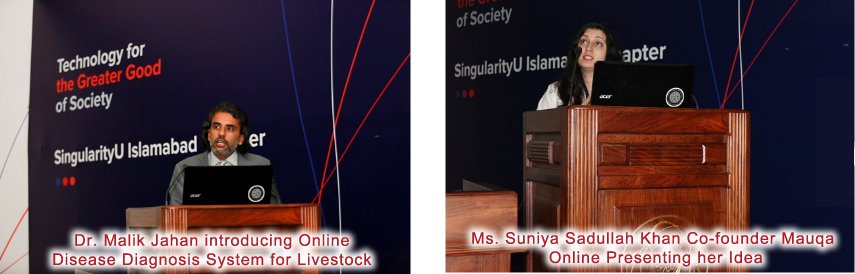
    This event served as a platform not only for tech enthusiasts, but also for the start-ups which are working to further the cause of prosperity and wellbeing for society. Four startups actively engaged with such innovations briefly introduced their ideas to the audience. These were, a) Clean drinking water using polymeric technology by Mr. Shayan Sohail Sarwar, b) Online Disease Diagnosis System for Livestock introduced by Dr. Malik Jahan, c) Contrail free Aero Engines (which will help in reducing global warming and inducing artificial rain during flight) by Dr. Sara Qureshi, and  d) An Online tool named Mauqa Online which connects uneducated and unskilled workers with nearby work opportunities, developed by Ms. Suniya Sadullah Khan.
    The Singularity University Islamabad chapter will be encouraging startups and projects along the following verticals, among others: Agriculture, Energy, Health, Education, and Finance. It will do this by focusing on social impact which should have tangible business outcomes for each targeting policymakers, media, entrepreneurs, regulators, corporates, and professionals.

    each targeting policymakers, media, entrepreneurs, regulators, corporates, and professionals.

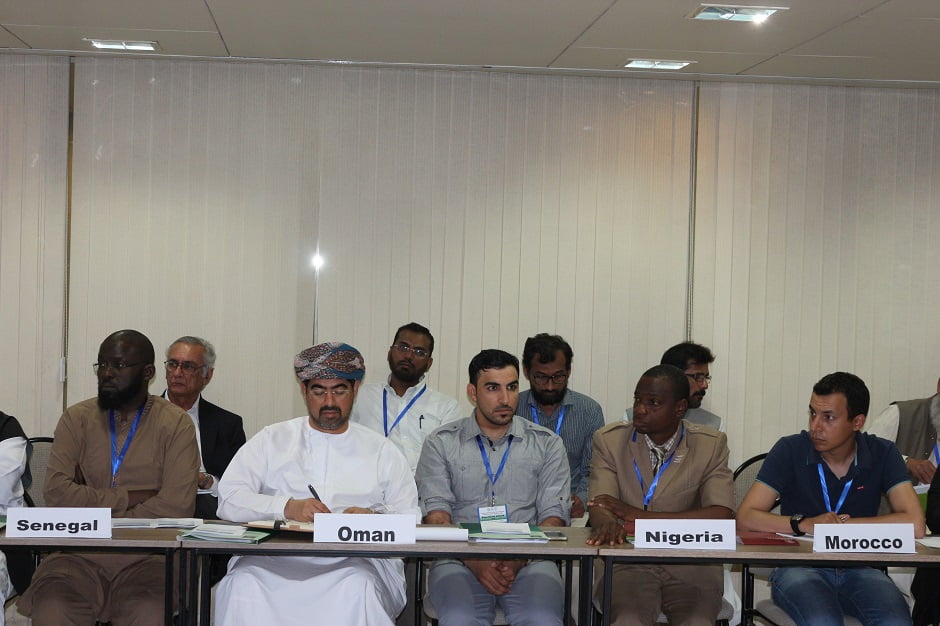
  • COMSTECH-PARC-ECOSF Workshop on Plant Genetic Resources and Genebank Operations Management System, held at COMSTECH Secretariat, Islamabad May 8-11, 2018

    The first OIC Summit on science, technology and innovation (STI) held at Astana, Kazakhstan, 10-11 September 2017 formulated OIC STI Agenda 2026 and the member states agreed to progress on STI. In the OIC STI Agenda 2026, the Priority # 3 focused Targets on Farm Productivity and Plant Biodiversity stating “Encourage setting up National Genebanks for conservation and exchange of plant genetic resources with research centres in Member States”.

    As an initiative, the first “Workshop on Plant Genetic Resources and Genebank Operations Management System” from May 8-11, 2018 was organized jointly by COMSTECH, Pakistan Agricultural Research Council, Islamabad, and ECO Science Foundation, Islamabad. Mr. Fazal Abbas Maken, Federal Secretary, Ministry of National Food Security & Research (MNFSR), Islamabad graced the event as the Chief Guest.

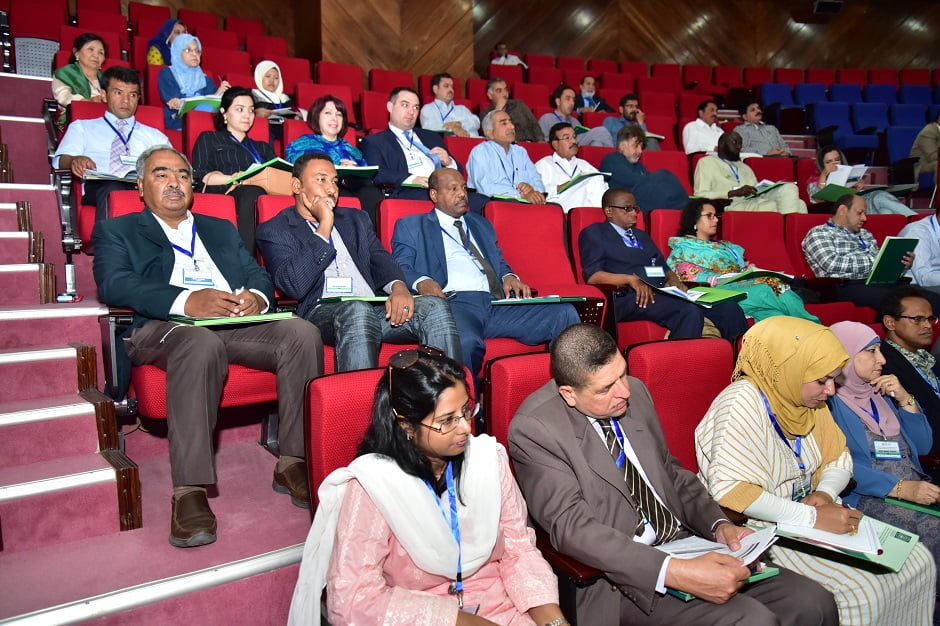
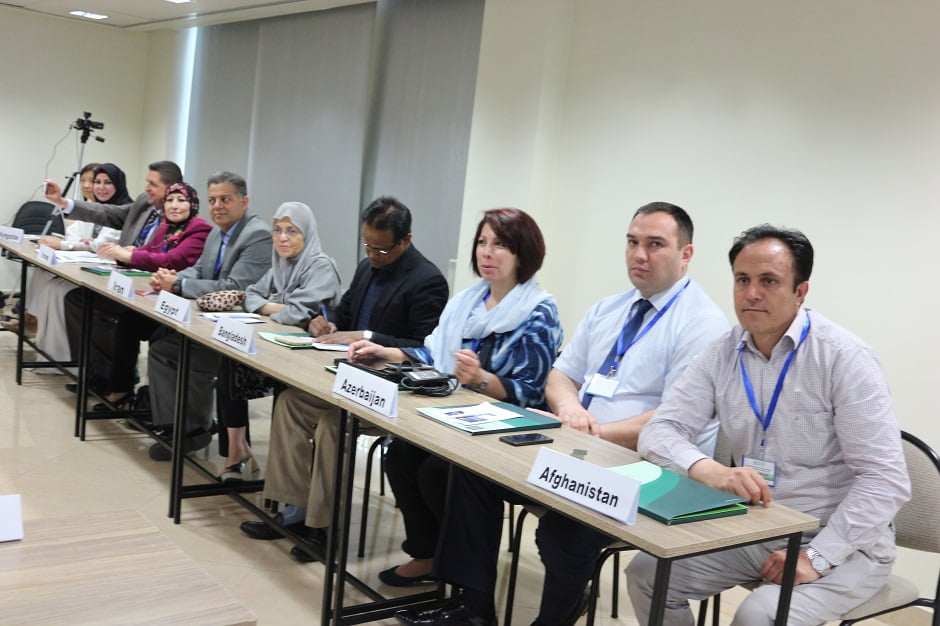
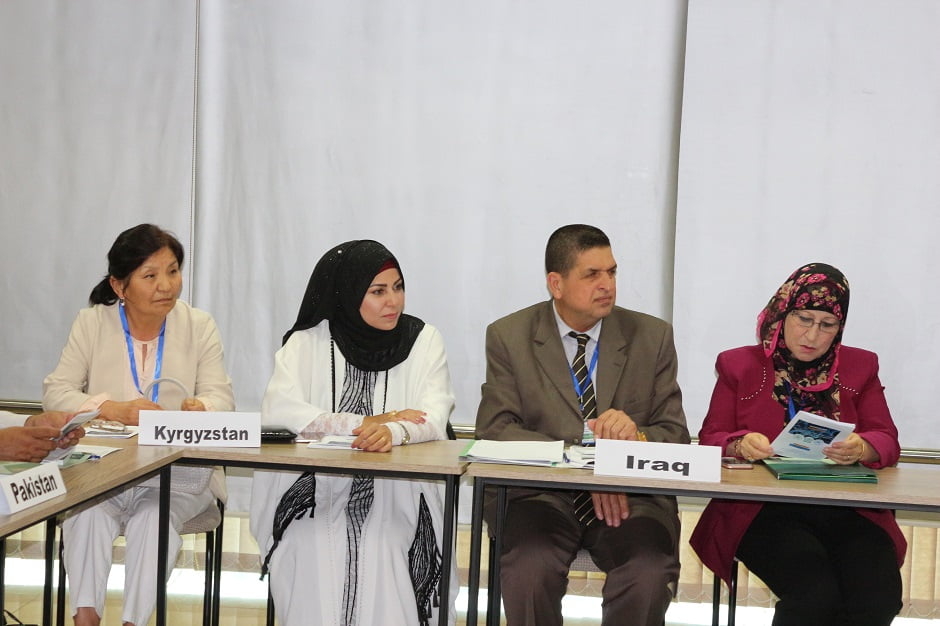
    Twenty-four participants from 15 OIC member states presented their respective country reports on PGR and genebank management systems. Twenty one participants from Pakistan representing the R & D institutes and Academia attended the workshop. Fifteen resource persons (4 from abroad and 11 from national institutes) discussed specialized topics related to the workshop themes.

    The workshop not only provided an opportunity to participants and resource persons to take stock of the situation of plant genetic resources and Genebank management systems in the respective countries but also enabled them to learn from each other experiences. It provided a platform to the member states representatives to interact on key issues be faced in the area of PGRFA, while creating awareness about aligning the in-vogue systems in accordance with international good practices.

    During the workshop proceedings, it was emphasized that due to human interventions as well as climate change threats the plant genetic resources conservation encounters challenge of deprivation and losses. This situation demands that pragmatic strategies and actions should be undertaken. The participants agreed on the need for implementation of conservation and efficient exploitation of available plant genetic resources for the development of new crop varieties. It was recommended that adoption of pragmatic strategies and enhanced interaction would be required for addressing the issues related to the plight of plant genetic resources in OIC and ECO member states.

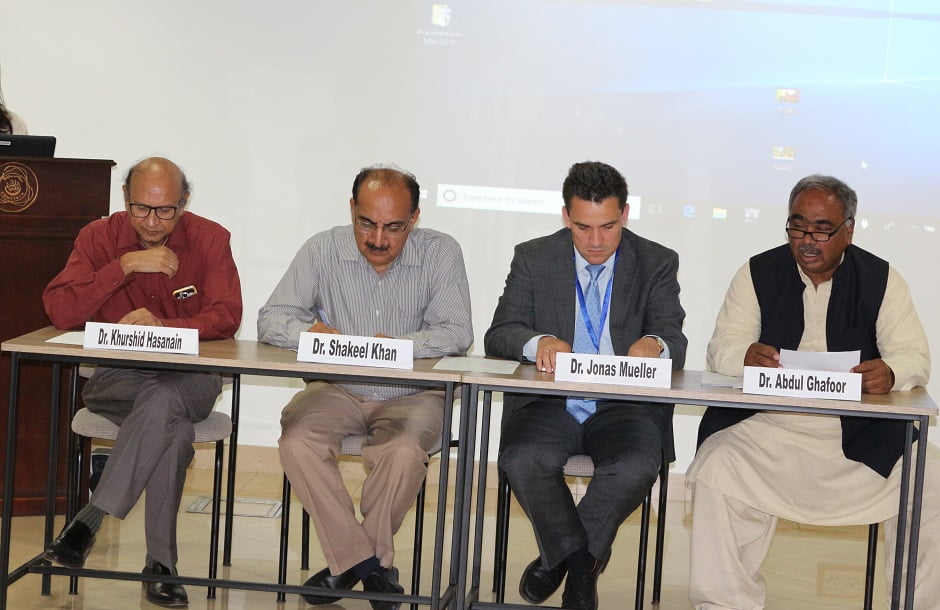
    The workshop participants had thorough discussions in the concluding session that was mediated by Dr. Jonas Mueller, Royal Botanic Gardens, Kew, UK; Dr. Abdul Ghafoor, Director BCI, NARC; Dr. Khurshid Hasanain, Senior Expert, COMSTECH and Dr. Shakeel Khan, Seed Sector Consultant, FAO Representative Office, Islamabad.  After detailed consultation, the participants agreed unanimously to the following points:

    1. Strengthening of germplasm collection, evaluation and sharing of information through networking, corresponding to the challenges of food security, particularly in the era of climate change.
    2. Promoting technical cooperation between Member states for Genebank establishment/management. COMSTECH may play a leading role in enabling this cooperation and availability of resources.
    3. Promoting evaluation and utilization of plant genetic resources for varietal development, and the integration of their seed system in the member states.
    4. Providing opportunities of Degree Programs for Postgraduate students from countries with lesser developed research programs so as to benefit from the expertise and resources of more developed Member States. Similarly, providing opportunities for exchange of researchers in PGR among OIC member states.
    5. It was proposed that COMSTECH may arrange a Workshop on Medicinal and Aromatics plants. The participants from Oman, Malaysia and Egypt agreed to contact their respective governments for hosting of this activity.
    6. It was proposed by participants from Kazakhstan that COMSTECH may organize an activity on GMO and Biosafety in one of the Central Asian states.

    It was proposed by COMSTECH that there should be a focal person to follow up on the above recommendations and to act as link between the PGR community and COMSTECH. Dr. Abdul Ghafoor, Director, Bio-resources Conservation Institute (BCI), National Agricultural Research Centre (NARC), Islamabad was unanimously agreed to as the focal person for PGR and Genebank management between OIC member states and COMSTECH for implementation of the recommendations of the workshop.

  • HIGHLIGHTS OF THE WORKSHOP “Options for an Energy Mix: Issues of Cost and Sustainability” from 26-28 June 2018

    The core mandate of COMSTECH is to strengthen cooperation among OIC Member States in science and technology (S&T), and to enhance their capabilities through training in emerging areas. As part of the capacity building program, COMSTECH organized a three day International Workshop on “Options for an Energy Mix: Issues of Cost and Sustainability” from 26-28 June 2018.   Former Planning Commission deputy Chief Sartaj Aziz was invited as a chief guest. He said that the country is in a power crisis because it lacks cost-efficient energy production options. He traced the origins of Pakistan’s energy crisis to a policy of encouraging independent power producers (IPPs) after 1994. He said that these IPPs operated on expensive imported furnace oil. “The cost of power generation went up to 16 cents per unit, while the Water and Power Development Authority (WAPDA) was selling electricity at 8-9 cents. The huge subsidy that was payable to the IPPs could not be paid in time leading to a huge circular debt and long hours of load-shedding,”   COMSTECH Coordinator General Dr Shaukat Hameed Khan presented a comprehensive and broad-ranging review of the global energy transition, highlighting the initiatives to decrease reliance on conventional sources of power by including various renewable sources as part of the energy mix. He also doused hopes of renewable energy advocates by identifying various real and hidden costs of different renewable technologies and observed that a complete reliance on renewable energy did not appear as a technical or economic possibility in the near future. “Fossil fuels are not going away anywhere soon and there is no single solution to combat the effects of climate change,” Dr Shaukat said.   Resource persons and participants from Malaysia, Turkey, Australia, Germany, Nigeria, Uganda, Bangladesh and China contributed in the workshop and shared their practices in the field of Renewable Energy (RE) technologies.    Dr. Kamaruzzaman Sopian from Solar Energy Research Institute (UKM), Malaysia shared his research on solar cell efficiencies and the silicon solar value chain. He also emphasized on the manufacturing process of solar cells to be more environment friendly as the conventional process uses toxic materials. He also shared how Malaysia has made reforms to promote Renewable Energy and increase the share of RE in the national grid for carbon neutral power generation in future. It was evident from his presentation, how the share of RE was increasing in their energy mix.   Dr. Abdülkadir BALIKÇI from Marmara Energy Institute, Tubitak, Turkey shared the list of R&D projects that have been executed under his institute. Marmara Energy Institute is engaged in R&D for developing technologies in fields of biofuels, solar heating/cooling, wind turbine manufacturing, materials for solar PV, and energy storage devices. Many pilot scale projects are operational and in next phase, they aim to deploy commercial scale plants. He shared that his institute is also engaged in developing solutions for the Renewable Energy Industry in Turkey, and closely working with manufacturers, EPC contractors and construction companies.   Mr. Peter Rae, President, World Wind Energy Association (WWEA) shared the global trends in the wind power industry. He emphasised on regional collaborations and development of new technologies for cost competiveness of Renewable Energy technologies. He added, the comparison of levelized cost at present shows that, RE technologies will lead power generation for green and cheap electricity. He acknowledged the work of wind power industry in Pakistan and announced that the next annual conference of WWEA will be held in Pakistan by the end of this year.    Ms. Umarah Mubeen, Max Planck Institute, Germany shared her research work in the field of Bio Fuels. She presented the comparison of different algae based biofuels that can be used for power generation and transport fuel.   Mr. Kenneth Muhwezi, Managing Director, Solar Today Uganda Ltd shared the community based success stories of small solar home systems in Uganda. He explained the business model of community based systems which is the most popular and practical solution for remote areas. Pay As You Go (PAYG) model is practically implemented across more than 20 African countries.   Mr. Khondokar Habibul Kabir from Islamic University of Technology, Bangladesh talked about the solar home system industry in Bangladesh. According to the stats, Bangladesh ranked first in terms of installations of small solar home systems in OIC member countries. Bangladesh alone installed more than 5.2 million solar home systems last year 2017.   Mr. Zhang Zhenhua, Chairman, CNNC, China, talked about the modular type nuclear reactors. He added, apart from power generation such small scale nuclear reactors can also be used for water desalination, industrial process steam etc. Local speakers also participated in the workshop from different organizations including Ministry of Climate Change, AEDB, SECMC, HDIP, Descon Engineering, NEECA, GCISC, Planning Commission, PAEC, PNRA, NEPRA, NUST Energy Centre, UNIDO, Nizam Energy, AKRSP, and NRSP. They shared the best practices and suggested the way forward for promotion of RE technologies.    Students from NUST Energy Centre presented their MS thesis posters to showcase the advanced research being carried out at NUST. Their posters mainly focused on energy storage, fuel cells, integrated energy modelling, green buildings, biogas etc.   More than 80 local participants from Universities, R&D organizations, Industry and Energy companies attended the workshop.  Summarizing the workshop explored the issues of cost and sustainability of various energy options, and experts from energy & environment industry shared their experience and knowledge with energy professionals and academics of OIC countries. The workshop focused on the analysis of different RE technologies, institutional policy and frameworks, and levelized costs of various RE technologies. The main suggestions to emerge from the workshop were:   • to have a sustainable energy mix • to develop strategies for integration of RE Technologies • to develop a greener and sustainable transition to combat climate change

  • INTERNATIONAL WORKSHOP ON RENEWABLE ENERGY: AFFORDABLE & CLEAN ENERGY FOR ALL 29 – 31 July 2019, Malaysia

    COMSTECH and Solar Energy Research Institute (SERI) UKM, Malaysia jointly organized a 3-day workshop, from 29 to 31 July 2019 to explore the issues and to share experiences and knowledge on renewable energy between energy professionals and academics of OIC countries.

    The workshop gathered energy scientists, experts and young scholars from several OIC Member States. The workshop continued for 3 days and experts gave insights into new technological advancements, R&D and commercialization of renewable energy technologies.

    The workshop was organized for capacity building in the light of the core mandate of COMSTECH to strengthen cooperation among OIC Member States in science and technology (S&T) and to enhance their capabilities through training in emerging areas.

    The resource persons talked about following topics:

    • Solar PV Technologies & Development
    • Solar Thermal Technologies & Development
    • Biomass Energy – Frontier Technologies
    • Smart & Micro Grids
    • Pico, Micro Hydro Power Plants
    • Low Energy Architecture and Thermal Comfort
    • Renewable Energy Installations, Policies, Pricing & Employability: An OIC Perspective
    • Fuel Cell & Hydrogen Energy Systems
    • Wind Energy Technologies
    • Marine Power Generation
    • The Future of Energy Storage Systems
    • Environmental & Economic Impacts of Solar PV Systems

    On the final day, all the participants were given hands on training on HOMER Software. The HOMER Pro software is the global standard for optimizing micro-grid design, from village power and island utilities to grid-connected systems. It uses three powerful tools in one software, so that engineering and economics work side by side. The session was very interactive and all the participants learned the basics of using all the tools and dynamics of the software.

    Resource persons and participants from Nigeria, Somalia, Sudan, Jordan, Turkey, Saudi Arabia, Iran, Iraq, Bangladesh, Indonesia, Malaysia and Pakistan, contributed to the workshop and shared their research and practices in the field of Renewable Energy (RE) technologies. A total of 38 participants from OIC Member Countries participated in the workshop other than Malaysia.

    Students and researchers from different universities of Malaysia also presented their posters to showcase the advanced research being carried out in the field of renewable energy technologies. Their posters mainly focused on energy storage, fuel cells, integrated energy modelling, green buildings, etc.

    On the concluding day, all the participants were taken to the SERI labs to showcase the research being carried out at their institute. SERI is already having many collaborative research projects with other energy institutes in OIC Member States.

    Summarizing, the workshop explored the advanced research in renewable technologies, issues of cost and sustainability of various energy options, and challenges in the adoption of new technologies. The workshop focused on the analysis of different RE technologies, institutional policy and frameworks, and levelized costs of various RE technologies. The main suggestions to emerge from the workshop were:

    • to develop strategies for integration of RE Technologies
    • to have a sustainable energy mix
    • to design support policies that promote the integration of green technologies
    • to facilitate researchers from Member States for collaborations and funding opportunities
    • to facilitate Member States in enhancing their institutional capacity building
    • to develop a greener and sustainable transition to combat climate change

    As a sideline activity, a brainstorming session on establishment of OIC Energy Working Group was conducted. Suggestions were invited from different stakeholders so as to formally establish the OIC Energy working group, in the third phase of this series of Energy workshops being organized by COMSTECH

Back to top button