
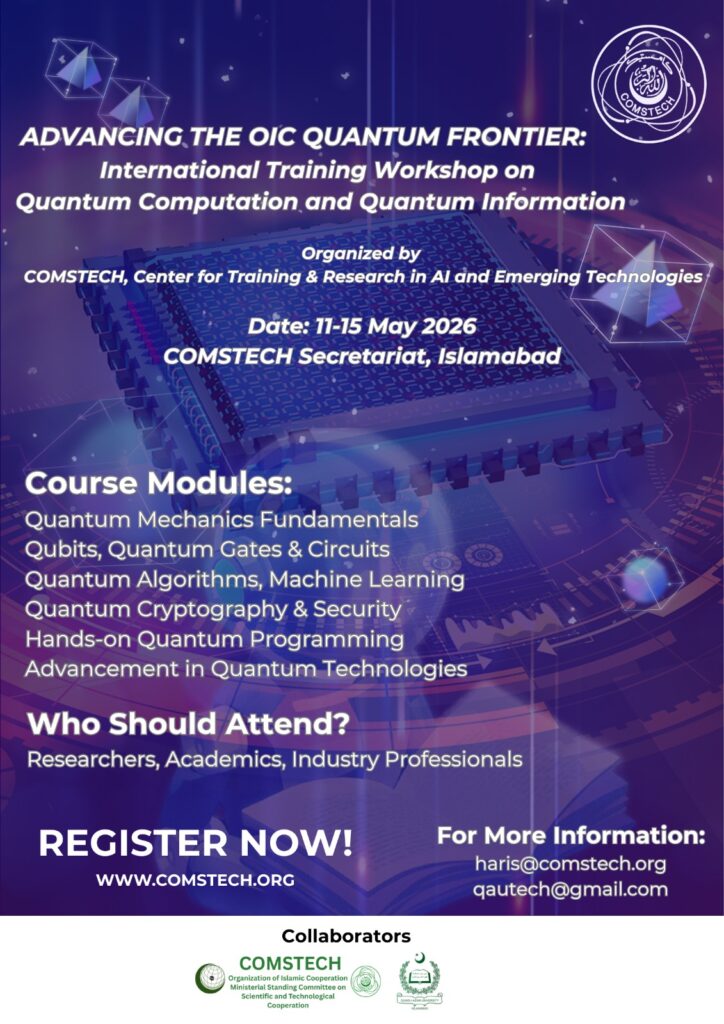
Advancing the OIC Quantum Frontiers: International Training Workshop on Quantum Computation and Quantum Information
Organized under COMSTECH Center for Training & Research in AI & Emerging Technologies
11-15 May, 2026
COMSTECH Secretariat, Islamabad
Flyer in Arabic: Click Here
Flyer in French: Click Here
Introduction:
Quantum computation and Quantum Information are rapidly emerging as a transformative technology with the potential to revolutionize fields such as quantum chemistry, data communication, cryptography, artificial intelligence, and medical science. Unlike classical computers, which relies on bits, quantum computers leverage qubits and quantum phenomena such as superposition and entanglement to perform calculations at unprecedented speeds.
Despite its promise, quantum computation and quantum information remain in its early stages of adoption, with limited awareness and technical capacity in many parts of the world. Building human capital and research capacity is critical to ensure that developing countries are not left behind in this new technological era.
The proposed Training Workshop on Quantum Computation & Quantum Information aims to build foundational knowledge, practical skills, and collaborative networks among researchers, students, and professionals in science, technology, engineering, and mathematics (STEM) fields.
Objectives:
The training workshop aims to:
- Introduce participants to the fundamentals of quantum mechanics underlying quantum computation and quantum information.
- Provide practical training on quantum algorithms, programming languages, and available quantum computing platforms.
- Explore real-world applications of quantum computing across different industries.
- Foster collaboration among participants, researchers, and industry experts.
- Inspire young scientists and innovators to engage in quantum research and development.
Target Audience:
- Graduate and postgraduate students in computer science, electronics, mathematics, physics, and engineering with basic understanding of Quantum Mechanics.
- University faculty and researchers working in the relevant fields.
- ICT professionals, data scientists, and innovators interested in emerging technologies.
- Policy stakeholders exploring quantum computation and quantum information applications in national strategies.
Duration & Format
Duration: 5 days
Format:
- Plenary seminars and training lectures by experts in quantum computation and quantum information.
- Hands-on training with quantum programming environments.
- Panel discussions with industry leaders on future opportunities and challenges.
Key Contents:
Key Thematic Areas:
- Quantum Mechanics Fundamentals
- Qubits, Quantum Gates & Circuits
- Quantum Algorithms, Quantum Machine Learning
- Quantum Cryptography & Quantum Security
- Hands-on Quantum Programming
- Future Applications & Challenges
Day 1: Introduction & Fundamentals
- Opening session & keynote address.
- Basics of quantum mechanics relevant to quantum computation and quantum information
- Introduction to qubits, superposition, and entanglement
Day 2: Foundation Concepts and Applications
- Qubits, Quantum Logic Gates & Circuits
- Quantum algorithms
- Practical session: programming
Day 3: Foundation Concepts and Applications
- Cryptography and cybersecurity
- Optimization in finance, logistics, and supply chains
- AI and machine learning applications
- Quantum parallelism and no-cloning
Day 4: Advanced Topics & Future Outlook
- Quantum hardware (superconducting qubits, ion traps, photonics)
- Error correction and scalability challenges
- Panel: “Building a Quantum Ecosystem in Developing Countries”
Day 5: Advanced topics and closing
- Group projects: solving real-world problems using quantum computing platforms
- Advanced Quantum Technologies
- Closing session & certificates
Expected Outcomes
- Enhanced knowledge and skills in quantum computation and quantum information.
- Increased awareness of practical applications of quantum computation and quantum information.
- Establishment of a local/regional network of quantum researchers and students.
- Recommendations for integrating quantum computing into academic curricula and research agendas.
Registration Process:
For Participation, please register at:
For Physical Participation: Click here
For Virtual Participation: Click here
Selected candidates will be notified through email; hence, applicants are required to check their emails.
Collaborators:
Technology Development Center, Quaid-i-Azam University, Islamabad, Pakistan