- COMSTECH Report (II) on Science Publications of OIC Member States

- Introduction to Science Profile (II)
- Countries in Part (II)
Uncategorized
COMSTECH Report (II)
COMSTECH Report (I)
- COMSTECH Report (I) on Science Publications of OIC Member States
- Introduction to Science Profile
- Countries
The 24th Islamic World Academy of Sciences Conference
On
“Challenges to Promote Science & Technology for
Socio-Economic Development in OIC Countries.”The Islamic World Academy of Sciences (IAS) is non-political, non-profit-making, independent, autonomous and self-governing institution that was established by the COMSTECH Under the high patronage of His Excellency the President of Pakistan, and H.R.H Prince El-Hassan bin Talal of Hashemite Kingdom of Jordan. It is considered a ‘Brain Trust’ comprised of the leading scientists and the most renowned thinkers of the OIC region that are designated as elected Fellows of the IAS. The Fellows regularly gather in one of the member states of the OIC and brainstorm the current problems and challenges confronting the Islamic World. The gathering suggests solutions for a rapid and coherent socio-economic development by means of the modern science and technology.
IAS convened its annual conference this year in Karachi, Pakistan. It was Twenty-fourth conference of the Islamic World Academy of Sciences’ that was devoted to the topic “Challenges to Promote Science & Technology for Socio-Economic Development in OIC Countries”. Held at the International Center for Chemical and Biological Sciences (ICCBS) (H.E.J. Research Institute of Chemistry and Dr. Panjwani Center for Molecular Medicine and Drug Research), University of Karachi, during 7-8 March 2023. It was sponsored jointly by the OIC Ministerial Standing Committee on Scientific and Technological Cooperation (COMSTECH), ICCBS, and the Higher Council for Science and Technology (HCST), Amman, Hashemite Kingdom of Jordan. The partner institutions that played an organizational and executive role included the Pakistan Academy of Sciences (PAS), Dr. Panjwani Memorial Trust, the Husein Ebrahim Jamal (HEJ) Foundation and the Government of Sindh.
Around 150 local and international participants attended the conference from 20 countries. Among the participants were Fellows of the IAS and local scientists from various universities and institutions. The Twenty-fourth Conference adopted the following declaration at the end of the conference:
The 24th Islamic World Academy of Sciences Conference
on
“Challenges to Promote Science & Technology for Socio-Economic Development in OIC Countries.”
Conference Declaration
Adopted at Karachi, Pakistan
On Wednesday, 7-8 March, 2023The Islamic World Academy of Sciences (IAS), the International Center for Chemical and Biological Sciences (ICCBS), the Ministerial Standing Committee on Scientific and Technological Cooperation of the OIC (COMSTECH), and the Higher Council for Science and Technology (HCST) extend their appreciation and gratitude to His Excellency the President of Pakistan for his high patronage of the conference and to His Royal Highness Prince El Hassan bin Talal, the Founding patron of IAS.
- Whereas, seeking knowledge is upheld in Islam.
- Whereas, knowledge is derived from research observation and development on our planet sphere, geosphere, biosphere and ecosphere and cybersphere.
- Whereas, the delivery of R&D in science, technology and innovation (STI) ecosystem is used for promotion of socio-economic development.
- Whereas, OIC member states recognized education, science and technology as a vehicle for socio–economic transformation in 2020, reconfirmed in 2021 OIC summit conference.
- Whereas, OIC countries and humanity in general are facing global, natural and man-made disasters; i. e., earthquakes, floods, hurricanes, droughts, climate change, pollution of (drinking water, oceans, land and biosphere) resulting in loss of biodiversity, disrupting food chain supply, energy deficiency, poor health and hence increase in poverty.
We the Fellows of the IAS and participants in the IAS 24th conference entitled “Challenges to Promote Science & Technology for Socio-Economic Development in OIC Countries.” Held in Karachi on 7-8 March 2023 in partnership with ICCBS;
- Call on OIC member states for the inclusion of enquiry-based education to enhance creativity, curiosity and problem solving for building-capacity in STI and enriching human resources.
- Call on OIC member states to formulate and implement National Innovation Policies in order to promote entrepreneurship targeted at manufacture and export of high technology goods.
- Call on OIC member states to identify centers of excellence for the IAS network STIs leading to regional R&D delivery or commons scientific application, innovation and leading to socio-economic development and digital transformation.
- Bridge the academia and industry for joint R&D leading to socio-economic development.
- Create social and technology parks and incubators to commercialize the delivery of research and innovations into start-up SMEs and enhance diversification of new materials and quality control.
- Create a consortium for a sustainable triangle of energy-water-food security linked to IAS platform to network reputable research centers in OIC countries for self-reliance and meeting the SDGs, and call on COMSTECH to increase their mobility grants to scientists from LDCs to centers of excellence for training and research in combating poverty and hunger.
- Strengthen world class research institutions, such as the International Center for Chemical and Biological Sciences, at Karachi University, and use them for human resource development in frontier fields of science and technology in the OIC region.
- Align cooperation and collaboration with private sector on achieving a sustainable triangle of food, water and energy security, for future generations.
- Promote cooperation and collaboration of the private sectors for health security of vaccines and drugs to embark across borders, a joint enterprise of manufacturing vaccines and needed drugs for emerging pandemics in the OIC member states.
- Academia and research centers of OIC member states should encourage interdisciplinary research to deal with “common” problems of the Islamic world, including fields of humanity and social sciences such as climate change, the triangle for sustainability, population, poverty, Medicare etc.
- Urge the OIC member states to invest at least 1% of their GDP in research in science, technology and innovation (STI) for socio-economic development.
- Encourage the OIC member states to provide sustained support to the OIC S&T institutions, such as COMSTECH and IAS so that they can fulfil their assigned mandate.
- Encourage the OIC member states to venture into getting benefits of game changing technologies like nanotechnology. Artificial Intelligence (AI), and other emerging technologies, including radionuclide medical technology leading to the 4th Industrial Revolution.
The role of the scientific heritage of Abu Raykhan Beruni in the development of world science
The Government of the Republic of Uzbekistan is organizing an International Scientific and Practical Conference.
September 2023
Partner Institutions of the AIUA Program
S/N UNIVERSITY COUNTRY 1 The University of Nairobi Kenya 2 Ummah University Kenya 3 Ahman Pategi University, Patigi, Kwara State Nigeria 4 Al Ansar Foundation Nigeria 5 Al Ansar Foundation Nigeria 6 Al-Ansar University, Maiduguri, Borno State, Nigeria Nigeria 7 Al–Istiqama University, Sumaila, Kano State, Nigeria Nigeria 8 Al-Qalam University, Katsina, Katsina State, Nigeria 9 Borno State University, Maiduguri, Borno State, Nigeria Nigeria 10 Federal University Gashua, Nigeria Nigeria 11 Fountain University Osogbo Osun State – Nigeria Nigeria 12 Islamic University in Niger Niger 13 Nasarawa State University Nigeria 14 Sule Lamido University Kafin Hausa, Jigawa State, Nigeria. Nigeria 15 Summit University, Offa, Kwara State Nigeria Nigeria 16 University of Maiduguri, Nigeria Nigeria 17 University of Bosaso, Garowe Somalia 18 University of Somalia (UNISO) Somalia 19 University of The Gambia The Gambia 20 Al-Sumait University Tanzania 21 Zanzibar University Tanzania 22 Muslim University of Morogoro Tanzania 23 Islamic Call University Uganda 24 Islamic University in Uganda Uganda 25 Kampala University Uganda 26 Kampala International University Uganda Partner Institutions of the CFEER Program
1- Sahel Coalition, Brussels, Belgium

2- Songhai Center, Porto-Novo, Benin

3-Permanent Interstate Committee for Drought Control in the
Sahel (CILSS), Ouagadougou, Burkina Faso
4-Xinjiang Institute of Ecology and Geography, Chinese Academy
of Sciences, China
5-UN Environment Programme-International Ecosystem
Management Partnership (UNEP-IEMP), Chinese Academy of
Sciences, Beijing, China
6-l’Institut Tchadien de Recherche Agricole et le Développement
(Chadian Institute of Agricultural Research for Development),
N’Djamena, Chad7-Arid Land Agricultural studies and Research Institute (ALARI),
Faculty of Agriculture, Ain Shams University (ASU), Cairo, Egypt.8-School of Agriculture and Environment Science, University of The
Gambia (UTG), Serekunda, The Gambia
9-United Nations Convention to Combat Desertification (UNCCD),
UNCCD Secretariat, Bonn, Germany
10-Potsdam Institute for Climate Impact Research, Germany

11-CSIR-Crops Research Institute, Ghana
12-Belantara Foundation, Jakarta, Indonesia

13-Royal Scientific Society, Jordan.

14-Islamic Organisation for Food Security (IOFS), Kazakhstan
15-Institut du Sahel (Sahel Institute), Bamako, Mali
16-Centre National de Recherche Agronomique et de
Développement Agricole (National Center for Agricultural
Research and Agricultural Development) (CNRADA), Kaédi,
Mauritania17-Islamic World Educational, Scientific and Cultural Organization
(ICESCO), Rabat, Morocco
18-AGRHYMET Regional Center, Niamey, Niger
19-International Center for Agricultural Research in the Dry Areas
(ICARDA), NARC, Park Road, Islamabad, Pakistan
20-University of Karachi, Pakistan

21-Centre National de Recherches Forrestieres de l’Institut
Senegalese de Recherche Agricole (National Centre for Forestry
Research of the Senegal Institute of Agricultural Research),
Dakar, Senegal
22-Tanzania Industrial Research and Development Organization
(TIRDO), Dar es Salaam, Tanzania
23-Institut du Conseil Agricole du Togo (Agricultural Advisory
Institute of Togo), Lomé, Togo
24-Center for Water Research Technologies, Barj Cedria S&T Park,
Tunisia
25-Agrilenz Ltd, United Kingdom
26-UN Environment Programme

Science and Technology Exchange Program
1- For more information, please visit: https://step.mstfdn.org/
2- For registration, please fill out the form: https://step.mstfdn.org/join/form
(no title)
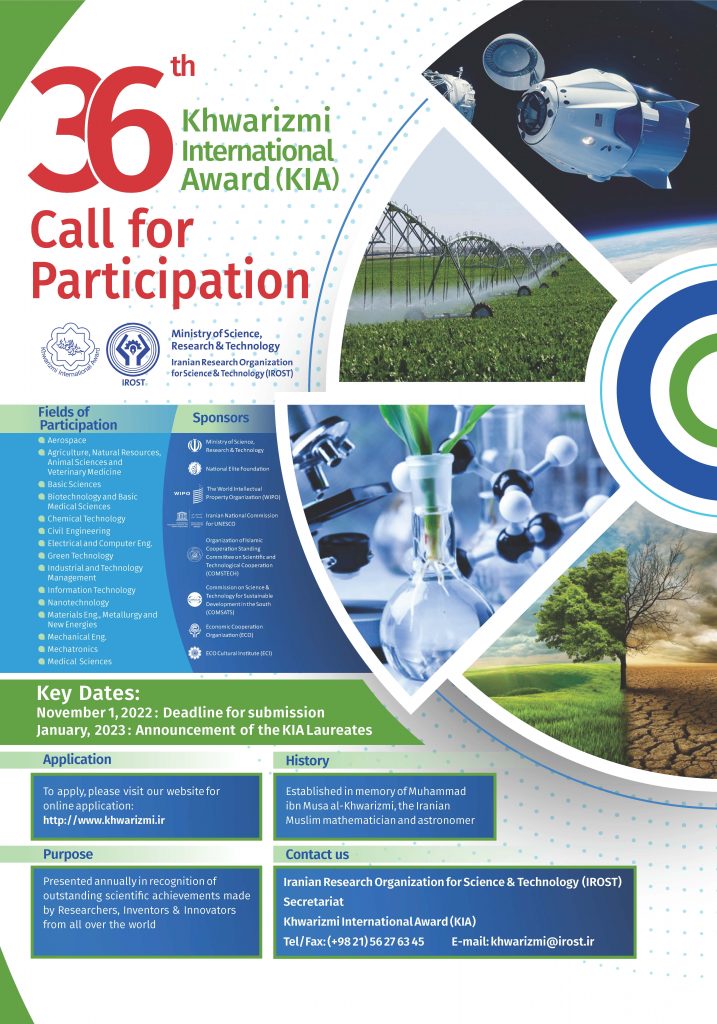
36th Khwarizmi International Award (KIA) Call for Participation

Click here for more details
PAINTING EXHIBITION ON ALLAMA IQBAL’S POETRY IN ALMATY JUNE 1, 2022