
COMSTECH News & Announcements
COMSTECH Webinars 2020

COMSTECH Webinar on Nanomaterials for Sensors and Photochemical Applications
Prof. Dr. Farid Abou Rageh Mohamed Harraz
Professor at the Advanced Materials and Nano-Research Centre,
Najran University, Saudi ArabiaDate and Time: 16th December 2020
03:00 pm Pakistan Standard Time; 02:00 pm Gulf Standard Time: 10:00 am Greenwich Mean TimeIn this webinar speaker will give an overview of recent research being done in the area of sensors technology (chemical sensors, electrochemical sensors and biosensors) and photochemical applications, focusing on photocatalysis under visible light illumination.
Target Audience: This webinar is open to academicians, scientists (particularly from chemistry, biology, nanoscience and materials engineering background), and general public from all the member OIC states.
Poster of webinar: Attached
Abstract of talk: Attached
Profile of Speaker: Attached
Link for registration and E- certificate:
https://docs.google.com/forms/d/e/1FAIpQLSdS65xBv4YJRWB2jK2aAnLVA4eWYdPTvLcPJPa9sUDm0Jw9uQ/viewform
Procedure to join:
Topic: Webinar on Nanomaterials for Sensors and Photochemical Applications
Time: Dec 16, 2020 03:00 PM Islamabad, Karachi, Tashkent
Join Zoom Meeting
https://us02web.zoom.us/j/85425333990?pwd=VFFTWWpNeW5tcXNaL0NrdXZRK0JyUT09
Meeting ID: 854 2533 3990
Passcode: 203765Address: COMSTECH Secretariat, 33-Constitution Avenue, G-5/2, Islamabad
Phone No. : 92 51 9220681-3
Email:Khazima@comstech.org ; comstech@comstech.orgCOMSTECH-CIIT Joint International Workshop on “Rational Design of Materials for Energy Needs: Computation & Experimentation”
May 22 to 26, 2017, Islamabad, Pakistan
Abstracts of the talks download
COMSTECH regularly organizes workshops, training courses and conferences to build capability of the 57 member states of the Organization of Islamic Conference (OIC) in emerging areas of science and technology. In this perspective a one-week intensive hands-on workshop on “Rational Design of Materials for Energy Needs: Computation & Experimentation” was organized by COMSTECH in collaboration with COMSATS Institute of Information Technology (CIIT), Islamabad from May 22 to 26, 2017.
The training workshop was aimed to introduce students, young researchers and young faculty members with modern trends in experimentation and computation with their applications in materials discovery for energy needs.
Foreign experts each delivered a series of lectures on various aspects of this theme besides guiding the hands-on computational activities. The foreign faculty comprised Prof. Talat Rahman, Prof. Laurene Tetard, Prof. Peter Dowben, Prof. Marisol A. Ortigoza and Prof. Ted Einstein from USA. Condensed matter experts from some local institutions also contributed lectures in the workshop. The practical exercises on computation and modelling of materials for energy needs were conducted, In addition to the foreign faculty, by Dr. Altaf Karim (CIIT, Islamabad), Dr. Gul Rahman (QAU, Islamabad), and Mr. Naseem Uddin & Mr. Tao Jiang (Research Assistants at the University of Central Florida).
Besides the local and foreign experts, thirty-five participants attended the workshop. Most of these participants were young faculty members and researchers. Several MPhil and PhD students also attended the workshop.
The workshop focused on the following themes;
A Crash Course on Quantum Mechanical Approach to Materials: Density Functional Theory (DFT) Methods
Crash Courses on Molecular Dynamics and Kinetic Monte Carlo Methods and their Applications to Surfaces.
Multiscale Modeling: Connecting the Scales together
Computational Catalyst Design
Tailoring Properties of 2D materials: Looking Beyond Graphene
Novel Pathways in the Rational Design of Materials: An Application to Clean Energy
Energy Storage and Conversion Materials
Photo Water Splitting
All participants were asked to fill out an assessment questionnaire anonymously to evaluate the training. Participants were asked to rate the overall programme, lectures, relevance of lectures to the course aim and objectives, significance of their learning goals and general comments related to the programme
Participants found the hands-on exercises very useful and many of them found the allocated time insufficient for these exercises. In response to a question “if any topic of participants’ interest was not covered”, few of the participants stated material chemistry and experimental techniques. Many of the participants were in favor of using both computational and experimental analysis side by side. Some of the experimental researchers mentioned that through this workshop they learnt about the problem solving style of theoretical scientists using theoretical calculations. One of the participants was of the view that “the concept of experiments and theory going in parallel should be introduced in universities on larger scale”.
November 2020 (Press Coverage)
AI Workshop & Exhibition Coverage
CFM Participation Coverage
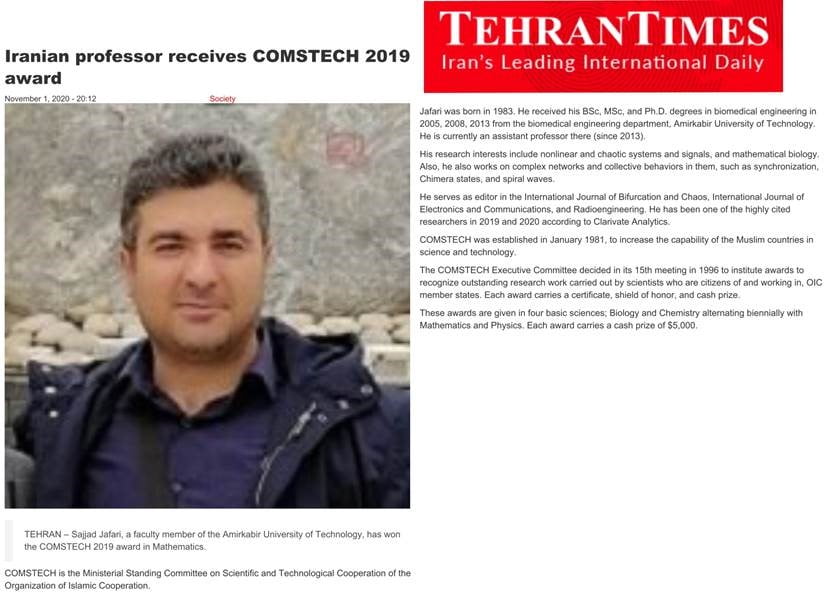
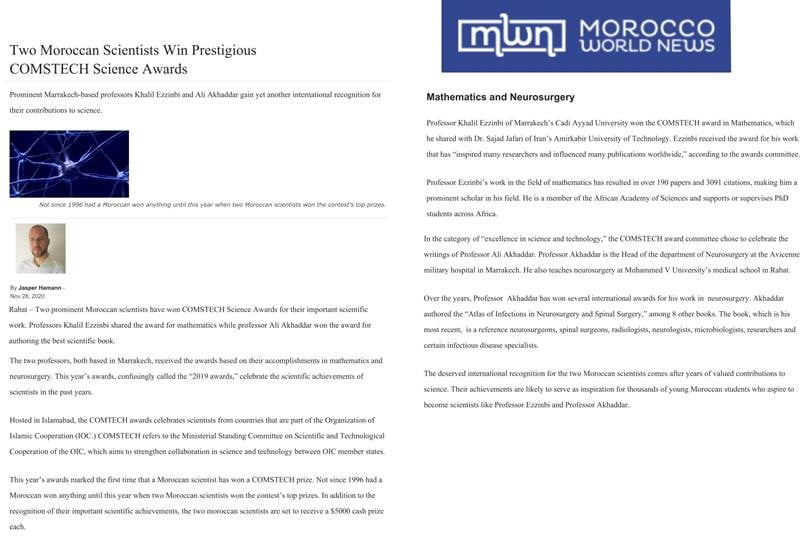
International Coverage COMSTECH Awards
Webinar On Megastability: Definition And Its Relation With Multistability, Extreme Mutlistability, And Hidden Attractors
Dr. Sajad Jafari
Assistant professor, Amirkabir University of Technology , Iran,
Clarivate Analytics, Highly Cited Researchers in 2019 and 2020 COMSTECH Award in Mathematics (2019)Date and Time: 03 December 2020
03:00 pm Pakistan Standard Time; 02:00 pm Gulf Standard Time:
10:00 am Greenwich Mean TimeCOMSTECH has arranged a webinar to understand phenomena of Multistability. Multistability is one of the most important phenomena in dynamical systems. It occurs in many areas of science including physics, chemistry, biology, economics, and nature.
Target Audience: This webinar is open to academicians, scientists (Particularly from Mathematics and Physics background), and general public from all the member OIC states.
Poster of webinar: Attached
Abstract of talk: Attached
Profile of Speaker: Attached
Procedure to join:
Join Zoom Meeting
https://us02web.zoom.us/j/86259884853?pwd=R1JIZVFRc1ZmQTBwaERwVjZ6NkIrZz09
Meeting ID: 862 5988 4853
Passcode: 934995
Address: COMSTECH Secretariat, 33-Constitution Avenue, G-5/2, Islamabad
Phone No. : 92 51 9220681-3
Email: Khazima@comstech.org ; comstech@comstech.orgPakistani Scientists at ICCBS carry out Genomic Analysis of SARS-CoV-2: Important mutations identified
Genomic analysis of any emerging virus is important to understand its structure, pathogenicity and evolution (i.e. it’s change and adaption in new environmental conditions). Massive genome sequencing efforts are underway globally to document a comprehensive mutational spectrum of SARC-Car-2. In this context, scientists at the International Centre for Chemical and Biological Sciences (ICCBS), Karachi University, Karachi, Pakistan, have successfully carried out the sequencing and analysis of 48 genomes of SARS-CoV-2 from Karachi. Samples were collected in a time phased approach from May to August 2020 from the areas designated as COVID hot spots by the local administrative authorities.
The ICCBS analysis identified 109 mutations including 36 recurrent mutations. (Recurrent mutations are those which are observed in more than one sample). Few frequent mutations were found that are associated with increased infectivity and fatality while several mutations were found in the spike protein which is very important for entry of virus into host cells. This data depicts the first detailed mutational spectrum from Pakistan and an in-depth analysis is underway for further insights. With the current onset of the second wave of the virus, the scientists at ICCBS are collecting samples for genome analysis related to this second wave.
Whole genome sequencing of 48 SARS-CoV-2 samples was carried out by using Illumina MiSeq NGS sequencing system with reference genome sequence of SARS-CoV-2 from Wuhan. Notably, two missense mutations P4715L in ORF1ab and D614G in Spike protein gene were found in 25 cases each. These two mutations have been reported to be associated with higher fatality in BCG-vaccinated countries, while another study has reported that D614G mutation enhances replication on human lung epithelial cells and primary human airway tissues through an improved infectivity of virions.
The ICCBS intends to complete 1000 – genome SARS-CoV project in next 6 months.
Technical details of the analysis are provided in the footnote (https://www.cogconsortium.uk/)
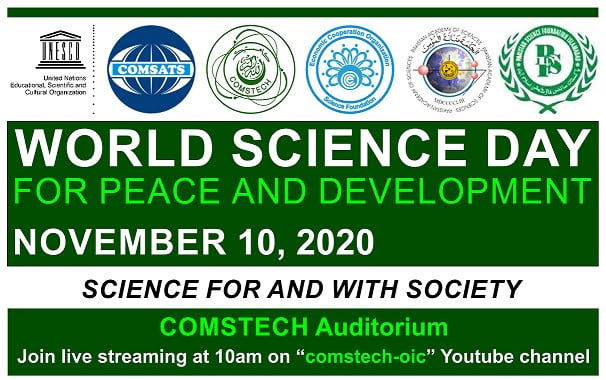
World Science Day

Academic Proposal Writing Techniques (Social Scinces)
Dr. Muhammad Akram Sheikh’s Book

September 2020 (Press Coverage)