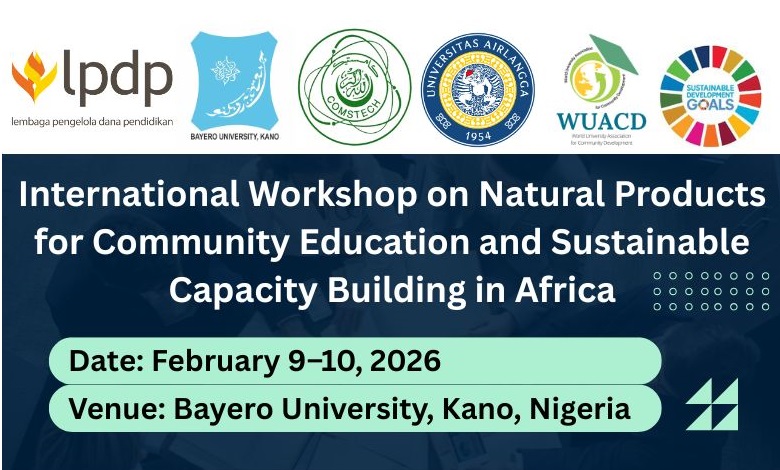
International Workshop on Natural Products for Community Education and Sustainable Capacity Building in Africa
Community education through universities and research capacity building is a strategic pathway toward sustainable social, economic, and health advancement. Strengthening local scientific expertise enables universities to serve as catalysts for community empowerment, innovation, and evidence-based solutions to local challenges.
Within the community education framework, natural product development is a key driver of community capacity building, particularly in biodiversity-rich regions such as Africa. When strategically utilized, local natural resources can support community-based health initiatives, strengthen local industries, and promote sustainable livelihoods. Yet, gaps in advanced analytical skills and structured training continue to limit the translation of this potential into tangible benefits for communities.
To address this gap, OIC-COMSTECH, WUACD (World University Association for Community Development) of Universitas Airlangga, Indonesia, and Bayero University, Kano, Nigeria, are jointly organizing a two-day international workshop aimed at strengthening analytical skills and institutional capacity as a foundation for community development in African universities and related institutions.
This international workshop is designed not only to enhance technical competence in natural product utilization but also to position universities as key drivers of community-oriented research, knowledge transfer, and sustainable development. By strengthening analytical skills and fostering international collaboration, the program supports the broader mission of empowering academic institutions to contribute meaningfully to local and regional development.
Workshop Objectives
- To strengthen university-led community development through enhanced research capacity in natural product sciences
- To build technical competencies that support community-based health, pharmaceutical, and bioresource initiatives
- To enhance understanding of modern extraction, separation, and purification techniques relevant to local resources
- To develop practical skills in chromatographic and spectroscopic analytical methods
- To promote international academic collaboration focused on sustainable and community-responsive research
Target Participants
- Academic staff and researchers engaged in community-oriented research in chemistry, pharmacy, biology, and related fields
- Postgraduate and senior undergraduate students with an interest in applied and community-based research
- Laboratory personnel supporting research and community service programs
Workshop Structure and Community Education Orientation
The workshop is structured over two days, combining scientific knowledge sharing with applied capacity building aimed at strengthening the role of universities in community development.
Day 1: Opening Ceremony & Community-Oriented Scientific Orientation (Hybrid)
Day 1 establishes a shared understanding of how natural product research can support community development and sustainable scientific ecosystems. The sessions are open to both onsite and virtual participants to maximize access and inclusivity.
Key Activities:
Opening Ceremony
Formal inauguration with welcoming remarks from the host institution and organizing partners, highlighting the role of universities in advancing community development through research and international collaboration.
Pre-Training Assessment (Pre-Test)
Participants will complete an online pre-test to assess baseline knowledge and identify capacity-building needs.
Note: The pre-test will be administered via Google Forms.
Guest Lecture: Integrated Metabolism and Its Community Relevance
Delivered by Prof. Dr. Ni Nyoman Tri Puspaningsih (Universitas Airlangga), this lecture will discuss integrated metabolism, its role in understanding bioactive compounds, and its relevance to community health, traditional medicine, and sustainable biomedical applications.
Day 2: Capacity Building in Natural Product Research for Community Impact
Day 2 focuses on strengthening practical and analytical skills that can be directly applied in university laboratories to support community-based research, local innovation, and sustainable utilization of natural resources. This day is open to both onsite and virtual participants.
Core Scientific and Community-Relevant Focus Areas:
Secondary Metabolite Extraction Techniques
Principles and practical considerations in extracting secondary metabolites from local natural sources, emphasizing optimization strategies relevant to community-based research and resource efficiency.
Chromatographic Methods
Foundations and applications of key chromatographic techniques, including:
- Thin Layer Chromatography (TLC)
- Gravity Column Chromatography (GCC)
- Vacuum Liquid Chromatography (VLC)
Structure Elucidation of Natural Products
Introduction to spectroscopic techniques essential for validating bioactive compounds used in community health and applied research:
- UV–Visible (UV–Vis) Spectroscopy
- Infrared (IR) Spectroscopy
- Nuclear Magnetic Resonance (NMR) Spectroscopy
Sessions will be delivered by experienced resource persons from Universitas Airlangga, integrating scientific rigor with applied perspectives relevant to community development. The training aims to enhance research quality, promote responsible use of local biodiversity, and support sustainable community-focused research initiatives.
(Note: Day 3 will consist of hands-on laboratory training sessions for physical participants.)
Registration and Participation Modalities
Participation Mode: Hybrid (Onsite and Virtual)
Virtual Participation Registration: Click Here
Physical Participation Registration (Primarily for participants from Africa): Click Here
Travel & Hospitality (Physical Participants):
Participants will arrange their own travel. Bayero University will provide local hospitality, including accommodation, meals, and local transportation, for confirmed onsite participants.
Workshop Coordinators
Muhammad Haseeb Ahmad
Program Officer, OIC-COMSTECH
Email: Haseeb.ahmad@comstech.org
Dr. Yuni Sari Amalia
World University Association for Community Development (WUACD), Indonesia
Prof. Aminu Mohamad
Bayero University, Kano, Nigeria