
AI Applications for Ecosystems Resilience in the Context of One Health
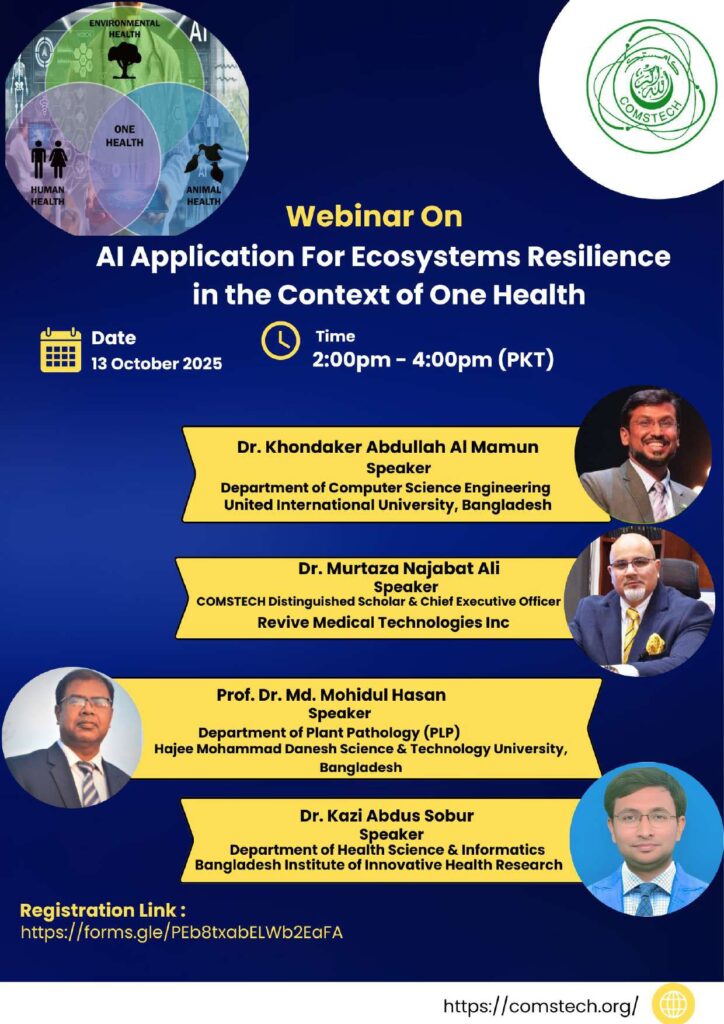
Abstract:
Ecosystem degradation caused by unsustainable agricultural practices poses urgent risks to food security, biodiversity, and public health. The One Health framework recognizes the interconnectedness of human, animal, and environmental health, and Artificial Intelligence (AI) is emerging as a transformative tool to strengthen this approach. AI-driven applications from precision monitoring of soil and crop health to predictive models of climate risks offer practical solutions to reduce chemical inputs, enhance productivity, and safeguard ecological balance. Artificial Intelligence (AI) is increasingly becoming a transformative force in addressing the challenges of unsustainable agricultural practices, environmental degradation, and public health risks. This webinar will explore how AI-driven solutions can advance the One Health approach by integrating human, animal, and environmental health for a sustainable and resilient future.
Webinar Objectives
•
Explore AI-driven approaches for ecosystem preservation and resilience
•
Initiate knowledge-sharing and dialogue with experts and participants
•
Promote collaboration among OIC member states in One Health innovation
•
Build capacity for AI literacy and adoption in agricultural and health practices
Target audiences: Young Scholars, Health Sciences, PhD students, Ecosystems Sciences, and Environmental sciences, Policymakers, and scientists with expertise in data analysis, including NGO, to strengthen evidence-based solutions across the OIC member states.
Distinguished Speakers:
Prof. Dr. Khondaker A. Mamun
Professor, Department of CSE
Director, MSCSE Program & IRIIC United International University, Bangladesh
Profile: Prof. Dr. Khondaker A. Mamun is a renowned professor, innovator, and entrepreneur specializing in computer and biomedical engineering. He earned his Ph.D. from the University of Southampton, UK, and later worked as a Postdoctoral Research Fellow at the University of Toronto and Bloorview Research Institute in Canada. Since 2014, he has been serving as a Professor of Computer Science & Engineering at United International University (UIU), Bangladesh. He is the Founder and Director of the Advanced Intelligent Multidisciplinary Systems Lab (AIMS Lab), where his team focuses on applying AI, big data, IoT, and brain-computer interfaces in healthcare,
disabilities, and education. He has published over 130 international journal and conference papers and holds several patents for digital healthcare innovations. Prof. Mamun is also the Founder of CMED Health, a pioneering digital health startup serving more than 3 million people in Bangladesh and working toward SDG 3: Universal Health Coverage. His innovations, including Autism Barta and Bolte Chai, have won prestigious awards such as the National ICT Award, APICTA Award, Bangladesh Business Innovation Award, DBS-NUS Social Innovation Award, and SeedStars Global Innovation Award. Prof. Mamun research and innovations have been featured internationally in media such as BBC and New Scientist, cementing his reputation as a global leader in health technology and sustainable innovation.
Dr. Murtaza Najabat Ali
Chief Executive Officer
Revive Medical Technologies Inc, Pakistan.
Profile: Dr. Murtaza Najabat Ali is a renowned biomedical engineer, entrepreneur, and academic leader with over two decades of contributions to healthcare innovation. He currently serves as CEO of Revive Medical Technologies Inc. (USA) and Professor & Head of Biomedical Engineering at Riphah International University, Islamabad. After earning his Ph.D. and postdoctoral training at the University of Sheffield, UK, he returned to Pakistan with a mission to build the country’s first indigenous medical device industry. In 2007, with support from the Ministry of Science and Technology, he established a pilot facility that launched Pakistan into local cardiovascular device production. He later founded N-ovative Health Technologies (NHT), the country’s first state-owned medical device industry, licensed by DRAP and ISO 13485-certified. As Executive Director of the Medical Devices Development Centre (MDDC) at NUST, he led the development of four DRAP-approved cardiovascular products, reducing costs compared to imported devices.
During the COVID-19 crisis, he pioneered Pakistan’s first indigenous ventilators and localized production of critical manufacturing equipment. In academia, he founded the Department of Biomedical Engineering & Sciences at NUST, establishing advanced labs and transferring technologies to industry. His portfolio includes 27 patents, 50+ international publications, and over 30 medical device prototypes. Dr. Ali’s leadership also extends to training engineers and researchers in specialized equipment and production technologies. His global recognition includes the Presidential Award, National Development Award, PEC Excellence Award, and the COMSTECH Distinguished Scholar Award. He has been instrumental in advancing research, innovation, and capacity building across OIC member states through the OIC-COMSTECH initiatives.
Dr. Md. Mohidul Hasan Professor,
Department of Plant Pathology (PLP) Faculty of Agriculture,
Hajee Mohammad Danesh Science & Technology University, Bangladesh
Profile: Dr. Md. Mohidul Hasan is a distinguished Professor in the Department of Plant Pathology at Hajee Mohammad Danesh Science & Technology University, Dinajpur, Bangladesh. He has made significant contributions to plant pathology and biotechnology through both teaching and research. Dr. Hasan earned his PhD in Biotechnology from Yeungnam University, Republic of Korea, in 2014. He also holds an MS in Plant Pathology (2004) and a B.Sc. in Agriculture (2000) from Bangladesh Agricultural University. His research focuses on molecular plant–microbe interactions and the formulation of biocontrol agents, aiming to advance sustainable agriculture. He has published 50 research works, including journal articles, conference papers, book chapters, and posters. He is actively involved in professional societies, serving on the Executive Committee of the Bangladesh Phytopathological Society and Bangladesh Society for Safe Food (2023–2025).
He is a review editor for Frontiers in Microbiology and an editorial board member for the Universal Journal of Agricultural Research. Dr. Hasan holds life memberships in the Bangladesh Phytopathological Society and Bangladesh Society for Safe Food, demonstrating his long-standing commitment to research and professional development in plant pathology.
Dr. Kazi Abdus Sobur
Department of Health Science & Informatics
Bangladesh Institute of Innovative Health Research
Profile: Dr. Kazi Abdus Sobur is a distinguished professional whose career bridges microbiology, veterinary medicine, public health, and education. He holds an MS in Microbiology from Bangladesh Agricultural University and a Doctor of Veterinary Medicine (DVM) from Sher-e-Bangla Agricultural University. His expertise lies in zoonotic diseases, antimicrobial resistance, and vaccine development, reflecting his deep commitment to advancing One Health. Dr. Sobur has published 32 peer-reviewed research papers and contributed to projects at the Bangladesh Agricultural University Research System (BAURES), including the development of a Brucella vaccine. Currently, he is working as a Value Chain Facilitator in the Rural Micrometeorites Transforming Project, funded by IFAD and DANIDA, and hosted by Wave Foundation. He is also engaged as a researcher at Bangladesh Institute of Innovative Health Research (BIIHR). A member of the American Society for Microbiology (ASM) and the Bangladesh Science Society, Dr. Sobur combines scientific research with science communication, writing for platforms such as Somewhere in blog, Zero to Infinity, and Quora. His ability to make complex science accessible underscores his role as both a researcher and communicator, advancing knowledge in microbiology, veterinary medicine, and public health.
Why Join?
•
Learn from pioneering researchers applying AI in agriculture, healthcare, and food safety
•
Understand how AI can address ecosystem degradation and global health threats
•
Engage in a multidisciplinary One Health dialogue with international experts
•
Network and collaborate with professionals across OIC member states
Register Now: Click Here
Zoom Link will be shared with the participants 1-2 days before the webinar.
Website: https://comstech.org/ Be part of shaping AI-powered solutions for a healthier planet and resilient ecosystems!
Webinar Coordinator:
Md. Rakibul Hasan Junior Program Manager
jpmrakib@comstech.org