prochains événements

  • INTERNATIONAL AEROSPACE TECHNOLOGY EXHIBITION AND CONFERENCE

    Background:

    Aerospace technology is one of the most advanced and strategically vital sectors, driving innovations in communications, defense, space exploration, and environmental monitoring. Despite the growing importance of aerospace capabilities globally, most OIC member states are underrepresented in this field due to limited investments, capacity gaps, and fragmented collaboration.

    Recognizing the urgent need to build indigenous capabilities and strengthen cooperation among OIC Member Countries, OIC-COMSTECH proposes a technology exhibition and conference to bring together stakeholders from government, academia, industry, and research institutions. This initiative aims to create a unified platform for knowledge-sharing, policy dialogue, and technology partnerships that reflect the collective aspirations of the Islamic world in aerospace innovation.

    Objectives:
    To catalyze capacity-building, collaboration, and technological advancement in aerospace sectors among OIC member states.

    • To showcase current developments and capabilities in aerospace technologies within the Muslim world.
    • To identify opportunities for joint research, development, and industrial collaboration among OIC countries.
    • To highlight the role of academia and youth in advancing aerospace innovation.
    • To promote policy dialogue on space governance, airspace security, and peaceful uses of space.
    • To establish a permanent working group or platform for aerospace cooperation under OIC-COMSTECH.

    Fields:

    • Aerospace Engineering
    • Avionics
    • Satellite Technology
    • Material Sciences
    • Precision Engineering
    • Astronomy
    • Any other relevant field

    Expected Outcomes:

    • A consolidated report outlining the state of aerospace development in OIC countries.
    • Identification of training and capacity-building needs and initiatives.
    • Launch of a collaborative network of aerospace institutions and experts across OIC states.
    • Increased awareness and visibility of aerospace as a strategic priority in the Muslim world.

    Beneficiaries:

    • Scientists, engineers, and researchers in aerospace and related fields.
    • Policymakers and space agency officials from OIC member states.
    • University students and faculty in engineering, physics, and related disciplines.
    • Industry stakeholders and technology innovators.
    • The broader scientific community in the Islamic world.

    Expected Impact:

    • Strengthened scientific and technological self-reliance of OIC countries.
    • Enhanced regional and inter-state cooperation on aerospace initiatives.
    • Promotion of peaceful uses of space and high-tech innovation in OIC countries.
    •  Contribution toward socio-economic development and national security through aerospace capabilities.

    To Exhibit or Participate Apply: Click Here

    Workshop Coordinators 

    Muhammad Haris Akram     
    Programme Manager
    OIC – COMSTECH Secretariat        
    Email: haris@comstech.org

    Muhammad Haseeb Ahmad
    Program Officer
    OIC – COMSTECH Secretariat 
    Haseeb.ahmad@comstech.org

  • INTERNATIONAL CAPACITY-BUILDING TRAINING PROGRAM ON TECHNOLOGY & INNOVATION ECOSYSTEM DEVELOPMENT

    Organized by: OIC-COMSTECH Technovation Academy
    Hosted by: Pardis Technology Park, Iran
    Location: Pardis Technology Park, Iran International Innovation District, Tehran
    Dates: 14-25 April 2026

    INTRODUCTION

    In today’s rapidly evolving global economy, technology and innovation ecosystems play a critical role in driving sustainable development, economic diversification, and competitiveness. Effective innovation ecosystems bring together policymakers, academia, industry, startups, investors, and support institutions to transform ideas into impactful solutions, generate high-value employment, and address complex societal challenges.

    Recognizing the growing importance of innovation-led growth across OIC Member States, the OIC-COMSTECH Technovation Academy, in collaboration with Pardis Technology Park (PTP), Iran, is organizing the International Capacity-Building Training Program on Technology & Innovation Ecosystem Development, to be held from 14–25 April 2026 at the Pardis Technology Park, International Innovation District, Tehran.

    This intensive, practice-oriented program is designed to equip mid- to senior-level professionals with the conceptual frameworks, practical tools, and hands-on exposure required to design, strengthen, and manage innovation ecosystems tailored to their national and regional contexts. Leveraging Iran’s experience—particularly the successful model of Pardis Technology Park—the program will combine expert-led training, technology tours, case studies, and collaborative group work to foster actionable learning and cross-country knowledge exchange among participants from OIC Member States.

    PROGRAM OBJECTIVES

    By the end of this program, participants will be able to:

    • Understand the core components and dynamics of innovation ecosystems
    • Design context-specific strategies for ecosystem development
    • Identify key stakeholders and build effective collaboration models
    • Develop funding, policy, and infrastructure roadmaps
    • Learn from global best practices and Iranian success stories
    • Build an international network of ecosystem builders

    PROGRAM STRUCTURE

    Duration: 10 Days

    Daily Schedule:

    • Workshops;
    • Tech tours;
    • Expert panels;
    • Group projects;
    • Networking sessions;
    • Iranian culture experience;

    BENEFITS

    Limited to 20 participants from OIC member countries — Selection is competitive.

    • Round-trip international airfare
    • Accommodation (shared twin rooms)
    • All local transportation (airport transfers & program-related travel)
    • Daily meals (breakfast, lunch, dinner)
    • Training materials & certification of completion
    • This program is fully funded for selected participants.
    • No participation fee.
    • Visa assistance provided.

    QUALIFICATION FOR PARTICIPANTS

    Eligible applicants include professionals from OIC member states, particularly those working in:

    • Government officials & policymakers in science, technology & innovation
    • Managers of science & technology parks, technology incubators, and innovation accelerators
    • Innovation ecosystem developers & consultants
    • Representatives of international development agencies
    • Academics & researchers in innovation policy
    • Startup ecosystem enablers & investors

    Applicants must be fluent in English and committed to implementing learnings in their home ecosystems.

    APPLICATION REQUIREMENTS

    Application form (Download here)

    CV/Resume (max. 2 pages in free format)

    Passport copy (valid until at least December 2026)

    HOW TO APPLY

    Applications including the required documents must be submitted via email to events@comstech.org  

    Training Coordinators:

    Mr. Haris Akram, Program Manager, COMSTECH. (Haris@comstech.org)

    Mr. Reza Aslani, Pardis Technology Park, Iran

  • L’OIC-COMSTECH organise un cours certifiant en spectroscopie RMN

    Résumé

    La spectroscopie par résonance magnétique nucléaire (RMN) est un outil analytique puissant permettant d’explorer la structure et la dynamique moléculaires, avec de larges applications en chimie, biochimie, sciences pharmaceutiques et science des matériaux.
    Ce cours certifiant de la COMSTECH vise à renforcer la compréhension théorique et les compétences pratiques des jeunes chercheurs et professionnels issus des États membres de l’OIC. Le cours permettra aux participants d’appliquer efficacement la spectroscopie RMN dans leurs travaux de recherche et projets industriels, contribuant ainsi au renforcement des capacités scientifiques et à l’innovation dans la région de l’OIC.

    Objectifs

    • Fournir une compréhension des principes théoriques fondamentaux de la spectroscopie RMN
    • Familiariser les participants avec le fonctionnement et l’utilisation des instruments RMN
    • Donner un aperçu de l’analyse et de l’interprétation des données en RMN
    • Favoriser la collaboration et l’échange de connaissances entre chercheurs des États membres de l’OIC

    Public Cible

    Chercheurs, scientifiques, étudiants et professionnels dans les domaines suivants :

    • Chimie et biochimie
    • Sciences pharmaceutiques et des matériaux
    • Biotechnologie et biologie moléculaire
    • Laboratoires de recherche analytique et industrielle

    Les participants issus des États membres de l’OIC sont particulièrement encouragés à postuler.

    Brochure : Cliquez ici

    Profil des Intervenants

    Prof. Dr. M. Iqbal Choudhary (H.I., S.I., T.I., Lauréat du Prix Mustafa (PSL))
    Coordinateur Général, COMSTECH
    Le Prof. Choudhary est un scientifique de renommée mondiale dans le domaine de la chimie des produits naturels et de la biologie structurale, avec une expertise approfondie dans la caractérisation moléculaire basée sur la RMN. Son leadership à la COMSTECH a considérablement renforcé la coopération scientifique et les capacités de recherche entre les États membres de l’OIC.

    Prof. Dr. Atia-tul-Wahab
    Professeure, H.E.J. Research Institute of Chemistry, Université de Karachi
    La Professeure Atia-tul-Wahab est experte en spectroscopie RMN et en chimie des produits naturels. Ses recherches portent sur l’élucidation structurale de molécules bioactives à l’aide de techniques RMN avancées. Elle a animé de nombreux ateliers et programmes de formation sur l’instrumentation analytique et l’interprétation des données.

    Dr. Humaira Zafar
    Professeure Assistante, Dr. Panjwani Center for Molecular Medicine and Drug Research, ICCBS, Université de Karachi
    Le Dr. Humaira Zafar est auteure de sept publications internationales dans le domaine de l’inhibition enzymatique. Elle a reçu une formation en biologie structurale utilisant la RMN à l’Université de Hambourg, en Allemagne. Ses recherches se concentrent principalement sur l’étude des interactions protéine-ligand d’enzymes d’importance thérapeutique à l’aide des techniques de RMN-STD.


    Registration Link: Click Here

    Deadline for Application: January 15th, 2026
    Mode: Hybrid (Physical + Online)
    Dates: 24-27 March, 2026
    Venue: COMSTECH Secretariat, Islamabad, Pakistan

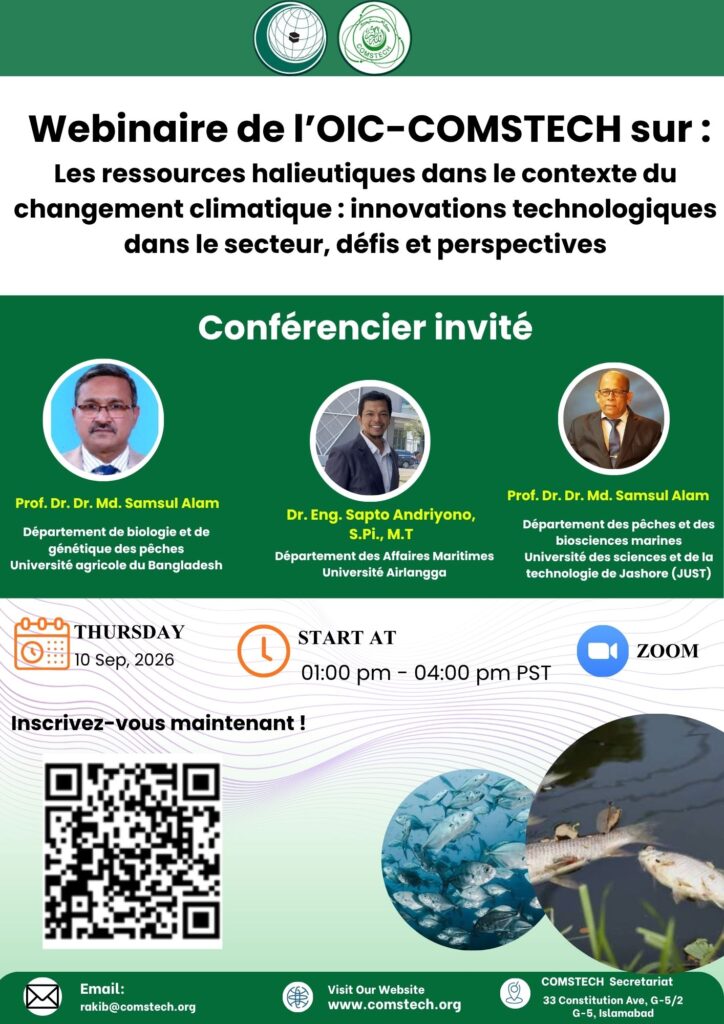
  • Workshop on Sustainable Management of Natural Resources: The Case of Medicinal Plants

    Venue: COMSTECH Secretariat, Islamabad (Online)

    Date: February 25th, 2026

    Flyer: Click Here

    Context

    Plant species occupy an important place in human life, due to their usefulness in many areas, including food, health, industry, crafts, custom and tradition, etc. (Bognounou and Guinko, 2006; Yaovi et al., 2021). Approximately 60% of the world population, and 80% of the population of developing countries rely on traditional medicine, most often through the use of plants, to meet their primary healthcare needs (WHO, 2008). This dependence to traditional medicine is not only justified by the efficacy of medicinal plants due to their richness in secondary metabolites, but also as an alternative to the health care services of so-called modern medicine, whose costs are beyond reach (Kodio et al., 2023; Bangou et al., 2024).

    In West Africa, over 80% of the population use medicinal plants for therapeutic purposes (WHO, 2020). The places where plant organs are harvested are varied and include domestic spaces, classified or unclassified forests, agricultural fields, individual or community groves (Ouoba et al., 2006; Vroh and Koné, 2021). Moreover, policies to promote the use of medicinal plants have tended to focus more on exploitation, and the over-exploitation of medicinal plants, leading to a reduction in biomass, could increase the risk of extinction. We can also add that climate change, in the absence of significant mitigation or adaptation efforts, will have profound negative effects on humanity and other species.

    This is why this webinar aim to strengthen the management of natural resources, especially medicinal plants, by those involved in the use of plant species for therapeutic purposes.

    Objectives:

    OS 1: Training and raising participants’ awareness of strategies for safeguarding medicinal plants;

    OS 2: Discuss how to optimize bioactive compounds in the exploitation of medicinal plants;

    OS 3: Demonstrate the usefulness of sophisticated extraction devices in the exploitation of plant organs;

    OS 4: Planting protected species of medicinal plants.

    Target Public:

    Participate in this training: Researchers in natural substances; Botanist; Pharmacologists; Phd Students; Traditional health practitioners; Researchers in Schools of Water and Forests;

    Outcomes

    • Establishment of a collaborative network with scientists at the University of Nazi BONI in Bobo-Dioulasso, Burkina Faso;
    • Discovery of sophisticated extraction methods for plant organs;
    • Endangered medicinal plant species are planted and preserved.

    Partners

    University of NAZI BONI Bobo-Dioulasso (Burkina Faso)

    OIC-Secretariat General

    Registration Link: Click Here

    Contact Persons:

    Dr. Gautier Roko (oladele09@yahoo.fr ), and Dr. Akim Socohou (akim@comtech.org)

    Zoom Meeting Link: Click Here

    Speakers Profiles:

  • Séminaire en ligne COMSTECH « Promouvoir la sensibilisation au cancer et la défense des technologies de radiothérapie et de la physique médicale dans les pays de l’OCI »

    14 février 2026 | 14 h 00 – 16 h 00 (heure du Pakistan)

    Registration link: Click Here

    Séminaire en ligne COMSTECH

    « Promouvoir la sensibilisation au cancer et la défense des technologies de radiothérapie et de la physique médicale dans les pays de l’OCI »

    14 février 2026 | 14 h 00 – 16 h 00 (heure du Pakistan)

    14 h 00 – 14 h 05

    Ouverture et récitation du Saint Coran

    14 h 05 – 14 h 15

    Mot de bienvenue et discours d’ouverture

    Prof. Dr M. Iqbal Choudhary, Coordinateur Général, COMSTECH

    14 h 15 – 14 h 20

    Présentation du modérateur et cadre de la session

    Dr Syed Javaid Khurshid, consultant, communication scientifique et diplomatie, COMSTECH

    14 h 20 – 15 h 05

    Conférence 1 :

    « Faire progresser la sensibilisation au cancer et les stratégies de détection précoce dans les pays de l’OIC »

    Conférencier : Dr Nadeem Abbasi (AKUH)

    15 h 05 – 15 h 50

    – Conférence 2 :

    « Technologies de radiothérapie et renforcement des capacités en physique médicale »

    Conférencier : Dr Asghar H. Asghar

    15 h 50 – 16 h 00

    Questions-réponses et remarques finales

  • International Workshop on Natural Products for Community Education and Sustainable Capacity Building in Africa

    Venue: Bayero University, Kano, Nigeria
    Date: 9–10 February 2026 | Mode: Hybrid

    Community education through universities and research capacity building is a strategic pathway toward sustainable social, economic, and health advancement. Strengthening local scientific expertise enables universities to serve as catalysts for community empowerment, innovation, and evidence-based solutions to local challenges.

    Within the community education framework, natural product development is a key driver of community capacity building, particularly in biodiversity-rich regions such as Africa. When strategically utilized, local natural resources can support community-based health initiatives, strengthen local industries, and promote sustainable livelihoods. Yet, gaps in advanced analytical skills and structured training continue to limit the translation of this potential into tangible benefits for communities.

    To address this gap, OIC-COMSTECH, WUACD (World University Association for Community Development) of Universitas Airlangga, Indonesia, and Bayero University, Kano, Nigeria, are jointly organizing a two-day international workshop aimed at strengthening analytical skills and institutional capacity as a foundation for community development in African universities and related institutions.

    This international workshop is designed not only to enhance technical competence in natural product utilization but also to position universities as key drivers of community-oriented research, knowledge transfer, and sustainable development. By strengthening analytical skills and fostering international collaboration, the program supports the broader mission of empowering academic institutions to contribute meaningfully to local and regional development.

    Workshop Objectives

    • To strengthen university-led community development through enhanced research capacity in natural product sciences
    • To build technical competencies that support community-based health, pharmaceutical, and bioresource initiatives
    • To enhance understanding of modern extraction, separation, and purification techniques relevant to local resources
    • To develop practical skills in chromatographic and spectroscopic analytical methods
    • To promote international academic collaboration focused on sustainable and community-responsive research

    Target Participants

    • Academic staff and researchers engaged in community-oriented research in chemistry, pharmacy, biology, and related fields
    • Postgraduate and senior undergraduate students with an interest in applied and community-based research
    • Laboratory personnel supporting research and community service programs

    Workshop Structure and Community Education Orientation

    The workshop is structured over two days, combining scientific knowledge sharing with applied capacity building aimed at strengthening the role of universities in community development.

    Day 1: Opening Ceremony & Community-Oriented Scientific Orientation (Hybrid)

    Day 1 establishes a shared understanding of how natural product research can support community development and sustainable scientific ecosystems. The sessions are open to both onsite and virtual participants to maximize access and inclusivity.

    Key Activities:

    Opening Ceremony
    Formal inauguration with welcoming remarks from the host institution and organizing partners, highlighting the role of universities in advancing community development through research and international collaboration.

    Pre-Training Assessment (Pre-Test)
    Participants will complete an online pre-test to assess baseline knowledge and identify capacity-building needs.
    Note: The pre-test will be administered via Google Forms.

    Guest Lecture: Integrated Metabolism and Its Community Relevance
    Delivered by Prof. Dr. Ni Nyoman Tri Puspaningsih (Universitas Airlangga), this lecture will discuss integrated metabolism, its role in understanding bioactive compounds, and its relevance to community health, traditional medicine, and sustainable biomedical applications.

    Day 2: Capacity Building in Natural Product Research for Community Impact

    Day 2 focuses on strengthening practical and analytical skills that can be directly applied in university laboratories to support community-based research, local innovation, and sustainable utilization of natural resources. This day is open to both onsite and virtual participants.

    Core Scientific and Community-Relevant Focus Areas:

    Secondary Metabolite Extraction Techniques
    Principles and practical considerations in extracting secondary metabolites from local natural sources, emphasizing optimization strategies relevant to community-based research and resource efficiency.

    Chromatographic Methods
    Foundations and applications of key chromatographic techniques, including:

    • Thin Layer Chromatography (TLC)
    • Gravity Column Chromatography (GCC)
    • Vacuum Liquid Chromatography (VLC)

    Structure Elucidation of Natural Products
    Introduction to spectroscopic techniques essential for validating bioactive compounds used in community health and applied research:

    • UV–Visible (UV–Vis) Spectroscopy
    • Infrared (IR) Spectroscopy
    • Nuclear Magnetic Resonance (NMR) Spectroscopy

    Sessions will be delivered by experienced resource persons from Universitas Airlangga, integrating scientific rigor with applied perspectives relevant to community development. The training aims to enhance research quality, promote responsible use of local biodiversity, and support sustainable community-focused research initiatives.

    (Note: Day 3 will consist of hands-on laboratory training sessions for physical participants.)

    Registration and Participation Modalities

    Participation Mode: Hybrid (Onsite and Virtual)

    Virtual Participation Registration: Click Here

    Physical Participation Registration (Primarily for participants from Africa): Click Here

    Travel & Hospitality (Physical Participants):
    Participants will arrange their own travel. Bayero University will provide local hospitality, including accommodation, meals, and local transportation, for confirmed onsite participants.

    Workshop Coordinators

    Muhammad Haseeb Ahmad
    Program Officer, OIC-COMSTECH
    Email: Haseeb.ahmad@comstech.org

    Dr. Yuni Sari Amalia
    World University Association for Community Development (WUACD), Indonesia

    Prof. Aminu Mohamad
    Bayero University, Kano, Nigeria

  • COMSTECH Lecture Series on Recent Advance in the Industrial Extraction of Edible Oil and Processing Techniques

    Date: 03-04 February, 2026

    Flyer: Click Here

    Résumé:

    L’industrie des huiles alimentaires est essentielle à la sécurité alimentaire mondiale, à la nutrition et au développement économique. Cette série de conférences de deux jours, organisée par l’OIC-COMSTECH, mettra en lumière les avancées récentes dans les technologies industrielles d’extraction et de transformation visant à améliorer le rendement, la qualité, la sécurité et la durabilité des huiles.

    Le programme couvrira les méthodes modernes d’extraction mécanique et par solvants, les technologies vertes émergentes, l’optimisation des procédés, le contrôle de la qualité ainsi que la conformité aux normes internationales de sécurité alimentaire. Animée par un expert de premier plan, cette série de conférences a pour objectif de créer un lien entre la recherche et les pratiques industrielles, en offrant des perspectives pratiques aux chercheurs et aux professionnels, tout en favorisant l’innovation et le développement durable dans le secteur des huiles alimentaires.

    Objectif:

    L’objectif de la série de conférences de deux jours sur « Les avancées récentes dans l’extraction industrielle des huiles comestibles et les techniques de transformation » organisée par le COMSTECH est de fournir des connaissances utiles aux jeunes chercheurs, aux étudiants, aux représentants de l’industrie, aux membres des organismes gouvernementaux et aux décideurs politiques afin de soutenir la recherche et le développement futurs.

    🎯 Public cible

    • Professionnels en sciences alimentaires, santé publique et sciences de la santé
    • Chercheurs en génie chimique, sciences agricoles et biotechnologie industrielle
    • Assistants de recherche et chercheurs en début de carrière
    • Professionnels de l’industrie des huiles comestibles et technologues en transformation

    Profil des conférenciers :

    Le Professeur Dr Syed Tufail Hussain Shah est un professeur éminent et directeur du National Centre of Excellence in Analytical Chemistry (NCEAC) à l’Université de Sindh, Jamshoro, Pakistan. Il est titulaire d’un doctorat en chimie et a effectué des recherches postdoctorales à l’Université McGill, au Canada. Fort de plus de trois décennies d’expérience dans l’enseignement, la recherche et l’industrie, le Dr Shah a apporté des contributions majeures à la chimie analytique et industrielle, en particulier dans le domaine de la transformation des huiles comestibles et de l’analyse de leur qualité.

    Avant d’embrasser une carrière universitaire, il a occupé des postes de direction de haut niveau dans l’industrie des graines oléagineuses et des huiles comestibles, notamment en tant que chimiste en chef, directeur de production et directeur général. Ses vastes intérêts de recherche couvrent le développement de méthodes analytiques, la spectroscopie, les techniques chromatographiques, l’optimisation des procédés et l’assurance qualité des aliments.

    Le Dr Shah est l’auteur de plus de 225 articles scientifiques évalués par des pairs, a édité des ouvrages et des chapitres de livres, et a présenté ses travaux lors de nombreuses conférences nationales et internationales. Il est rédacteur en chef du Pakistan Journal of Analytical and Environmental Chemistry et siège au sein de plusieurs comités de rédaction. Ses travaux lui ont valu de prestigieuses distinctions, notamment des prix nationaux de productivité en recherche, des récompenses de meilleur enseignant universitaire et des médailles d’or décernées par des organismes scientifiques.

    Par son leadership et son expertise, le Dr Shah établit un lien solide entre la recherche académique et la pratique industrielle, ce qui fait de lui une figure influente dans les sciences analytiques et la technologie des huiles comestibles.

    Hüseyin KARA, Ph. D.
    Professeur de chimie analytique
    Faculté des sciences, Département de chimie
    Université de Selçuk, Turquie

    Le Prof. Dr. Hüseyin Kara est professeur titulaire de chimie à l’Université de Selçuk, en Türkiye, avec plus de trois décennies d’expérience académique, scientifique et de direction. Spécialiste en chimie analytique et chimie alimentaire, ses travaux portent sur les techniques chromatographiques, le raffinage des huiles comestibles, la qualité et la sécurité alimentaires, l’analyse environnementale et l’extraction par fluide supercritique.

    Il a dirigé et contribué à plus de 30 projets de recherche nationaux et internationaux, publié plus de 100 articles indexés SCI, et encadré de nombreux étudiants en master et doctorat. Le Prof. Dr. Kara a également occupé les fonctions de vice-recteur, de doyen et de doyen fondateur dans des universités turques de premier plan, et continue de contribuer au monde académique et industriel par l’enseignement, la recherche et le conseil.

    Aperçu du programme:

    Heure (Heure normale du Pakistan)Session / TitreIntervenant / Affiliation
    Day 1Première session: Introduction aux huiles et aux graisses, types d’huiles et de graisses, applications alimentaires et non alimentaires des huiles végétales.   Deuxième session: Extraction des huiles végétales: extraction mécanique et chimique, qualité des huiles extraites.                Prof. Dr. Syed Tufail Hussain Shah
    Professeur et ancien directeur
    Centre national d’excellence en chimie analytique
    Université du Sindh, Jamshoro, Pakistan     Hüseyin KARA, Ph. D.
    Professeur de chimie analytique
    Faculté des sciences, Département de chimie
    Université de Selçuk, Turquie
    Day 2  1ère session: Introduction au traitement industriel, étapes impliquées dans le traitement industriel, aperçu général du dégommage et de la neutralisation.   Deuxième session: Introduction aux techniques de blanchiment et de désodorisation, paramètres importants pour vérifier la qualité des huiles blanchies et désodorisées, sous-produits de l’industrie des huiles comestibles et leur valorisation. Avancées récentes dans l’industrie de la transformation des huiles comestibles.
       
Bouton retour en haut de la page