Workshop on Sustainable Management of Natural Resources: The Case of Medicinal Plants
Venue: COMSTECH Secretariat, Islamabad (Online)
Date: February 25th, 2026
Flyer: Click Here
Context
Plant species occupy an important place in human life, due to their usefulness in many areas, including food, health, industry, crafts, custom and tradition, etc. (Bognounou and Guinko, 2006; Yaovi et al., 2021). Approximately 60% of the world population, and 80% of the population of developing countries rely on traditional medicine, most often through the use of plants, to meet their primary healthcare needs (WHO, 2008). This dependence to traditional medicine is not only justified by the efficacy of medicinal plants due to their richness in secondary metabolites, but also as an alternative to the health care services of so-called modern medicine, whose costs are beyond reach (Kodio et al., 2023; Bangou et al., 2024).
In West Africa, over 80% of the population use medicinal plants for therapeutic purposes (WHO, 2020). The places where plant organs are harvested are varied and include domestic spaces, classified or unclassified forests, agricultural fields, individual or community groves (Ouoba et al., 2006; Vroh and Koné, 2021). Moreover, policies to promote the use of medicinal plants have tended to focus more on exploitation, and the over-exploitation of medicinal plants, leading to a reduction in biomass, could increase the risk of extinction. We can also add that climate change, in the absence of significant mitigation or adaptation efforts, will have profound negative effects on humanity and other species.
This is why this webinar aim to strengthen the management of natural resources, especially medicinal plants, by those involved in the use of plant species for therapeutic purposes.
Objectives:
OS 1: Training and raising participants’ awareness of strategies for safeguarding medicinal plants;
OS 2: Discuss how to optimize bioactive compounds in the exploitation of medicinal plants;
OS 3: Demonstrate the usefulness of sophisticated extraction devices in the exploitation of plant organs;
OS 4: Planting protected species of medicinal plants.
Target Public:
Participate in this training: Researchers in natural substances; Botanist; Pharmacologists; Phd Students; Traditional health practitioners; Researchers in Schools of Water and Forests;
Outcomes
- Establishment of a collaborative network with scientists at the University of Nazi BONI in Bobo-Dioulasso, Burkina Faso;
- Discovery of sophisticated extraction methods for plant organs;
- Endangered medicinal plant species are planted and preserved.
Partners
University of NAZI BONI Bobo-Dioulasso (Burkina Faso)
OIC-Secretariat General
Registration Link: Click Here
Contact Persons:
Dr. Gautier Roko (oladele09@yahoo.fr ), and Dr. Akim Socohou (akim@comtech.org)
Zoom Meeting Link: Click Here
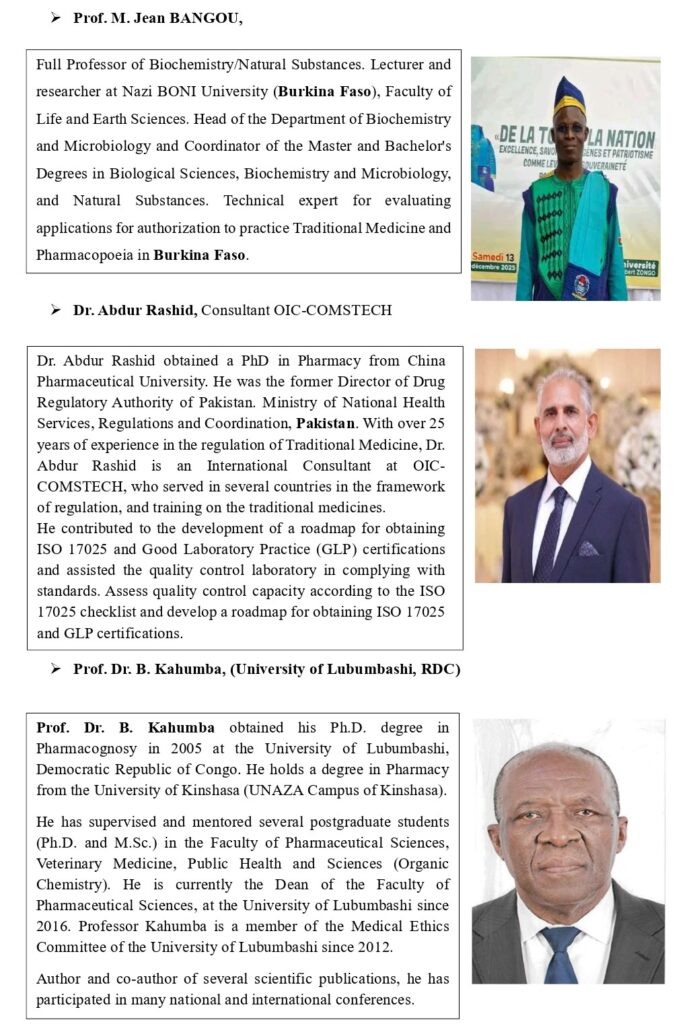
Speakers Profiles: